Million AI Satellites Could Cloud Earth’s Upper Atmosphere, Scientists Warn
SpaceX plans a groundbreaking AI satellite network that will orbit Earth, heralding a new era of space infrastructure and data processing.
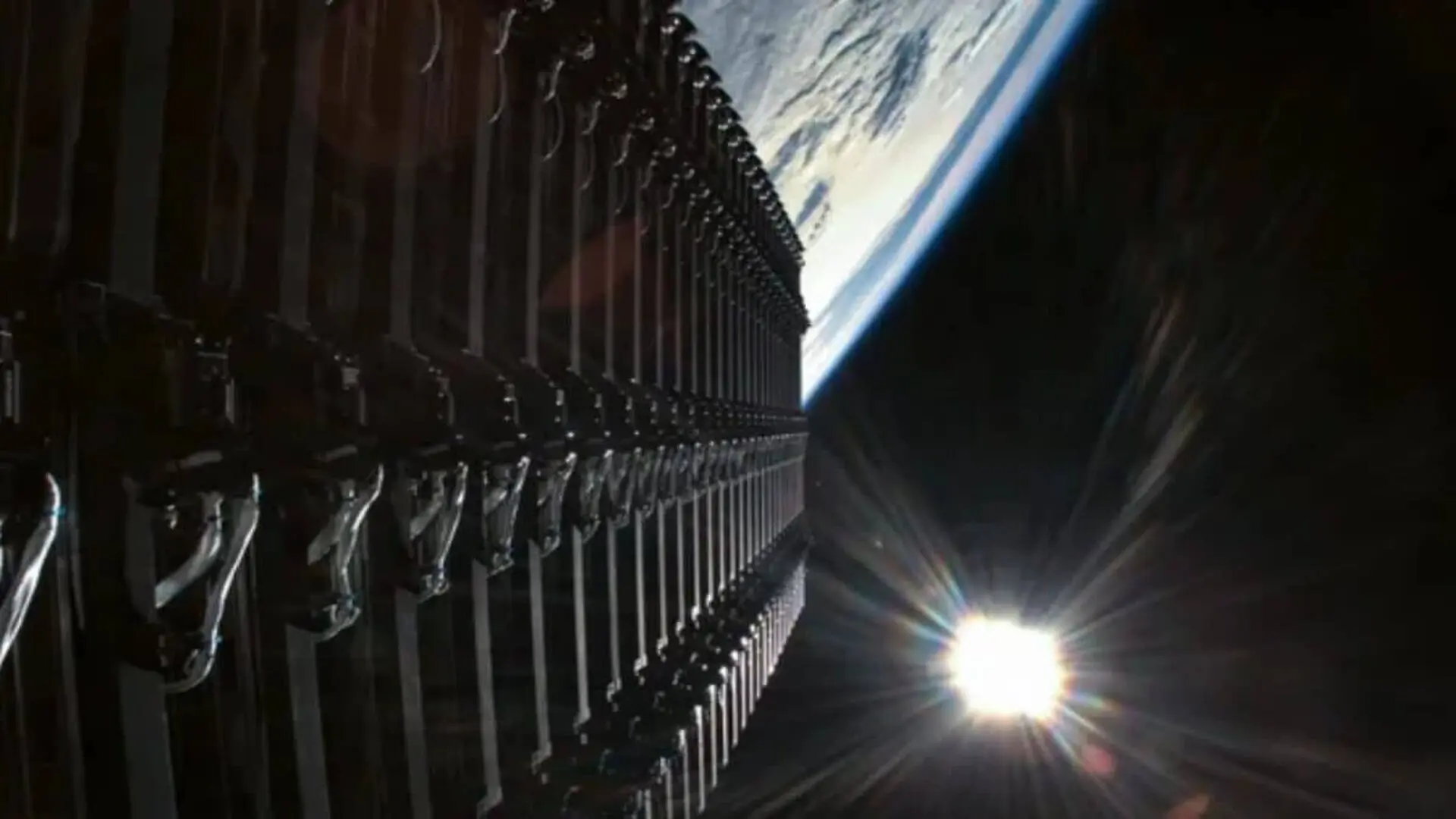
A coalition of aerospace firms, led by SpaceX, has filed with the Federal Communications Commission to launch more than one million satellites that would act as orbital data centers for artificial‑intelligence workloads. Amazon and Blue Origin have lodged similar applications, while SpaceX’s chief executive, Elon Musk, has publicly outlined a target of one million AI‑focused satellites within the next ten years.
Proponents argue that moving compute platforms into space could tap into abundant solar power and sidestep the cooling and electricity demands that strain terrestrial data centers. Critics, however, warn that the unprecedented scale of launches and eventual re‑entries could inject sizable quantities of soot, metal particles, and greenhouse gases into atmospheric layers that are still poorly characterized.
Starship‑driven launch cadence would dwarf today’s space traffic
SpaceX plans to rely on its heavy‑lift Starship vehicle to place the AI constellation in orbit. Although Starship burns methane and liquid oxygen—a cleaner propellant than the kerosene used by Falcon 9—the rocket’s massive size means it consumes far more propellant per flight.
“Starship is a bigger rocket burning more propellant,” Eloise Marais, a professor of atmospheric chemistry at University College London, told Space.com. She added that the cleaner fuel could be offset by the sheer volume of propellant required.
Researcher Andrew Wilson, who focuses on space‑related sustainability, has estimated that a single Starship launch releases roughly 76,000 metric tons of carbon‑dioxide‑equivalent emissions, a figure comparable to the annual output of about 17,700 gasoline‑powered passenger cars.
Ars Technica projects that deploying a million‑satellite network could require up to 77,000 Starship launches. By contrast, the total number of orbital launches recorded worldwide in 2025 was just 324, underscoring the magnitude of the proposed expansion.
What a massive satellite fleet could mean for the upper atmosphere
Atmospheric scientists are particularly concerned about black carbon—a soot‑like by‑product of rocket exhaust—that can linger in the mesosphere for up to three years. Unlike pollutants near the surface, which are cleared by rain and wind within weeks, material deposited at high altitude depends on much slower processes.
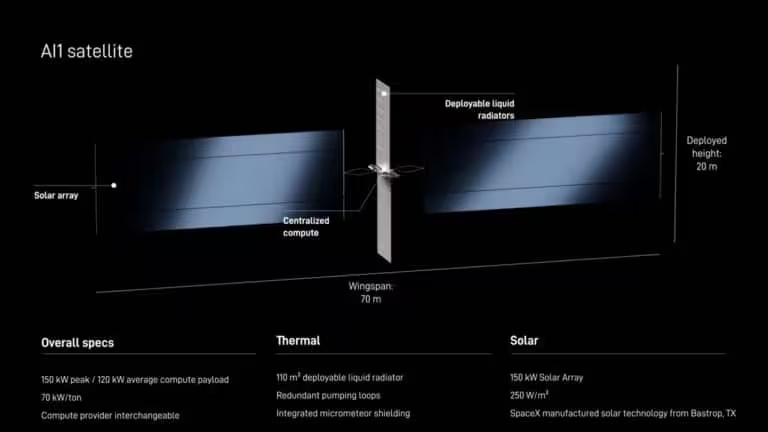
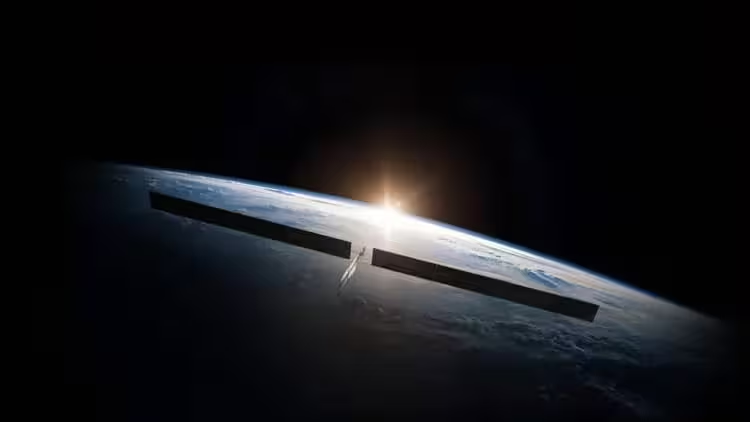
The European Space Agency currently monitors roughly 19,000 active or defunct objects in orbit. Existing Starlink V2 Mini satellites, among the most numerous operational platforms, weigh about 800 kilograms (1,760 pounds) each. By comparison, the proposed AI satellites could tip the scales at up to 7.5 metric tons and sport solar arrays spanning roughly 75 meters (246 feet).
When such large spacecraft re‑enter the atmosphere, most of their structure vaporizes, releasing particles of aluminum and other metals. The oxidation of aluminum can generate aluminum oxide, a compound known to affect ozone chemistry, though the net impact of thousands of simultaneous re‑entries remains an open question.
“But if you have hundreds of thousands or millions of satellites in space at any one time, you are essentially going to create a rain of man‑made materials, electronic equipment and metals that otherwise wouldn’t be coming into the atmosphere,” he warned.
Scientists call for rigorous study before the fleet launches
Experts note that humanity’s only direct method of delivering material to the upper atmosphere is through launch and re‑entry events. Aaron Boley, an astronomy professor at the University of British Columbia, emphasizes this point:
“Launches and the reentries are really the only things that humans do that deposit material directly into the upper atmosphere,” Aaron Boley, a space‑sustainability researcher at the University of British Columbia, explained.
Marais points out that while weather patterns can scrub pollutants from lower layers quickly, the thin air at higher altitudes means particles persist for months or years. She stresses that “way more observations and way more time” are needed to quantify the impact of a million‑satellite network.
“We absolutely have to understand,” he said, “and we have to understand that before we actually launch a million satellites. Not that we launch them and wait [to see] what happens.”
This article has been fact checked for accuracy, with information verified against reputable sources. Learn more about us and our editorial process.
Last reviewed on .
Article history
- Latest version
Reference(s)
- “Discovery.” <https://profiles.ucl.ac.uk/77783-eloise-marais>.
- Pultarova, Tereza. “SpaceX wants to put 1 million AI satellites in orbit. What would that do to Earth's climate?.”, August 11, 2026 Space <https://www.space.com/space-exploration/launches-spacecraft/spacex-wants-to-put-1-million-ai-satellites-in-orbit-what-would-that-do-to-earths-climate>.
- Berger, Eric. “How hard is it to build orbital data centers, actually? - Ars Technica.”, July 15, 2026 Ars Technica <https://arstechnica.com/space/2026/07/how-hard-is-it-to-build-orbital-data-centers-actually/>.
- “Aaron C. Boley.” <https://www.aaronboley.com/>.
Cite this page:
- Posted by Bilal Abbasi