James Webb Telescope Detects Mysterious Infrared Signal Shared by Titan and Pluto
James Webb spots a mysterious signal linking Titan and Pluto, hinting at an unexpected connection between these distant worlds.
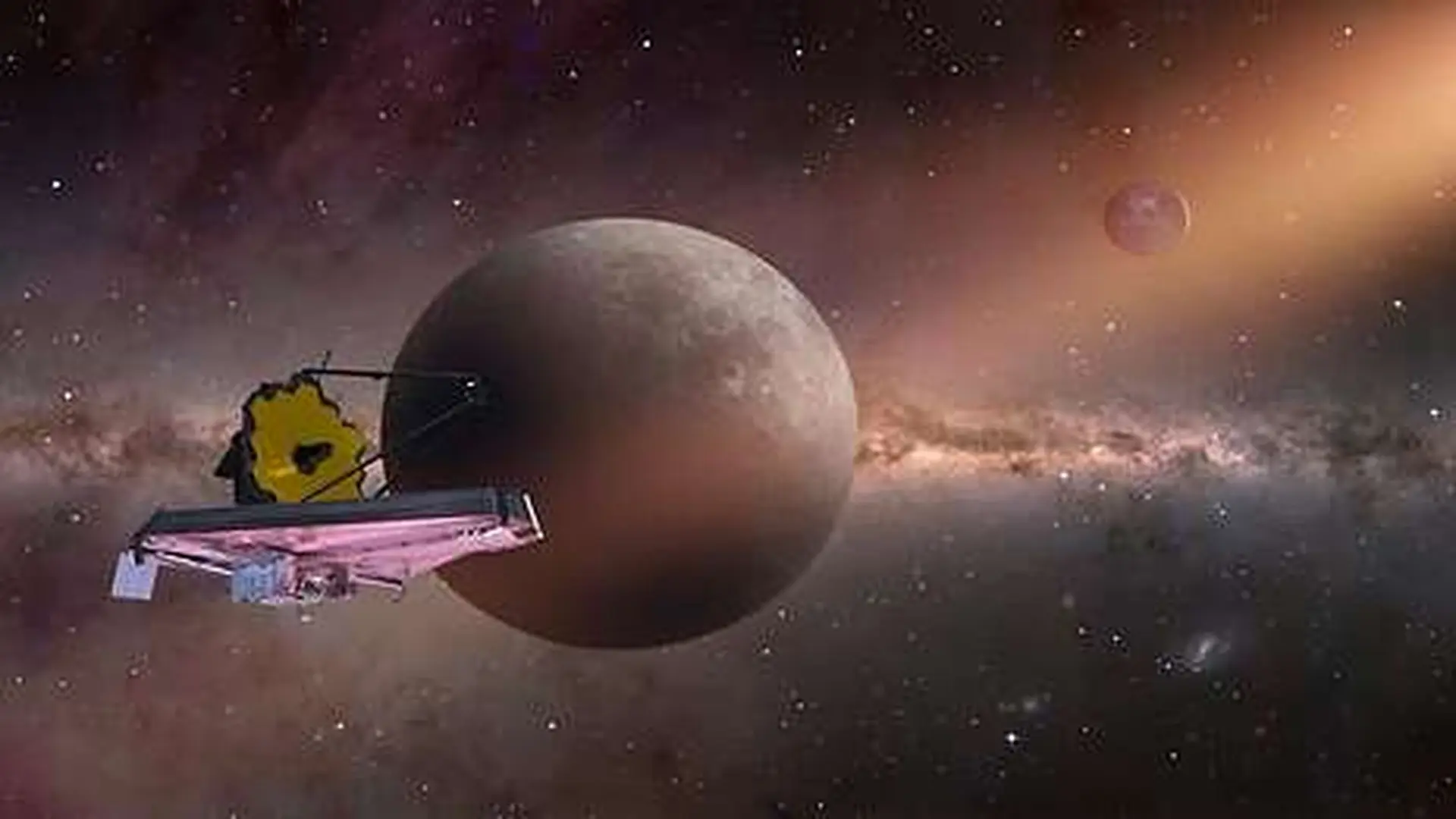
The James Webb Space Telescope has identified an identical, unexplained infrared absorption feature on both Saturn’s moon Titan and the distant dwarf planet Pluto. Researchers suggest the signature may belong to a previously unknown molecule or a family of related compounds, but the exact nature of the material remains uncertain.
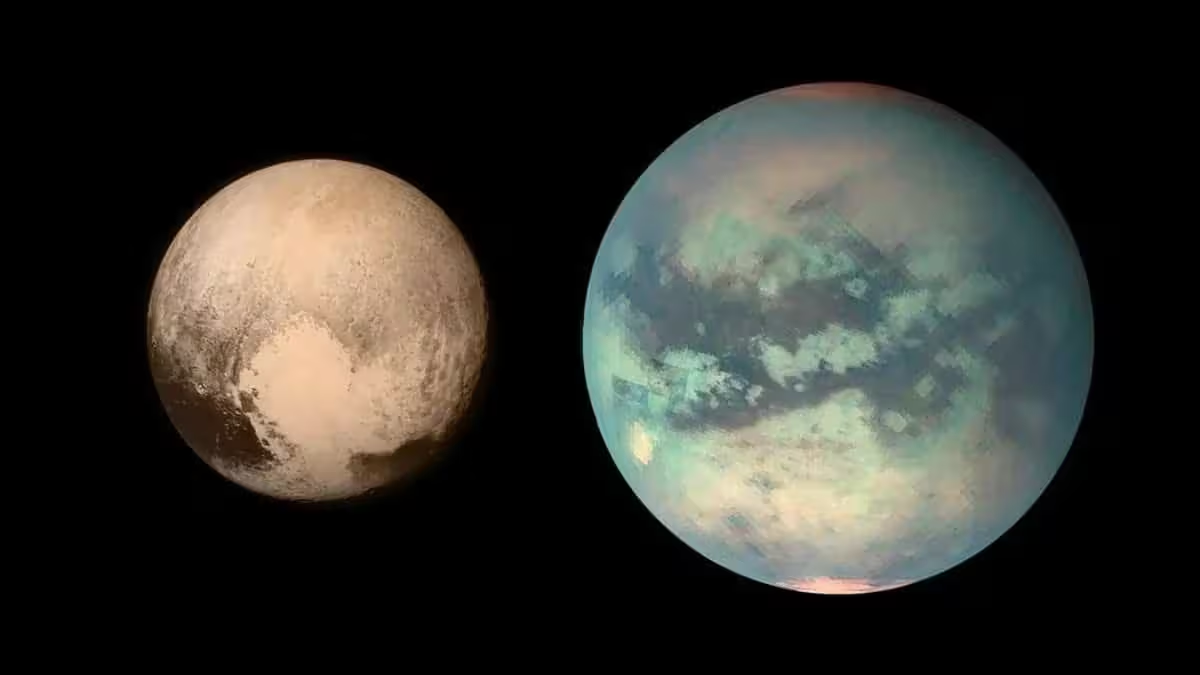
Titan and Pluto occupy dramatically different niches in the solar system—Titan boasts a dense, hazy atmosphere, methane‑filled seas, and dunes rich in organic material, while Pluto is a frigid world with a tenuous atmosphere far beyond Neptune’s orbit. Despite these contrasts, JWST’s infrared spectra reveal a common chemical imprint that does not correspond to any entry in existing molecular databases.
Identical Infrared Anomaly Detected on Two Distant Bodies
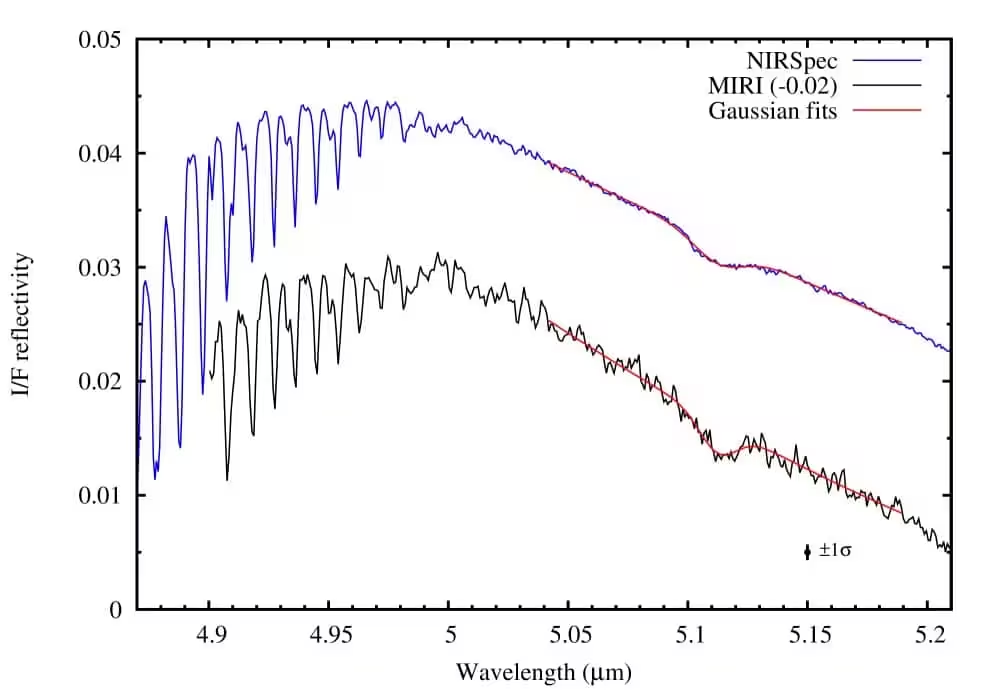
A re‑examination of JWST observations taken of Pluto in May 2023 uncovered the same mysterious absorption band that had first been spotted on Titan.
Spectroscopic techniques rely on each molecule’s unique light‑absorption pattern—its spectral fingerprint. The feature observed by JWST does not match any known fingerprint in current reference collections.
The researchers confirmed that the signal is not an artifact of the instrument. The absorption appears in data from both JWST’s Near‑Infrared Spectrograph (NIRSpec) and the Mid‑Infrared Instrument (MIRI), as detailed in the arXiv preprint. To verify the Pluto result, Bézard reached out to colleague Emmanuel Lellouch, who had previously examined JWST spectra of Pluto.
“I asked him, ‘Do you also have a signature [on Pluto] at this exact wavelength?’” Bézard told Space.com. “So we looked, and we found that it is present there.” The shared infrared pattern hints at comparable surface chemistry despite the vastly different environments.
Possible Origin in Sun‑Driven Organic Synthesis
The team does not attribute the signal to biological activity. Instead, they propose that the feature arises from the long‑running organic chemistry driven by sunlight and methane on Titan.
Both Titan and Pluto possess atmospheres dominated by nitrogen and methane. Ultraviolet photons break these gases into reactive fragments, which can recombine into increasingly complex hydrocarbons. Some of these products eventually settle onto the surface as a kind of “chemical snow,” where JWST can detect their spectral signatures.
On Titan, the absorption weakens when observations shift from the center of the disk toward the limb, a behavior consistent with a surface‑based source.
“This is what you expect if it comes from the surface,” Bézard explained.

By contrast, carbon monoxide in Titan’s atmosphere shows a uniform distribution across the disk, reinforcing the idea that the mysterious absorption is not atmospheric.
Pluto’s exceedingly thin atmosphere also cannot produce a strong infrared band, pointing to a solid‑state source on the surface. One candidate class is the allenes—a group of hydrocarbons known to absorb near the five‑micron wavelength observed—but many specific isomers remain uncharacterized, leaving the identification unresolved.
Future Observations May Pinpoint the Source
The team is now mining additional JWST datasets of Titan to map the spatial distribution of the unknown compound, looking for correlations with features such as the moon’s extensive organic dunes.
NASA’s upcoming Dragonfly mission, slated for launch in 2028 and arrival at Titan in the mid‑2030s, will carry a mass spectrometer capable of directly sampling surface material. While Dragonfly will not rely on infrared spectroscopy, its in‑situ analysis could verify which organic molecules are present and provide laboratory analogs for the JWST signature.
“It’s always exciting when you discover something that was not seen before,” Bézard remarked. “It’s really the nicest part of our job.”
He added that Dragonfly’s findings could narrow down the list of plausible organics on Titan, enabling researchers to test candidate molecules under laboratory conditions on Earth.
This article has been fact checked for accuracy, with information verified against reputable sources. Learn more about us and our editorial process.
Last reviewed on .
Article history
- Latest version
Reference(s)
- Sabia, Stephen. “NIRSpec - NASA Science.”, August 12, 2024 NASA <https://science.nasa.gov/mission/webb/nirspec/>.
- Sabia, Stephen. “Mid-Infrared Instrument (MIRI) - NASA Science.”, August 12, 2024 NASA <https://science.nasa.gov/mission/webb/mid-infrared-instrument-miri/>.
- Bézard, B.. “An unidentified absorption feature at 5.11 $μ$m on the surface of Titan and Pluto from JWST spectroscopy.” arXiv.org <https://arxiv.org/abs/2606.13350>.
- <https://www.researchgate.net/scientific-contributions/Emmanuel-Lellouch-2120483899>.
- Kuthunur, Sharmila. “Scientists discover mystery molecule on Pluto and Saturn's moon Titan: 'We cannot say what it is'.”, July 20, 2026 Space <https://www.space.com/astronomy/james-webb-space-telescope/scientists-discover-mystery-molecule-on-pluto-and-saturns-moon-titan-we-cannot-say-what-it-is>.
Cite this page:
- Posted by Bilal Abbasi