High School Student Discovers Rare Dwarf Galaxies That Could Change Our View of the Universe
Three unusual dwarf galaxies discovered by a student may unlock the mystery of how galactic encounters effectively shut down star formation.
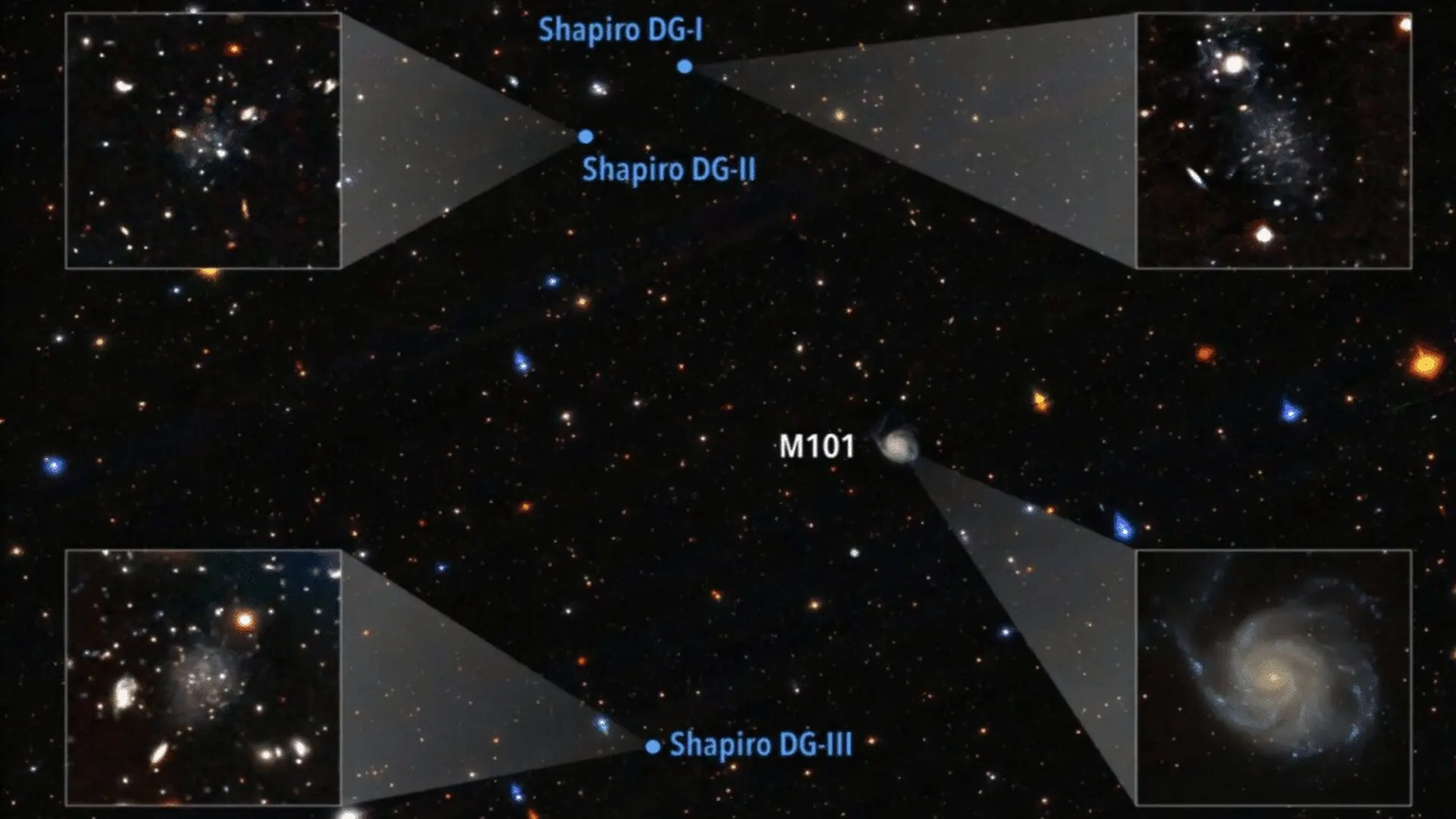
A fresh study led by a young researcher has identified three elusive dwarf galaxies that appear to defy the typical rules of cosmic evolution. Published in The Astrophysical Journal, the research highlights a trio of galaxies that are currently drifting in relative isolation, yet lack the star-forming fuel that usually characterizes such solitary systems.
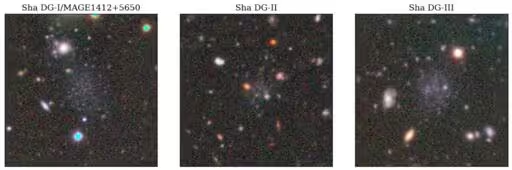
The discovery was spearheaded by Julian Shapiro, now an undergraduate at the University of California, Berkeley, who initiated the work during his time in high school. The three systems—labeled Shapiro Dwarf Galaxies I, II, and III—are situated between 15 million and 25 million light-years away from Earth. Their existence poses a significant question for astronomers: how can these small, isolated structures appear “dead” when they have no large neighbors to strip away their interstellar gas?
The Backsplash Hypothesis
In the standard lifecycle of a dwarf galaxy, those orbiting larger structures are often depleted of their gas through gravitational interactions, while those in the “field”—or open space—typically continue to produce stars. Shapiro’s findings suggest these three objects are exceptions that may have lived a more turbulent life than their current locations imply.
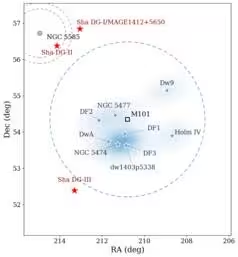
The researchers propose that these objects are “backsplash” galaxies. This theory suggests that these dwarf systems previously took a close, high-velocity journey through the environment of the Pinwheel Galaxy (M101), a massive spiral neighbor. During this flyby, the intense gravitational and hydrodynamical forces would have effectively scrubbed the smaller galaxies of their star-forming reservoirs. Having survived the encounter, the galaxies were subsequently flung outward, landing in their current, seemingly peaceful, isolated positions.
Testing Cosmological Models
Confirming the existence of such galaxies serves as a vital stress test for the Lambda Cold Dark Matter (Lambda-CDM) model. While current computer simulations have long predicted the existence of “backsplash” populations, concrete observational evidence has remained elusive. If these candidates are confirmed as true backsplash objects, it would provide crucial validation for our current theoretical understanding of how dark matter structures influence the distribution and evolution of smaller galaxies.
However, the researchers caution that the classification is not yet definitive. For example, Shapiro Dwarf Galaxy II may potentially be a satellite of the spiral galaxy NGC 5585, which would complicate the backsplash narrative. Future studies, involving more precise measurements of their orbital trajectories and distances, will be essential to map their true histories.
The Path Forward
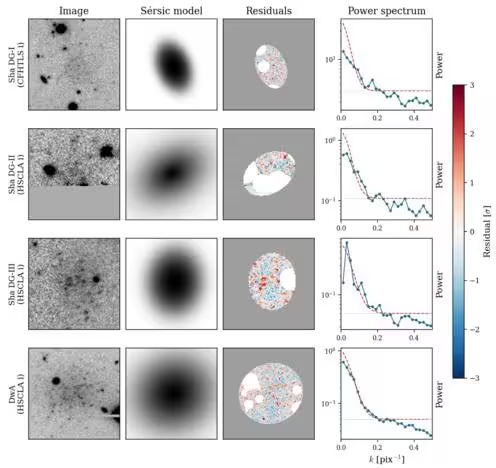
Shapiro’s methodology—which relied on mining archival telescope data and matching it with computational predictions—highlights a growing trend in modern astronomy where researchers extract deeper insights from existing datasets. Having moved from his initial high school research into university-level work, Shapiro is now tackling the Hubble tension, a major discrepancy in current measurements of the expansion rate of the universe.
Alongside his work with the research group led by Alex Filippenko at UC Berkeley, Shapiro is continuing his exploration of galaxy evolution through a new, intensive imaging program focused on low-surface-brightness galaxies. These faint, elusive systems are expected to offer further clues into the complex gravitational dances that shape the cosmos over eons.
This article has been fact checked for accuracy, with information verified against reputable sources. Learn more about us and our editorial process.
Last reviewed on .
Article history
- Latest version
Cite this page:
- Posted by Farah Siddiqui