New Study Reveals The Solar System Could Collapse Much Sooner Than Previously Thought
New simulations suggest the Sun’s final act will be surprisingly turbulent, upending previous theories about the dramatic fate of our solar system’s planets.
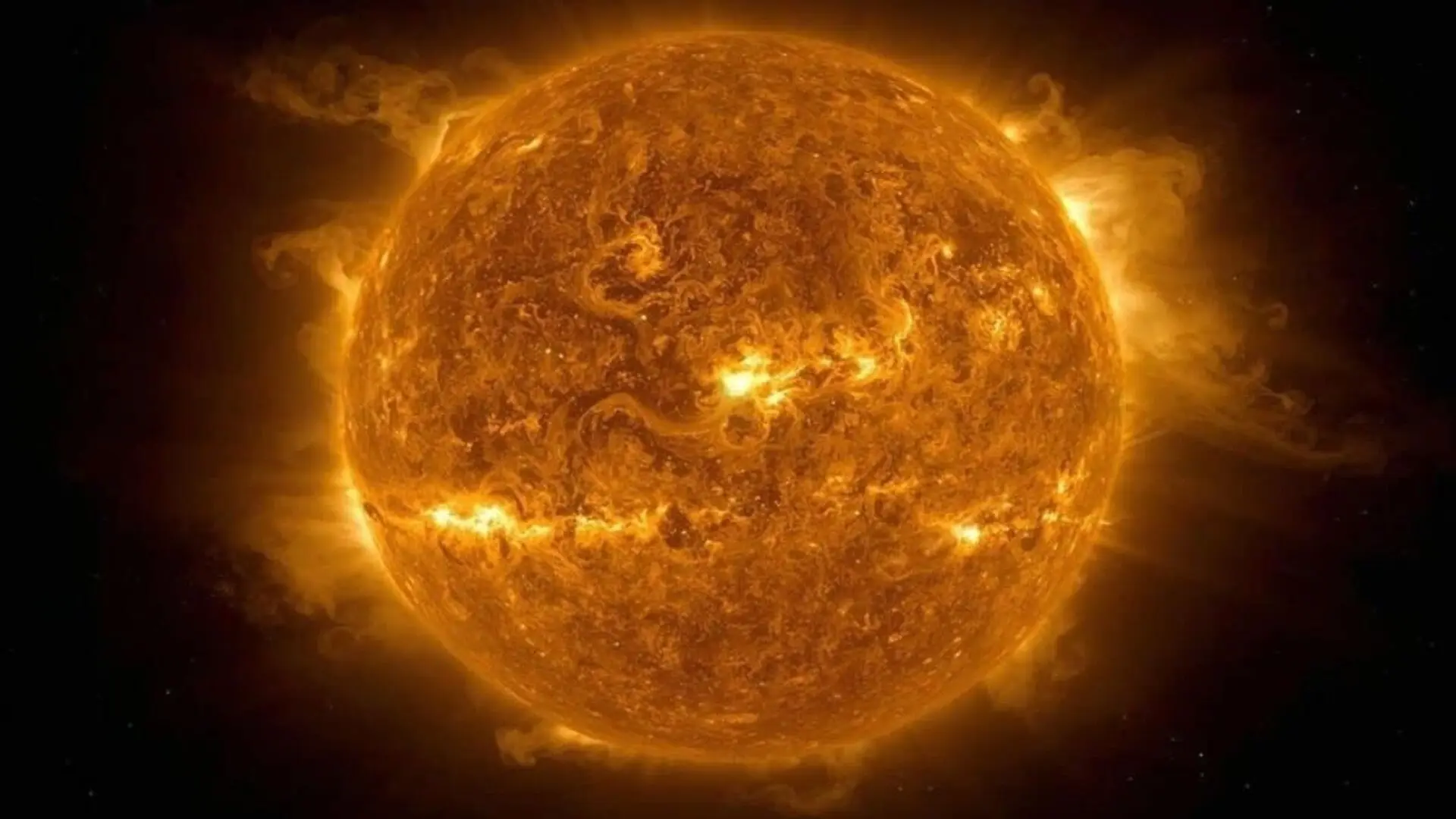
New astrophysical modeling suggests that our solar system’s outer giants may face a far more precarious future than previously imagined. While traditional theories long maintained that Jupiter, Saturn, Uranus, and Neptune would remain stable for a quintillion years following the death of the Sun, recent calculations indicate that the timeline for potential disintegration could be compressed to just one billion years.
This revised outlook, published in The Astrophysical Journal Letters, was developed by theoretical astrophysicists Konstantin Batygin and Jim Fuller of the California Institute of Technology, alongside Fred Adams of the University of Michigan. Their work shifts the focus from external threats—such as the gravitational influence of passing stars—to the internal, violent volatility of the Sun’s own final evolutionary stages.
Stellar Mass Loss and Orbital Chaos
The core of this new research challenges the assumption that the Sun will shed its outer layers in a steady, uniform stream. Instead, the team modeled the transition into a giant star and eventually a white dwarf as a process defined by discrete, energetic bursts of stellar material.
“Everything changes when the envelope departs in pieces,” the study authors noted.
Simulating the Fate of the Outer Planets
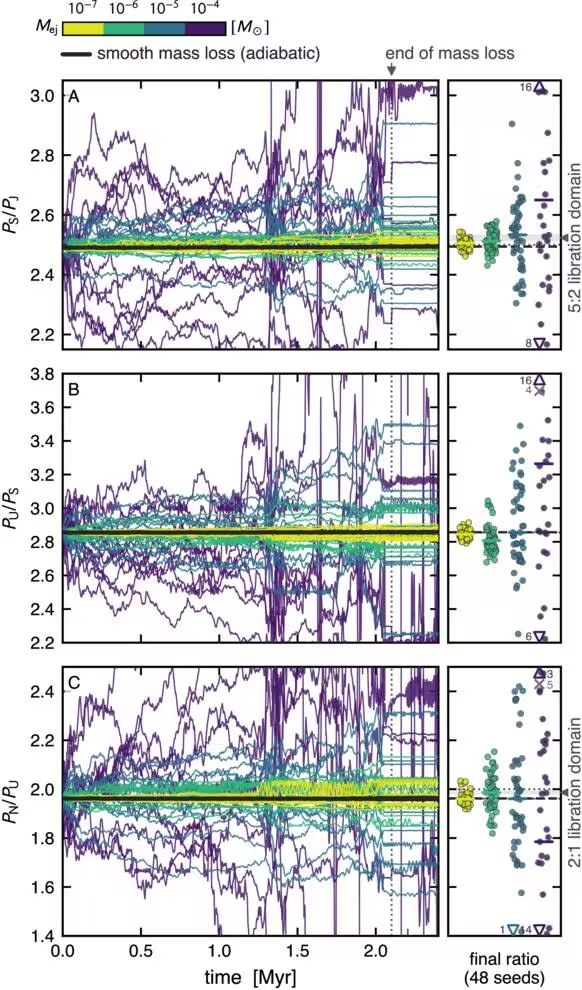
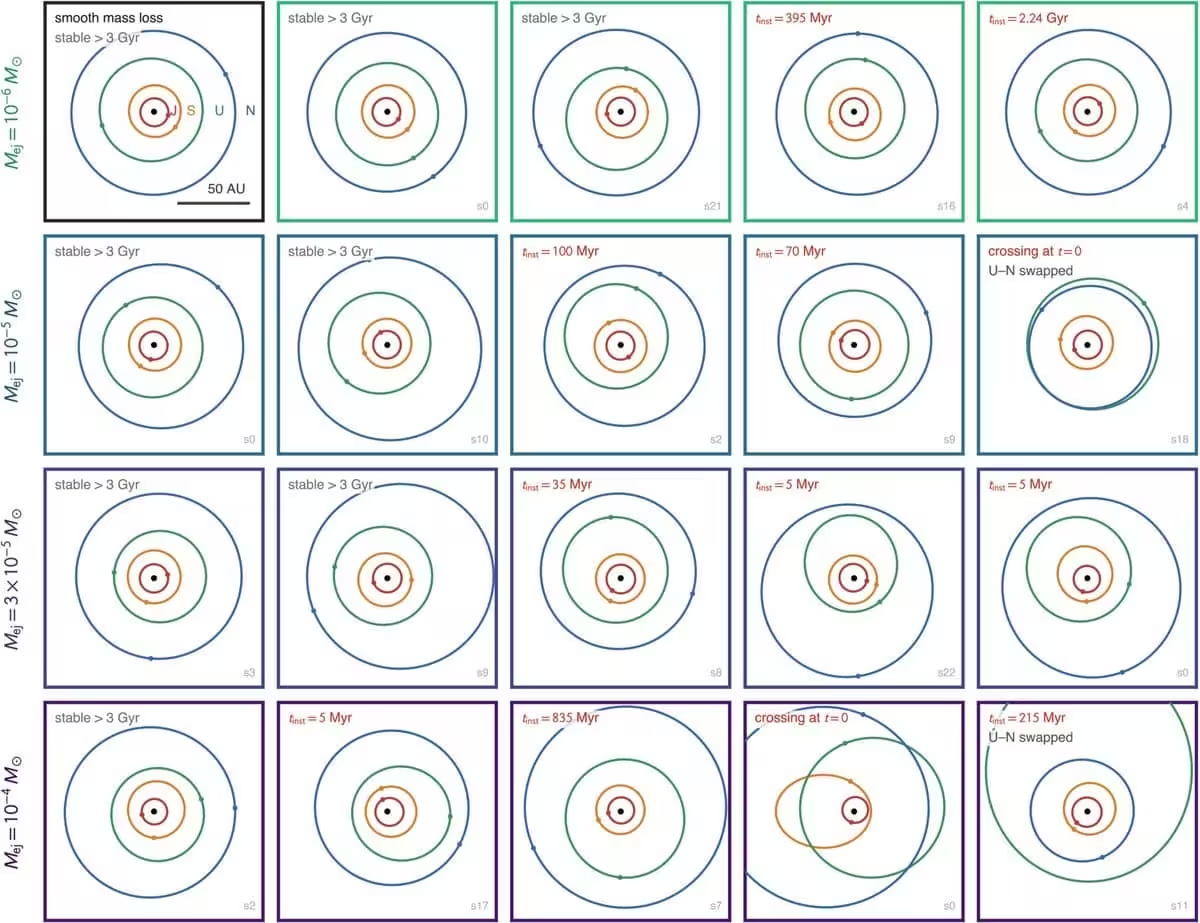
To quantify these effects, the researchers performed 672 distinct simulations, varying the size and frequency of the mass-loss bursts. Each configuration was projected over 3 billion years to observe how the gravitational balance between the outer planets would hold up as the central star underwent its transformation. The results were stark: even systems that appeared perfectly secure during the early stages of the Sun’s decline could harbor latent instabilities that manifest billions of years later.
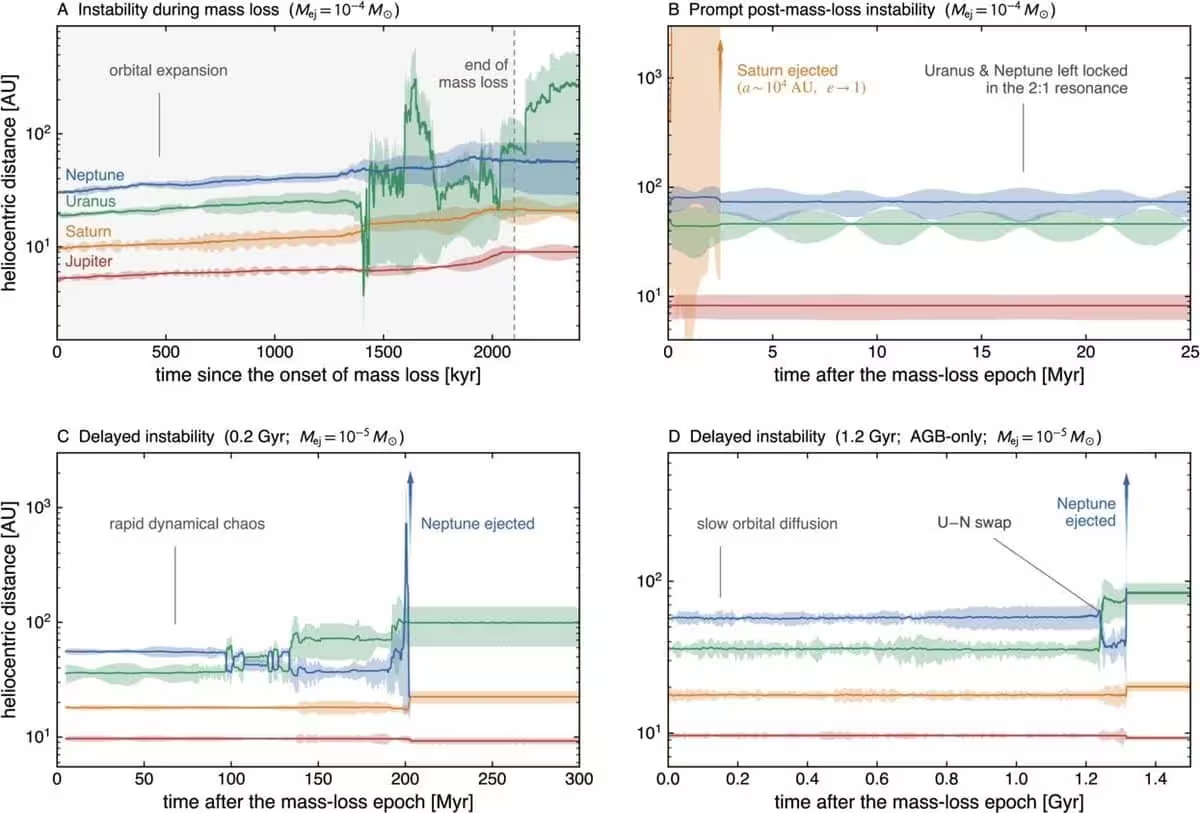
According to the findings, up to 96% of the tested systems reached a state of instability within 3 billion years of the Sun becoming a white dwarf. In approximately 40% of cases, the disruption began even earlier, during the active mass-loss phase. The resulting chaos varied significantly between models, with some scenarios witnessing the total expulsion of planets from the solar system, while others saw Uranus and Neptune swapping their orbital positions.
Resonance and Survival
Not every outcome was catastrophic. The research highlighted that in cases where the Sun’s mass-loss bursts were less violent, some planetary systems successfully entered into synchronized, stable orbits known as mean-motion resonances. These configurations, which are impossible to achieve under models assuming smooth mass loss, allowed some planets to remain in place for the full 3-billion-year duration of the simulation.
Ultimately, the study underscores that the architecture of our solar system is not merely a static arrangement awaiting external interference, but a dynamic, long-term casualty of the Sun’s final act. The researchers emphasize that “visually pristine systems can carry Gyr-delayed instabilities,” suggesting that the long-term survival of the outer planets remains a delicate balancing act influenced by the specific mechanics of stellar death.
This article has been fact checked for accuracy, with information verified against reputable sources. Learn more about us and our editorial process.
Last reviewed on .
Article history
- Latest version
Reference(s)
- Batygin, Konstantin., et al. “Terminal Instability of the Solar System Triggered by Stochastic Solar Mass Loss.” The Astrophysical Journal Letters, vol. 1009, no. 2, September 21, 2026, pp. L22 American Astronomical Society, doi: 10.3847/2041-8213/aea290. <https://iopscience.iop.org/article/10.3847/2041-8213/aea290>.
Cite this page:
- Posted by Farah Siddiqui