Astronomers Detect Rare Molecule Near Young Star That Defies Chemical Models
Astronomers have discovered unexpectedly high levels of deuterated methanol near a young star, challenging current models of organic chemistry in space.
Astronomers have achieved a milestone in astrochemistry by confirming the presence of a rare, fully deuterated form of methanol near the protostar IRAS4A2. Located within the Perseus molecular cloud, this discovery marks the first time a molecule containing four deuterium atoms has been definitively identified in interstellar space.
The findings, detailed in Astronomy & Astrophysics, shed light on the complex chemical evolution that occurs during the earliest stages of star formation. By replacing the four hydrogen atoms in standard methanol (CH3OH) with deuterium—a hydrogen isotope containing an extra neutron—researchers have uncovered a chemical signature that challenges existing models of how organic material accumulates in cold, dense clouds before evolving into planetary systems.
A Breakthrough Detection via ALMA
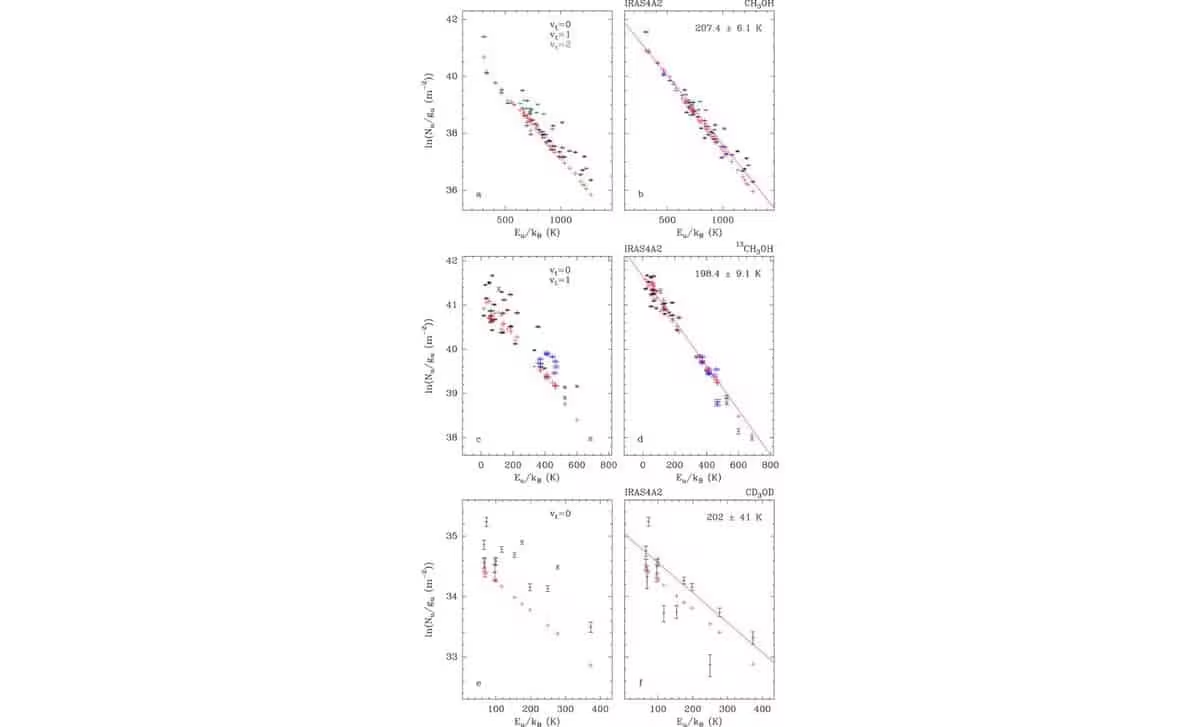
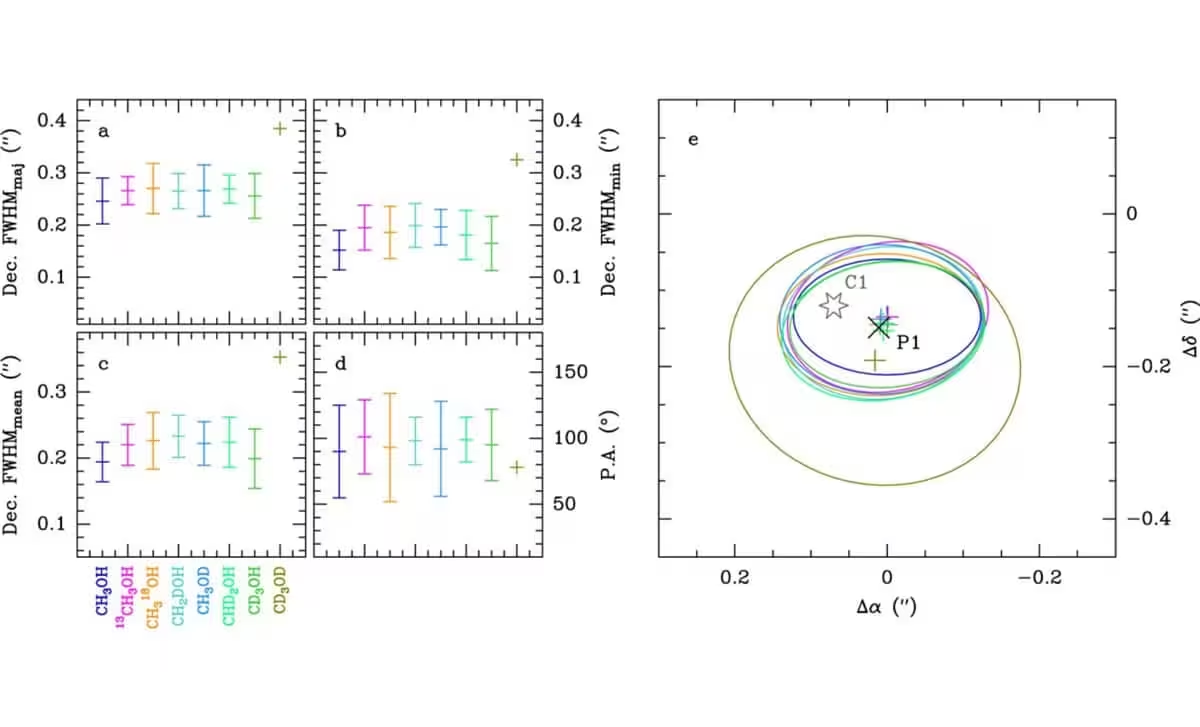
The identification was made as part of the ALMA COMPASS Large program, a comprehensive survey that utilizes the Atacama Large Millimeter/submillimeter Array (ALMA) in Chile to analyze the chemical makeup of 11 young stellar systems. By capturing ten distinct spectral lines, a team led by Arnaud Belloche of the Max Planck Institute for Radio Astronomy successfully isolated the signal of fully deuterated methanol, or CD3OD.
Methanol is believed to originate on the surfaces of icy dust grains in the frigid depths of molecular clouds. As the heat from a developing star radiates outward, these trapped molecules are released into the gas phase, allowing them to be detected by high-precision radio telescopes. Silvia Spezzano, a co-author of the study and research group leader at the Max Planck Institute for Extraterrestrial Physics, notes that these deuterated molecules are essential tools for tracking the chemical history of stellar and planetary development.
Discrepancies in Chemical Theory
The study highlights a significant gap between empirical observation and theoretical chemistry. The team discovered that CD3OD is approximately 100 times more abundant around IRAS4A2 than current chemical models predict. In some instances, existing frameworks failed to account for the observed quantity of the molecule by as much as five orders of magnitude.
Furthermore, the data suggests that the deuterium-to-hydrogen ratio climbs as the number of deuterium atoms in the methanol increases. Beyond the confirmed CD3OD, the team observed additional, as-yet-unidentified spectral lines that may point toward other multiply deuterated variants, such as CH2DOD and CHD2OD. To solve this puzzle, researchers are now pursuing laboratory spectroscopy to map these missing signatures, a move expected to refine our understanding of the chemical diversity inherent in the birth of stars.
This article has been fact checked for accuracy, with information verified against reputable sources. Learn more about us and our editorial process.
Last reviewed on .
Article history
- Latest version
Cite this page:
- Posted by Bilal Abbasi