Scientists Discover Human Brain Gene That Escaped Into A Poxvirus
New research on the BC200 gene reveals how its dual functions are challenging our understanding of mobile DNA and viral evolution in the human genome.

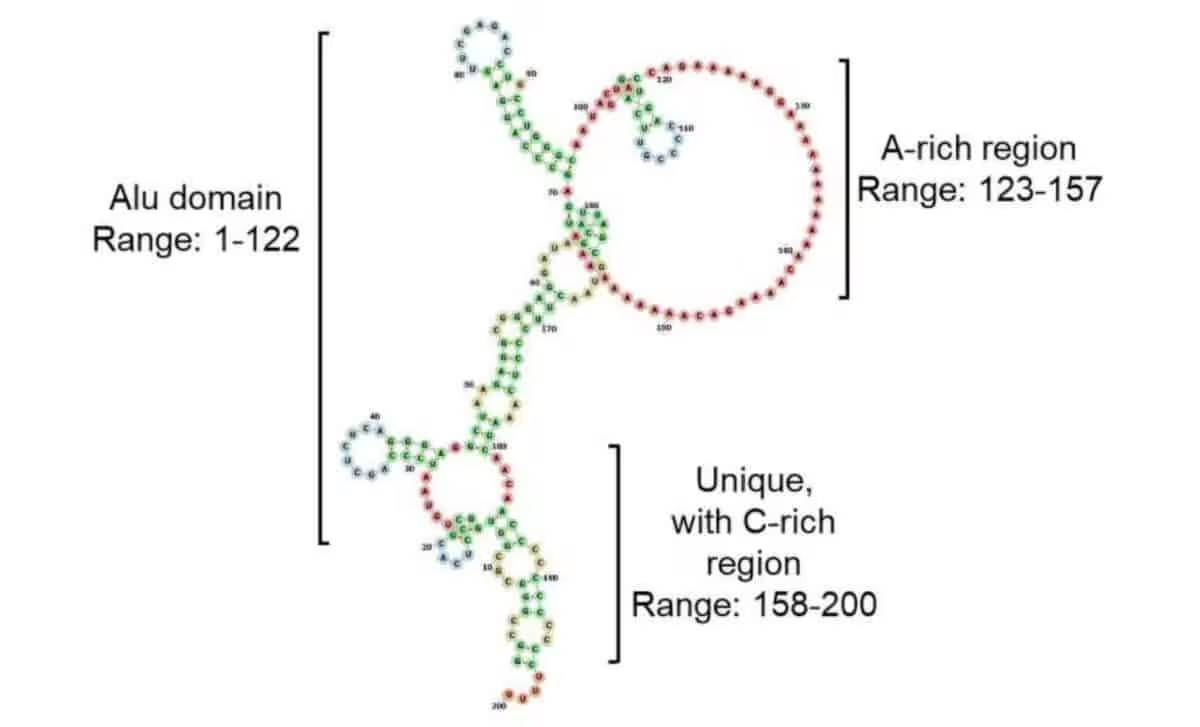
A peculiar genetic element known as BC200 is challenging long-held assumptions about how genomes evolve. Identified in the late 1980s, this gene has remained a biological enigma, serving an active, yet poorly understood, role in human neurons while simultaneously retaining the capacity to “jump” to new locations within the genome. A study published September 24 in the journal Science details this unprecedented behavior, highlighting a rare evolutionary state that persists despite the potential risks to cellular stability.
Most of the human genome is composed of transposable elements—so-called “jumping genes”—that have lost their ability to mobilize over millions of years. In a process called domestication, these sequences are often repurposed by cells to perform essential regulatory functions. Generally, once a gene is co-opted for a vital cellular role, it loses its mobility to avoid disrupting the host’s genetic architecture. BC200 defies this convention.
“Genes that come from transposable elements and that are repurposed for cellular functions are typically no longer transposable,” says Cédric Feschotte, a professor of molecular biology and genetics at Cornell University and senior author of the study. “BC200 was itself created from a mobile element but has retained its mobility, and yet it is also clearly serving a cellular function. Somehow evolution hasn’t been able to untangle these two things.”
An Unexpected Viral Connection
The research team, which included scientists from Cornell University, Capital Normal University, and the University of Texas at Arlington, discovered an even more surprising development: BC200 has successfully infiltrated a virus. While analyzing genomic databases, researchers identified two copies of the gene within the genome of the molluscum contagiosum virus (MCV), a human poxvirus that causes skin lesions. The presence of the gene in the virus suggests a recent cross-species jump, likely occurring within the skin cells that MCV infects.
This finding indicates that BC200’s influence is not limited to the host’s own DNA. While the functional significance of the gene’s presence within the viral genome remains unclear, it underscores the gene’s persistent capacity for movement. The authors of the study characterize BC200 as a sequence that effectively blurs the distinction between a stable gene and a nomadic transposon.
Clinical Implications and Lingering Questions
The duality of BC200—acting as both a cellular regulator and a mobile genetic element—has drawn significant attention regarding its potential involvement in human pathology. Elevated levels of BC200 have been observed in certain cancers and in the brains of patients with Alzheimer’s disease. In the context of mobile genetic elements, such abnormal expression is concerning; if the gene is actively jumping into new sites, it could potentially disrupt critical cellular processes or trigger oncogenic mutations.
However, researchers emphasize that a causal link between BC200 and these conditions has not been proven. Currently, the association remains correlative. Future investigations are now focused on determining whether BC200 is actively generating new insertions within cancer cells and if these events are contributing to disease progression. Despite being identified nearly four decades ago, BC200 continues to defy simple classification, leaving scientists to grapple with how its dual existence influences both normal neurological health and potential disease pathways.
This article has been fact checked for accuracy, with information verified against reputable sources. Learn more about us and our editorial process.
Last reviewed on .
Article history
- Latest version
Reference(s)
- Gao, Pu., et al. “Escape of the BC200 gene to a human poxvirus reveals its persistent transposition in primates.” Science, vol. 393, no. 6818, September 24, 2026, pp. 1342-1346. American Association for the Advancement of Science (AAAS), doi: 10.1126/science.aeh3441. <https://www.science.org/doi/10.1126/science.aeh3441>.
Cite this page:
- Posted by Hassan Raza