Astronomers Discover Rare Form of Alcohol in a Distant Stellar Nursery
Astronomers have detected a unique molecular signature of alcohol in a distant star-forming region, marking a surprising new discovery in space chemistry.
Astronomers have achieved a milestone in astrochemistry, identifying a rare form of alcohol in the depths of space for the very first time. The discovery, which sheds light on the complex chemical processes occurring in the nurseries where stars and planets are born, was made near a protostar located approximately 1,000 light-years from Earth.
The breakthrough was driven by the COMPASS Large Program, an international initiative utilizing the Atacama Large Millimeter/submillimeter Array (ALMA) to conduct a high-resolution survey of 11 young stars that share characteristics with our own Sun. By analyzing the organic molecules in the vicinity of these developing stars, researchers hope to map the chemical evolution that precedes the birth of planetary systems. The initial findings from this expansive study have been detailed in a series of seven papers published in Astronomy & Astrophysics.
Heavy Methanol Detected in the Perseus Molecular Cloud
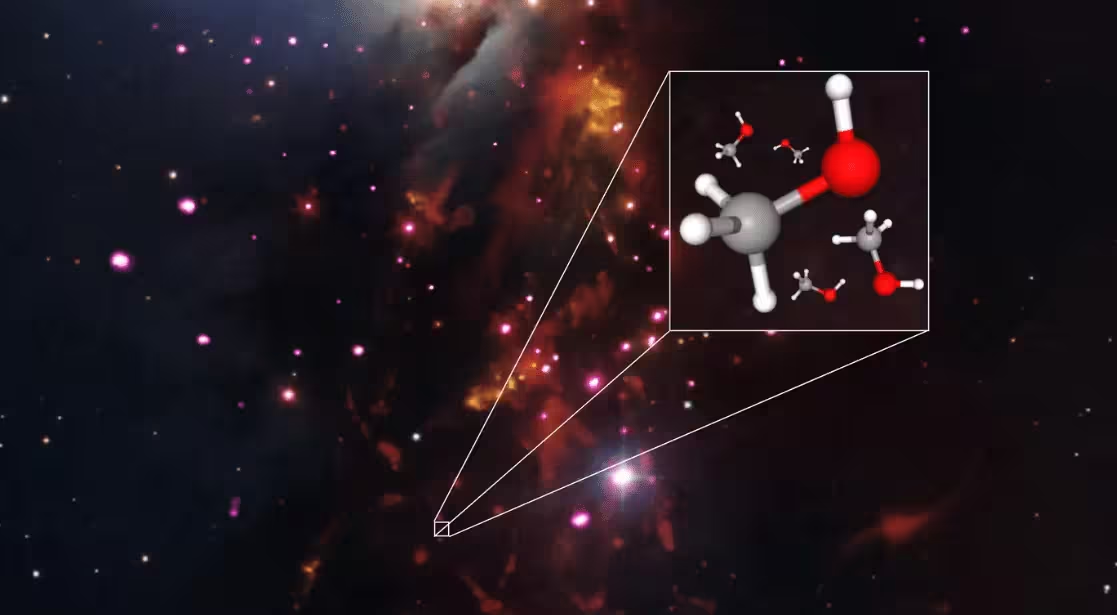
The rare molecule was identified in the environment surrounding IRAS 4A2, a protostar nestled within the Perseus molecular cloud. Known as fully deuterated methanol (CD₃OD), the substance is a variant of the simplest form of alcohol. While standard methanol contains four hydrogen atoms, this specific isotope features four atoms of deuterium, a heavier stable isotope of hydrogen.
Lead researcher Dr. Arnaud Belloche of the Max Planck Institute for Radio Astronomy and his team managed to isolate the molecule by filtering its distinct, faint spectral signature from the complex background noise of the surrounding stellar material. The identification of this specific isotope, as detailed in their formal study, represents a new benchmark in our understanding of chemical complexity in the interstellar medium.
Ubiquitous Radio Beacons in Stellar Nurseries
Beyond the detection of exotic molecules, the COMPASS team discovered that methanol masers—natural radio emissions produced by methanol—are significantly more prevalent around low-mass protostars than previously theorized. A study spearheaded by Jae-Hong Jeong of Seoul National University revealed these emissions in more than half of the 11 surveyed targets. These findings suggest that such masers are a consistent feature of early stellar evolution, only appearing elusive in past surveys due to lower telescope sensitivity.
The COMPASS project leverages over 100 hours of ALMA observation time, utilizing an array of up to 66 antennas to map chemical distribution at scales comparable to our own solar system. This precision allows scientists to observe the “chemical fingerprint” of young stars with unprecedented clarity.
Unlocking the Origins of Planetary Chemistry
The broader ambition of the COMPASS program is to decipher the chemical diversity of young stars and determine how these early conditions influence the composition of future planets. By comparing molecular data across all 11 protostars, researchers are beginning to identify which chemical variations stem from the local environment and which are inherent to the stages of stellar development.
“We are getting completely new insights into the complex chemistry occurring around the youngest protostars,” said Jes Jørgensen, a professor at the University of Copenhagen’s Niels Bohr Institute and the program’s principal investigator.
As the team continues to analyze their expansive dataset, they anticipate uncovering deeper links between interstellar chemistry and the precursors to planetary formation. According to Jeong-Eun Lee of Seoul National University, the current results are merely the beginning of a broader effort to understand how chemical complexity evolves during the transition from collapsing clouds to stable solar systems.
This article has been fact checked for accuracy, with information verified against reputable sources. Learn more about us and our editorial process.
Last reviewed on .
Article history
- Latest version
Reference(s)
- “Large Programs.” ALMA Science Portal at ESO <https://almascience.eso.org/alma-data/lp>.
- <https://www.aanda.org/articles/aa/full_html/2026/10/aa58734-25/aa58734-25.html>.
- “Arnaud Belloche's homepage.” <https://www3.mpifr-bonn.mpg.de/staff/abelloche/>.
- “First detection of heavy methanol in space.” <https://www.mpifr-bonn.mpg.de/pressreleases/2026/first-detection-of-heavy-methanol-in-space>.
- “Jae-Hong Jeong.” <https://scholar.google.com/citations?user=cfUIBOsAAAAJ&hl=en>.
- “Jes Kristian Jørgensen.” University of Copenhagen Research Portal <https://researchprofiles.ku.dk/en/persons/jes-kristian-j%C3%B8rgensen/>.
Cite this page:
- Posted by Bilal Abbasi