New Simulations Reveal the Milky Way Was Born From Thousands of Mysterious Ancient Galaxies
New cosmic simulations reveal the Milky Way formed from a turbulent network of thousands of small galaxies in the early universe.
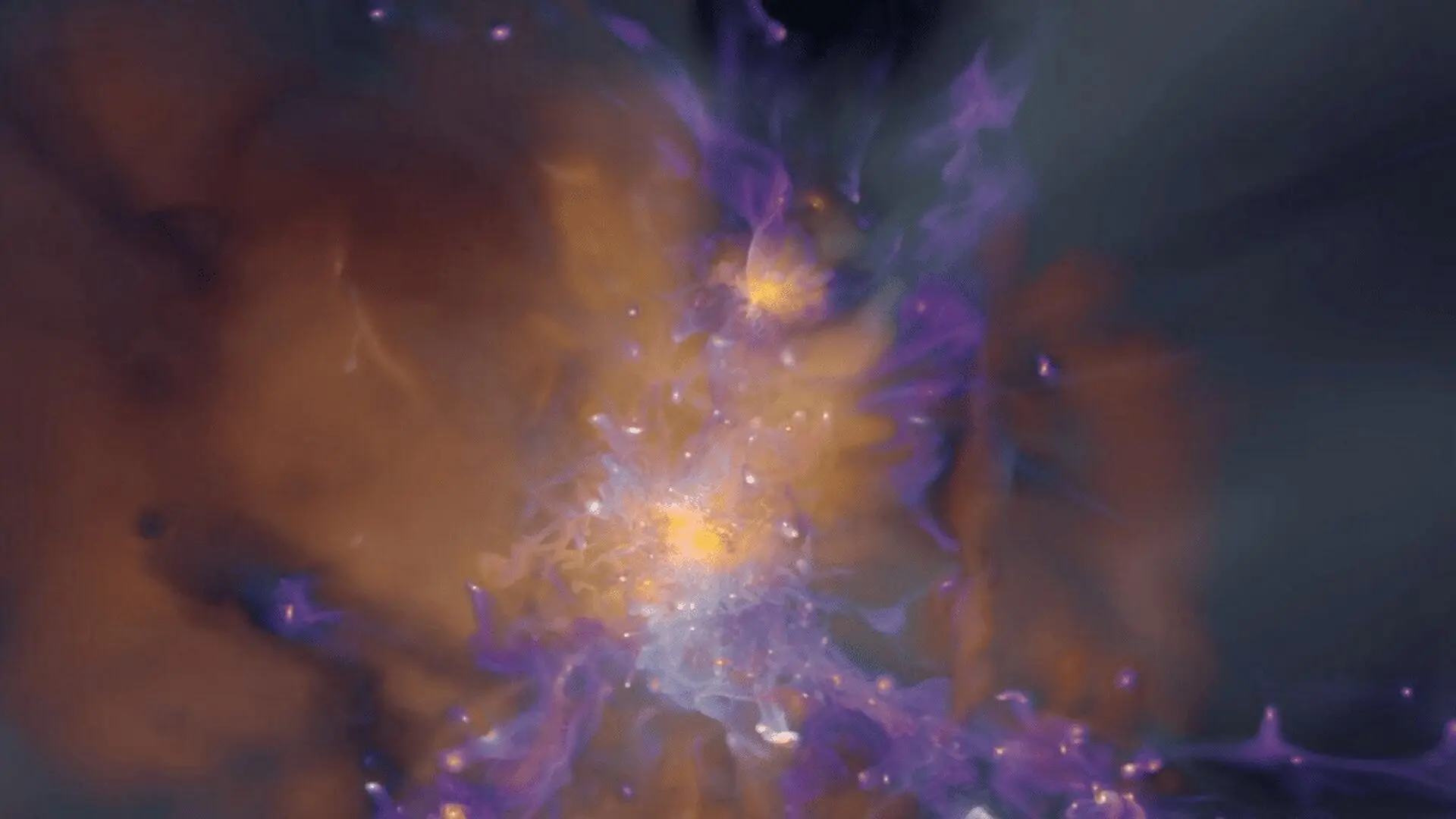
A sophisticated new suite of supercomputer simulations suggests our Milky Way began its life as a chaotic, densely packed cosmic neighborhood. Rather than forming in isolation, the galaxy we reside in was likely forged from the wreckage and merger of thousands of smaller, distinct galactic systems that existed during the dawn of the universe.
Simulating the Milky Way’s Turbulent Ancestry
Led by University of Chicago astronomer Harley Katz, the research team behind the MEGATRON project has constructed one of the most granular reconstructions of galactic evolution to date. The study, detailed in a series of six papers published in The Open Journal of Astrophysics, required three years of intense computation to track the development of the Milky Way across the first several billion years of cosmic time.
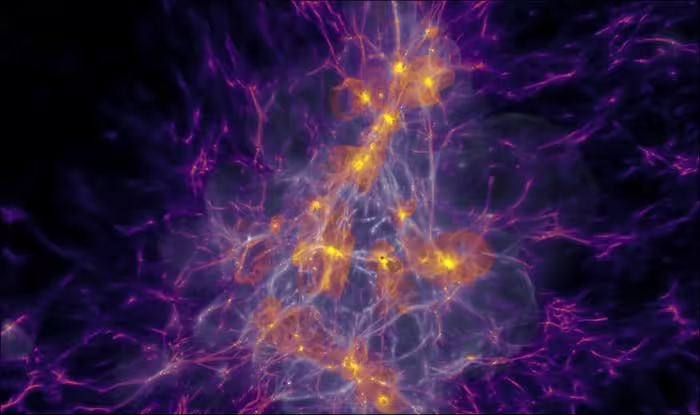
The simulations reveal a diverse collection of primordial structures. Some of these ancient building blocks were hotbeds of intense star formation, while others were relatively dormant or consisted primarily of gas. By tracking these thousands of subsystems, the team can now provide concrete predictions of how the early Milky Way would have appeared to instruments like the James Webb Space Telescope (JWST) and the Hubble Space Telescope.
Testing Physics Through Cosmic Evolution
Because humans cannot observe the long-term evolution of a single galaxy in real-time, astrophysicists rely on simulations to determine whether fundamental physical laws—such as gravity, hydrodynamics, and radiation—can accurately recreate the structures observed in our local universe today. By integrating these complex physical processes, the MEGATRON model allows researchers to watch the “cosmic web” reorganize itself over time.
“We follow thousands of subsystems in the model and directly compute what they all would have looked like with our most powerful space telescopes, which is many orders of magnitude more than what had been simulated before,” Katz noted.
Ghost Galaxies and Chemical Anomalies
One of the most intriguing findings from the project is the prediction of “dark” galaxies—objects that may appear as light-emitting sources in deep-space surveys but contain no stars. These systems might be composed entirely of gas or could be the remnants of early galactic structures where stars have already collapsed into black holes. This potential for “starless” light sources could force astronomers to recalibrate how they interpret observations of the very early universe.
The MEGATRON simulations also offer a potential solution to a long-standing chemical puzzle: why the concentration of iron in the smallest, faintest galaxies remains strangely high. The team posits that Population III stars—the elusive, metal-free first generation of stars—may be responsible. These massive, ancient stars would have produced significant iron when they exploded. While larger galaxies could retain these heavy elements, smaller ones might have shed them into the surrounding space, creating a unique chemical fingerprint that persists today.
Pushing the Boundaries of Galactic Chemistry
The project distinguishes itself by modeling the enrichment of individual chemical elements directly from specific stellar populations, rather than relying on broader statistical approximations. By incorporating non-equilibrium physics, the researchers have been able to map how gas behaves in the circumgalactic medium with unprecedented accuracy.
While the model is highly advanced, Katz emphasizes that the discrepancies between the simulation and actual observation are just as valuable as the successes. These “missing pieces” provide a roadmap for future research, highlighting where current theories of star formation and chemical evolution remain incomplete. Ultimately, the work underscores that the chaotic, high-energy environment of the early universe remains a fundamental architect of the galaxy we call home.
This article has been fact checked for accuracy, with information verified against reputable sources. Learn more about us and our editorial process.
Last reviewed on .
Article history
- Latest version
Reference(s)
- Rey, Martin., et al. “MEGATRON: how the first stars can create an iron metallicity plateau in the smallest dwarf galaxies.” The Open Journal of Astrophysics, vol. 9, September 30, 2026 Maynooth University, doi: 10.33232/001c.169605. <https://dx.doi.org/10.33232/001c.169605>.
Cite this page:
- Posted by Bilal Abbasi