Tiny Sea Creatures Reveal How Complex Behaviors Evolve Over a Lifespan
Researchers map the life cycle of a microscopic tunicate, showing that adult navigation emerges from reweighting existing motor primitives rather than inventing new ones.

Tiny transparent sea creatures known as pelagic tunicates reveal how complex behaviors evolve over a lifetime through a subtle reweighting of existing actions rather than the invention of new ones. Researchers tracking the microscopic chordate Oikopleura dioica across its entire life cycle found that its swimming kinematics, spatial exploration, and defensive tendencies scale up dramatically as it matures. The study, published in iScience, provides a quantitative blueprint for how rudimentary movements transform into sophisticated adult navigation within a compact nervous system.
How a Millimeter-Long Animal Builds a Behavioral Atlas
To understand how behavior develops, the team recorded 159 larvae, 106 juveniles, and 60 adult specimens using high-throughput tracking setups and machine learning tools like DeepLabCut. At just 8 hours post-fertilization, free-swimming larvae display simple episodic swimming with straight midlines and minimal spatial exploration, covering an arena median velocity of only 86 micrometers per second. By the juvenile stage, animals show increased turning and localized runs, but they still explore only a fraction of their test chambers.
Adults, tracked at 120 hours post-fertilization, exhibit sprawling trajectories and achieve velocities reaching a median of 2,847 micrometers per second, which is roughly 33 times faster than larvae. Using dimensionality reduction techniques, the authors mapped the creatures into seven core postural modes termed eigenoikopleuras. These mathematical shapes capture the animal’s physical bending and tail dynamics, showing that developmental stages and environmental contexts occupy distinct regions of a shared postural space.
Why Building a Mucus House Changes Everything
Adult Oikopleura dioica inhabit a complex extracellular filtration structure known as a house, which they secrete from their trunk epithelium and inflate within an average of 21 seconds. This gelatinous enclosure drastically alters movement. When animals are inside their houses filter-feeding, they display restricted spatial displacement, higher wave index motions, and strongly lateral-biased tail beating designed to pull water through internal filters.
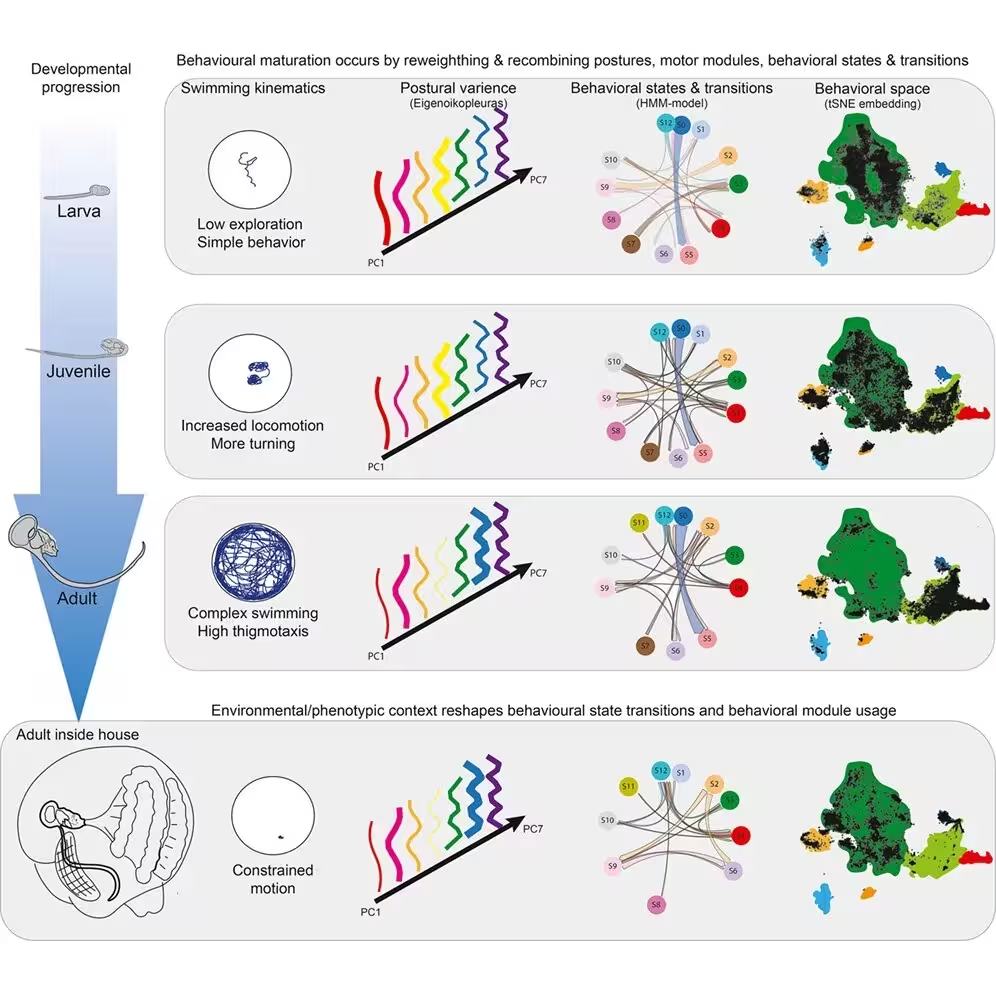
When forced out of their houses, the same adults engage in fast, symmetric propulsion and extensive spatial exploration, mirroring the behavior of free-swimming phases that occur naturally when old houses clog and are replaced every 3 to 4 hours. Hidden Markov modeling of behavioral sequences revealed that these contextual shifts do not introduce entirely new states, but rather reconfigure transition backbones and dwell times within a conserved motor repertoire.
What These Findings Mean for Chordate Evolution
With a central nervous system comprising only about 130 neurons, Oikopleura dioica manages a surprisingly rich behavioral repertoire despite extreme neural miniaturization. The research demonstrates that behavioral complexity arises from progressive reweighting, sequencing, and modulation of conserved motor primitives rather than adding new neural hardware. Because tunicates are the closest living invertebrate relatives of vertebrates, these insights offer a baseline for understanding how neuromuscular and sensory systems co-evolve across the animal kingdom.
The research was published in iScience on November 4, 2026.
This article has been fact checked for accuracy, with information verified against reputable sources. Learn more about us and our editorial process.
Last reviewed on .
Article history
- Latest version
Reference(s)
- Tolstenkov, Oleg., et al. “Behavioral ontogeny in a pelagic tunicate reveals developmental maturation and context-dependent modulation.” iScience, vol. 29, no. 11, November 1, 2026, pp. 118104 Elsevier BV, doi: 10.1016/j.isci.2026.118104. <https://doi.org/10.1016/j.isci.2026.118104>.
Cite this page:
- Posted by Kamran Akhtar