AI Weather Models Master Global Forecasts But Stumble on Record Extremes
A comprehensive review reveals that while artificial intelligence excels at tracking standard weather patterns, it consistently underestimates the intensity of unprecedented climate extremes.
When historic weather disasters strike, artificial intelligence weather models often nail the large-scale atmospheric patterns and the exact timing of the event, yet they frequently stumble when it comes to capturing the extreme intensity and sheer magnitude of record-breaking conditions. A comprehensive review by an international team of researchers explores how data-driven forecasting algorithms stack up against traditional physics-based numerical weather prediction systems when predicting dangerous weather extremes.
For decades, meteorologists relied on numerical models that solve complex physical equations of atmospheric motion using supercomputers. However, the meteorological landscape has been radically transformed by artificial intelligence systems trained on decades of historical reanalysis data, such as the European Centre for Medium-Range Weather Forecasts ERA5 dataset. Prominent AI models like GraphCast, Pangu-Weather, FuXi, and the Artificial Intelligence Forecasting System (AIFS) now routinely outperform traditional numerical methods on global headline skill scores while requiring a fraction of the computational power. Yet, a crucial question remains as to whether this apparent superiority extends reliably to extreme weather events, which often sit at the outer edges of historical distributions.
How Artificial Intelligence and Physics Models Compare on Everyday Extremes
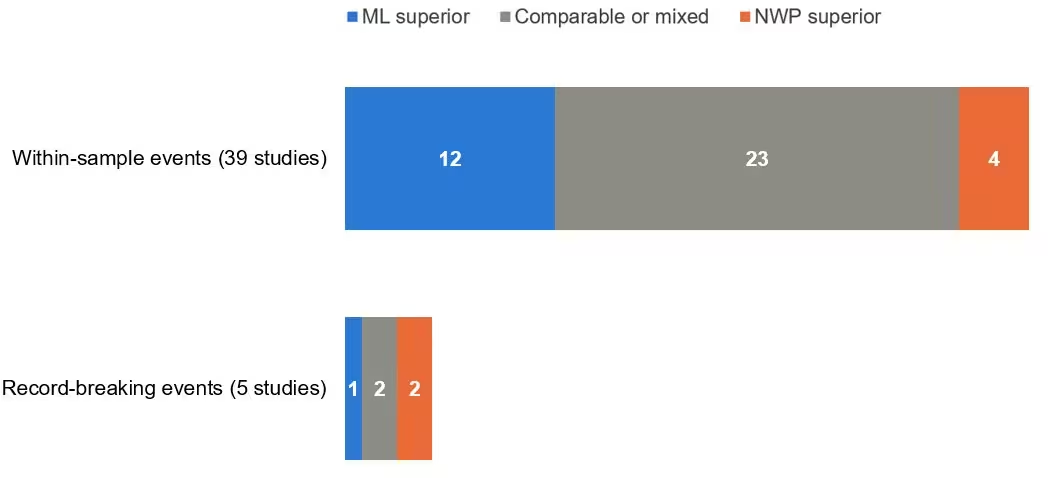
The authors point out that performance varies widely depending on the specific meteorological variable, geographic region, and lead time involved. When examining within-sample extremes, meaning severe weather events that are rare but still sampled within historical training data, data-driven systems display robust competence. For near-surface temperature extremes and tropical cyclone tracks, artificial intelligence models frequently match or exceed traditional numerical forecasts. For instance, data-driven frameworks typically excel at tracking the trajectories of tropical cyclones and capturing broad regional heatwaves across short-to-medium forecast ranges.
Despite these strengths, traditional physics-based numerical weather prediction models retain a distinct advantage when predicting the peak intensity of severe storms, local wind gust maximums, and sharp meteorological gradients. The authors note that deterministic data-driven models, which are commonly trained by minimizing mean-squared error metrics, tend to smooth out extreme values as forecast lead times increase. This mathematical penalty on outlier errors rewards overall average skill while inadvertently muting the localized peaks of severe weather phenomena. Furthermore, performance exhibits clear geographical dependencies, with artificial intelligence models often showing strong temperature skill in tropical latitudes while lagging behind traditional physics models at higher latitudes and along the eastern boundaries of ocean basins.
The Blind Spot of Out-of-Sample Record-Breaking Weather
When weather events cross the threshold into truly unprecedented territory, the limitations of purely data-driven models become starkly apparent. The review highlights recent findings published in Science Advances, which evaluated tens of thousands of land grid-point records across test years and found that traditional numerical weather prediction models outperformed artificial intelligence systems specifically when restricted to record-breaking extremes. While the AI models accurately identified where and when a major weather anomaly would unfold based on learned historical analogues, they consistently underestimated both the frequency and the magnitude of events that surpassed historical bounds.
This shortfall stems from the fundamental nature of machine learning emulators, which struggle to extrapolate reliably beyond the range of conditions seen during their training phase. An extreme heatwave or torrential rainfall event that shatters all prior local records demands physical extrapolation that historical pattern-matching alone cannot fully capture. Nevertheless, researchers emphasize that exceptions do occur through a mechanism termed translocation, where artificial intelligence models successfully leverage dynamical analogues learned from different geographic regions to forecast locally unprecedented events, such as extreme rainfall totals in regions unaccustomed to such volumes.
Hybrid Forecasting as the Path Forward
To harness the best of both worlds, the meteorological community is increasingly turning toward hybrid systems that bridge artificial intelligence with physical equations. These approaches range from using machine learning algorithms to post-process, calibrate, or downscale numerical model outputs, to directly coupling data-driven large-scale guidance with regional physics-based models. Studies demonstrate that incorporating machine learning corrections or boundary conditions can extend useful threat scores for severe precipitation and wind events by several days while preserving fine-scale physical consistency.
Ultimately, the review concludes that while artificial intelligence models represent a revolutionary leap forward in computational efficiency and baseline accuracy, physics-based numerical forecasting remains indispensable for resolving the extreme intensities and physical boundaries of unprecedented weather disasters. Future evaluations will require standardized benchmarking frameworks, transparent handling of observational ground truths, and expanded testing of generative and ensemble artificial intelligence architectures to see if they can successfully overcome the barriers of climate extrapolation.
The study was posted to the arXiv preprint server on November 18, 2026.
This article has been fact checked for accuracy, with information verified against reputable sources. Learn more about us and our editorial process.
Last reviewed on .
Article history
- Latest version
Reference(s)
- Messori, Gabriele. “Comparing Data-Driven and Numerical Weather Prediction Forecasts of Extreme Weather: A Review.” arXiv.org <http://arxiv.org/abs/2611.23863v1>.
Cite this page:
- Posted by Kamran Akhtar