Quantum Vapor Cells Reveal New Path for Uncooled Terahertz Space Sensors
Researchers assess whether highly excited rubidium atoms could replace cryogenic coolers in satellite atmospheric sensors.
High above Earth in the turbulent layer known as the mesosphere and lower thermosphere, elusive atomic oxygen emits faint signals at a staggering 4.7 terahertz that could reveal secrets about our climate, if only scientists could easily catch them. Conventional radiometers capable of probing this upper boundary of the atmosphere require bulky cryogenic cooling systems and complex local oscillators, making space missions exceptionally difficult to build and maintain. Now, a European Space Agency research team has evaluated an alternative concept that swaps freezing hardware for room-temperature quantum vapor cells. The theoretical assessment, published in arXiv by Richard J. Murchie and his colleagues, explores how highly excited Rubidium-87 atoms could directly translate high-frequency terahertz radiation into easily detectable optical light.
How Excited Vapor Cells Capture Invisible Terahertz Waves
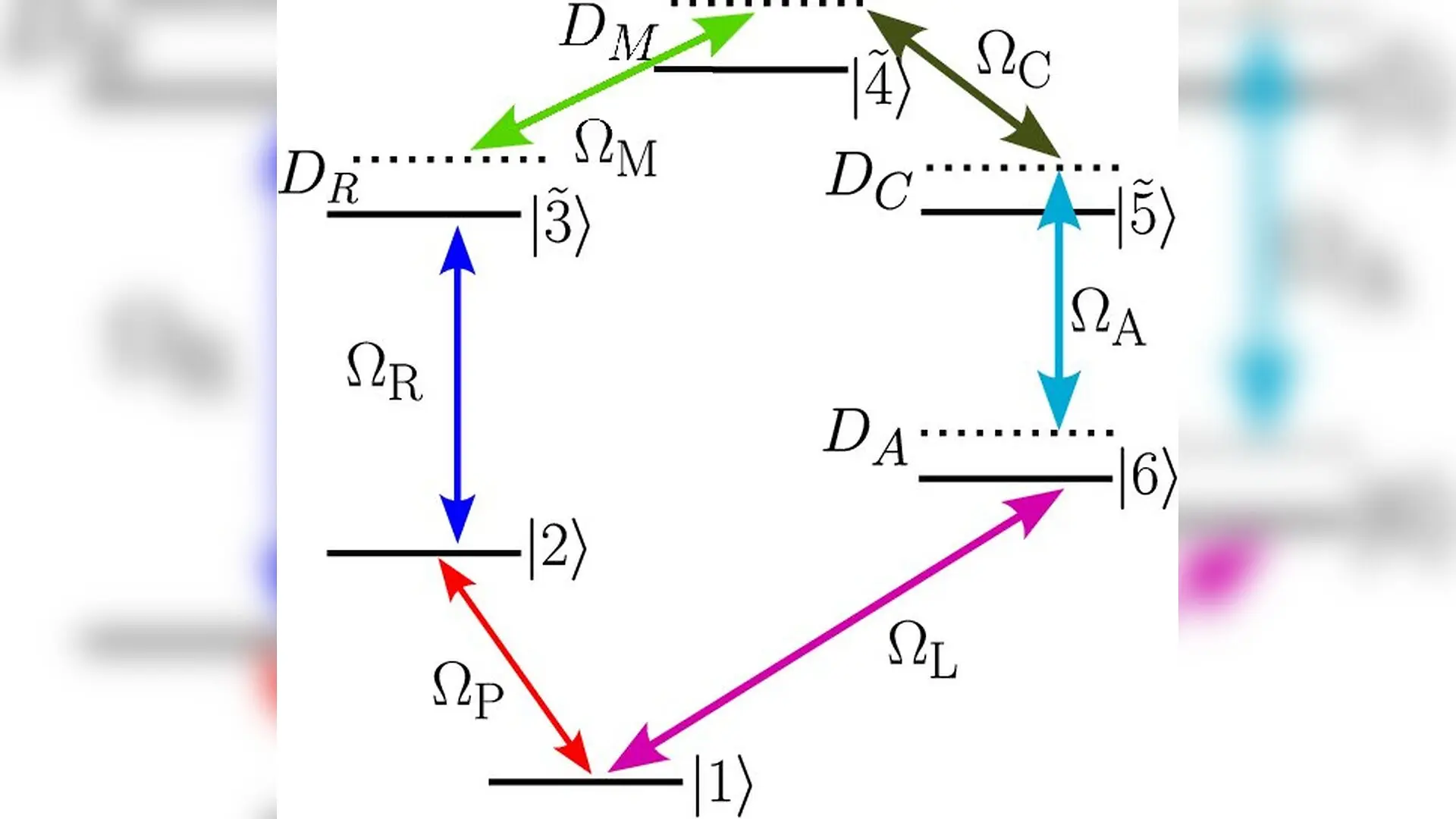
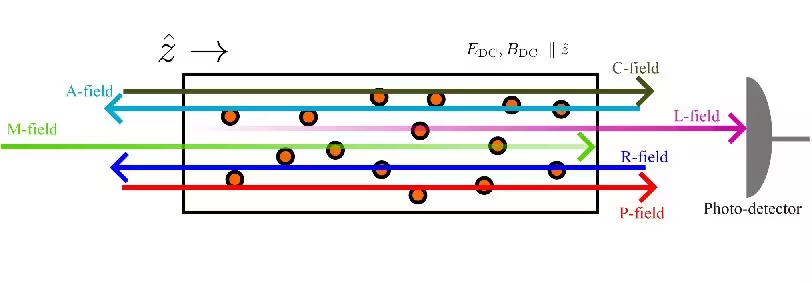
To bypass the heavy cooling requirements of traditional terahertz receivers, the authors modeled a vapor cell heated to 294.15 kelvins, containing rubidium atoms driven into what physicists call Rydberg states. In these elevated energy states, atoms develop an exaggerated electric dipole moment that makes them extraordinarily sensitive to external electric fields. By applying a static electric field along with a precise configuration of pump and coupling lasers, the team established a closed-loop six-wave mixing pathway. This quantum architecture allows incoming terahertz photons to mix with control laser fields and convert coherently into optical photons at a completely different wavelength.
The calculations show that this conversion process avoids the need for a local oscillator operating directly at the 4.7 terahertz input frequency. Instead, the system acts as a lossy frequency converter, transferring incoming radiative power into an outgoing optical field that can be monitored with standard photodetectors. The authors derived the full quantum mechanical behavior of the system using the Gorini-Kossakowski-Sudarshan-Lindblad master equation, factoring in Doppler broadening from the warm vapor and various dephasing mechanisms.
What Are the Performance Limits and Current Hurdles?
When the researchers evaluated the sensitivity of their proposed receiver, they calculated an input-referred noise equivalent power of 15 picowatts per root hertz, yielding an equivalent radiometric sensitivity of roughly 7.72 multiplied by ten to the fifth power in kelvins for a one-second integration time. When benchmarked against an established Schottky-diode space radiometer design that achieves a sensitivity of 25 kelvins, the current Rydberg concept falls significantly short of meeting mission demands. Furthermore, when tested against simulated atmospheric atomic oxygen emission lines, the signal-to-noise ratio yielded a modest value of 1.88 multiplied by ten to the minus third power.
The authors note that this poor performance stems from both a low absolute conversion efficiency and a mismatch between the narrow spectral conversion response of the atomic medium and the broader Gaussian profile of the 4.7 terahertz atomic oxygen line. To overcome these limitations, the team suggests treating the driven atomic vapor as a tunable spectral pre-filter, tailoring laser detunings and Rabi frequencies to maximize overlap with the target emission.
What Happens Next for Quantum Atmosphere Sensors?
Before these room-temperature quantum sensors can be seriously considered for space-borne Earth observation missions, considerable engineering hurdles must be cleared. The system requires exceptionally stable laser sources, rigorous magnetic and electric shielding against stray space radiation, and robust optical alignment across millimeter-scale interaction regions. Future improvements could also involve placing the vapor cell inside a terahertz resonant cavity to enhance field coupling, or utilizing optical heterodyning to detect Doppler shifts that reveal neutral winds in the upper atmosphere. While significant maturation is still required, the study outlines a viable roadmap toward compact, uncooled terahertz radiometry.
The study was posted to the arXiv preprint server on November 17, 2026.
This article has been fact checked for accuracy, with information verified against reputable sources. Learn more about us and our editorial process.
Last reviewed on .
Article history
- Latest version
Reference(s)
- Murchie, Richard J.., et al. “Performance analysis of a Rydberg atom THz radiometer concept.” Sensors, Systems, and Next-Generation Satellites XXX, November 13, 2026, pp. 36 SPIE, doi: 10.1117/12.3116900. <https://doi.org/10.1117/12.3116900>.
Cite this page:
- Posted by Kamran Akhtar