Serotonin Enzyme Drives Dangerous Prostate Cancer Resistance
An existing drug targeting serotonin synthesis suppresses aggressive tumor adaptation and resensitizes resistant cancer cells in laboratory models.
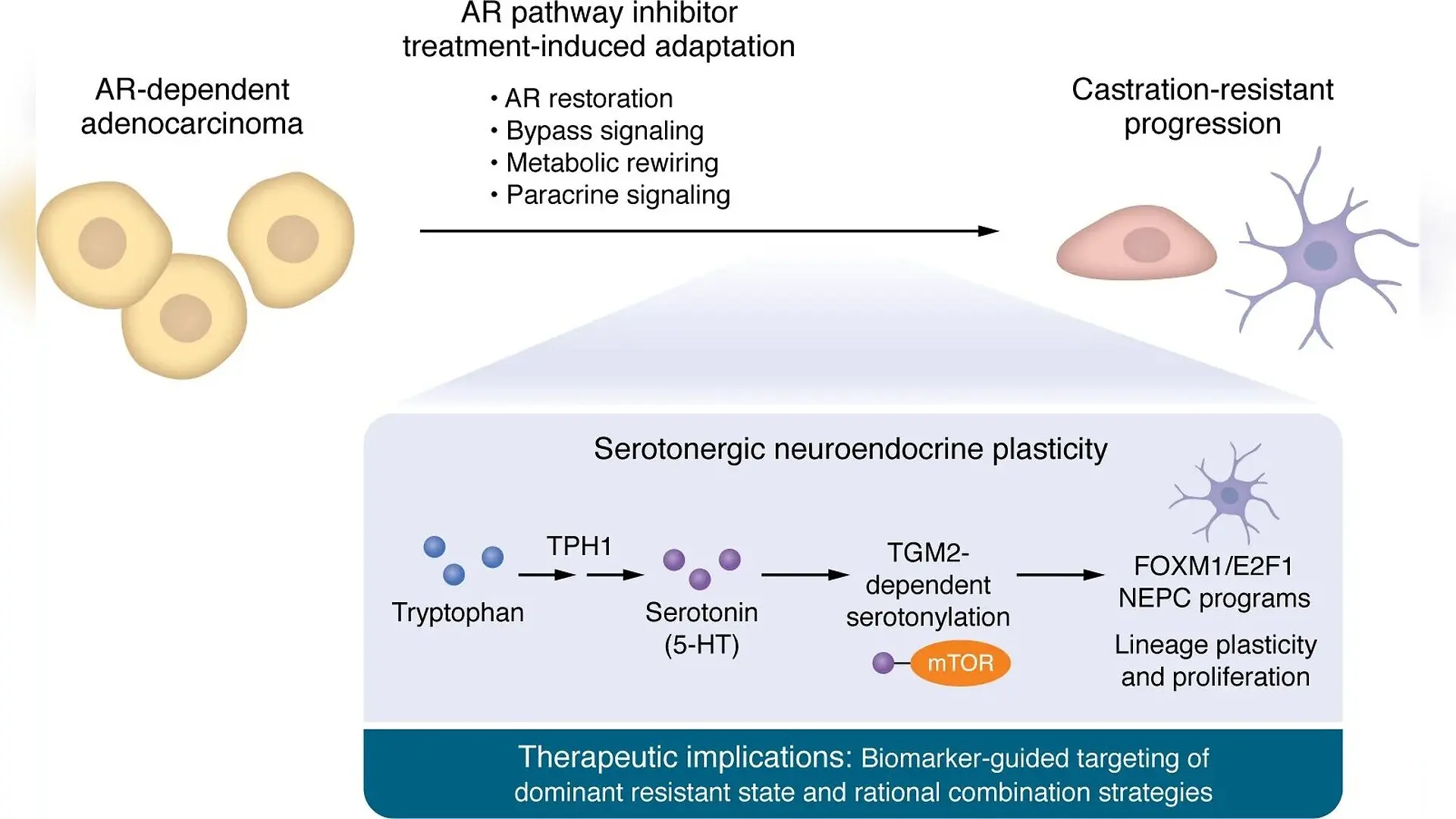
Advanced prostate cancer can escape standard hormone therapies by undergoing a dramatic cellular identity shift, transforming into an aggressive neuroendocrine form that no longer responds to standard treatments. Researchers analyzing this drug-resistance mechanism have found that a key enzyme involved in producing the neurotransmitter serotonin acts as a major metabolic driver for this dangerous transition. The study, published in The Journal of Clinical Investigation in 2026, reveals how metabolic rewiring fuels tumor survival and points toward an existing drug that might block it.
How Prostate Tumors Adapt to Hormone Blockade
Standard treatments for advanced prostate cancer rely on blocking androgen receptors, which are proteins that drive tumor growth in response to male hormones. While these drugs successfully starve the cancer initially, tumor cells frequently adapt by finding ways to bypass the blockade. Some tumors reactivate androgen signaling through mutations, while others undergo lineage plasticity, shedding their original identity to become neuroendocrine prostate cancer, an aggressive and drug-insensitive subtype.
Recent scientific work has shown that these treatment-resistant cancer cells undergo profound metabolic changes to support their new identities. Researchers have previously linked various metabolic pathways, including lipid metabolism and glucose transport, to this therapeutic escape. In this commentary, authors Kevin Holm and Neil A. Bhowmick highlight new findings by Wei and colleagues that place serotonin biosynthesis at the center of this adaptive shift.
The Role of Serotonin and TPH1 in Cancer Plasticity
Outside of the brain, the rate-limiting enzyme responsible for synthesizing serotonin is tryptophan hydroxylase 1, known as TPH1. Wei and colleagues discovered that TPH1 levels are significantly elevated in therapy-induced models of neuroendocrine prostate cancer, genetically driven models, and patient-derived xenograft systems. When the researchers depleted TPH1 in these laboratory models, they observed a sharp suppression in cancer cell proliferation, invasion, sphere formation, and organoid growth.
Rather than working solely through traditional extracellular serotonin receptors, TPH1-derived serotonin operates inside the cell. The study demonstrates that intracellular serotonin supports transglutaminase-dependent serotonylation, a chemical modification of the mTOR protein at a specific site designated as Gln2453. This modification enables mTOR activation and triggers downstream growth and lineage-control programs driven by FOXM1 and E2F1.
Testing an Existing Drug Against Resistant Cancer Cells
To explore potential clinical interventions, the researchers tested LX1606, also known as telotristat ethyl, an existing TPH1 inhibitor that has limited penetration across the blood-brain barrier. TPH1-high prostate cancer cells proved significantly more sensitive to the compound, showing up to 80 percent lower IC50 values compared to TPH1-low cells. Treatment with LX1606 successfully reduced the serotonylation rate in these cells.
Furthermore, testing in drug-resistant human prostate cancer cells showed that LX1606 resensitized the cells to the anti-cancer medication enzalutamide, increasing the expression of prostate-specific antigen proteins. Validations in xenograft mouse models revealed substantial reductions in tumor volume, serotonin levels, and neuroendocrine marker expression without significant changes in body weight or liver and kidney pathology.
Challenges and Path Forward for Clinical Translation
Because LX1606 is already approved in adults for treating carcinoid syndrome diarrhea that is inadequately controlled by somatostatin analog therapy, the findings provide a direct translational bridge from basic mechanism to potential clinical intervention. However, repurposing the drug for prostate cancer patients will require careful biomarker development, as standard blood tests and prostate-specific antigen levels alone are poorly suited to detect lineage conversion.
The authors note that tracking the primary urinary serotonin metabolite, 5-hydroxyindoleacetic acid, alongside biopsy confirmation of neuroendocrine prostate cancer could help guide future clinical trials. Determining which patients rely heavily on this serotonin-dependent axis will be essential for successfully combining TPH1 inhibitors with existing anti-cancer therapies.
The research was published in The Journal of clinical investigation on November 16, 2026.
This article has been fact checked for accuracy, with information verified against reputable sources. Learn more about us and our editorial process.
Last reviewed on .
Article history
- Latest version
Reference(s)
- Holm, Kevin., et al. “Serotonin biosynthesis emerges as a metabolic driver in prostate cancer therapy resistance.” Journal of Clinical Investigation, vol. 136, no. 22, November 16, 2026 American Society for Clinical Investigation, doi: 10.1172/JCI210677. <https://doi.org/10.1172/JCI210677>.
Cite this page:
- Posted by Elizabeth Taylor