Malaria Parasite Analysis in India Reveals Surprising Resistance Markers
A new study of 93 clinical samples points to high frequencies of drug resistance mutations in southwestern India.

A new genetic analysis of 93 malaria blood samples collected from adults in southwestern India reveals a high frequency of drug resistance markers in the parasite published in PLOS One. The findings offer a detailed look at how the parasite that causes vivax malaria adapts to regional treatments and indirect drug pressures.
What the Genetic Analysis of 93 Samples Revealed
Researchers collected clinical samples from symptomatic adult patients across three hospital sites in the Udupi and Mangaluru districts of Karnataka between July 2021 and September 2024. They targeted specific genes associated with resistance to standard antimalarial medications, including chloroquine and sulfadoxine-pyrimethamine. The work provides a snapshot of genetic variants circulating in a tropical coastal environment where seasonal monsoons create prime breeding conditions for mosquitoes.
In the chloroquine resistance transporter gene, known as Pvcrt-o, the team identified a K10 insertion in 25.81 percent of the samples. Meanwhile, analysis of the multidrug resistance protein 1 gene, or Pvmdr1, showed near-universal presence of the M908L mutation at 100 percent. Other mutations in that same gene, such as T958M and F1076L, appeared in 86.02 percent and 84.94 percent of the cases, respectively. A rare mutation called Y976F, which has previously been linked in laboratory studies to reduced chloroquine susceptibility, turned up in just 2.15 percent of the samples.
Why Antifolate Resistance Markers Appear Without Direct Treatment
The study also examined genes related to antifolate drugs, which are medications that block folic acid synthesis in parasites. For the Pvdhfr gene, researchers found that double mutant combinations such as S58R and S117N were present in 56.98 percent of the cases. For the Pvdhps gene, wild-type sequences made up 66.67 percent of the samples, though specific double mutants combining A383G and A553G were found exclusively in the Udupi region at a rate of 10.8 percent.
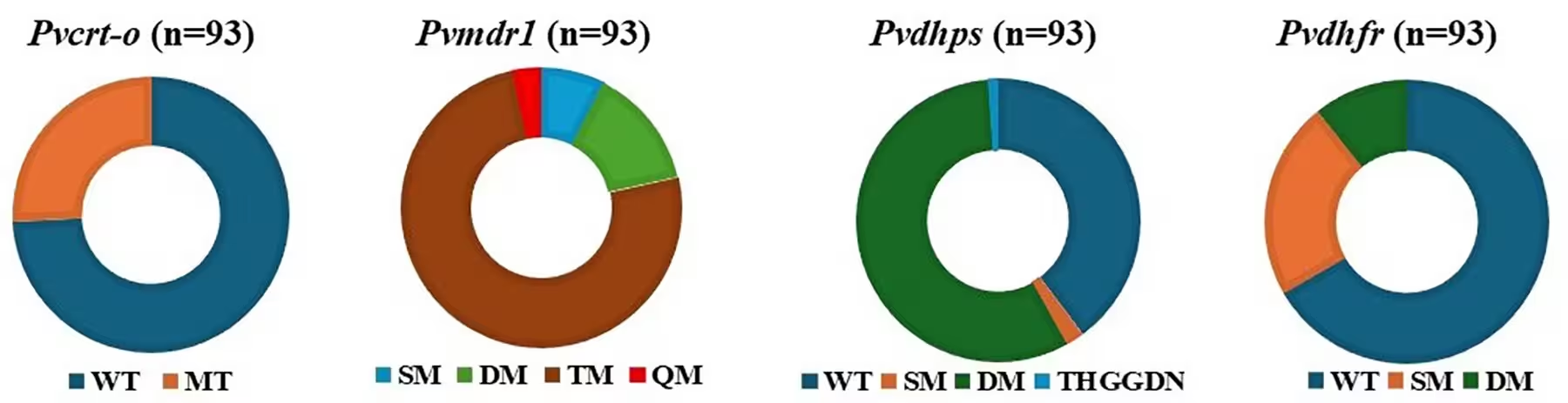
Because sulfadoxine-pyrimethamine is not the primary treatment for vivax malaria, the authors noted that these antifolate mutations likely persist due to indirect drug pressure. When doctors treat patients for falciparum malaria using artemisinin-based combination therapies that include sulfadoxine-pyrimethamine, overlapping parasite populations of Plasmodium vivax are inadvertently exposed. This collateral selection helps drive the survival and spread of resistant genotypes in co-endemic regions.
What These Molecular Patterns Mean for Future Public Health Policy
The authors emphasized that identifying these molecular markers does not prove clinical treatment failure or complete chloroquine resistance in the region. Instead, the genetic variants serve as an early warning system indicating potential reductions in therapeutic efficacy. The detection of distinct geographic clustering, such as the localized presence of certain double mutants in Udupi, points to the importance of fine-scale mapping rather than relying on a single national estimate for drug resistance.
The research team acknowledged several limitations, including a relatively modest sample size restricted to two districts and a lack of standardized therapeutic efficacy testing or laboratory drug-susceptibility assays. They concluded that continuous molecular monitoring, broader geographic sampling, and functional validation of novel mutations will be essential to guide rational treatment policies and protect India’s progress toward malaria elimination.
The research was published in PLOS One on November 17, 2026.
This article has been fact checked for accuracy, with information verified against reputable sources. Learn more about us and our editorial process.
Last reviewed on .
Article history
- Latest version
Reference(s)
- Nallapati, Vishnu Teja., et al. “Molecular surveillance of resistance mutations in Plasmodium vivax clinical samples from southwestern India.” PLOS One, vol. 21, no. 11, November 17, 2026, pp. e0362585 Public Library of Science (PLoS), doi: 10.1371/journal.pone.0362585. <https://doi.org/10.1371/journal.pone.0362585>.
Cite this page:
- Posted by Elizabeth Taylor