Diversity Preservation Rescues Hidden DNA Motifs From Crowded Genetic Landscapes
A quality-diversity search framework outperforms standard elitist baselines by maintaining behavioral archives of variable-length DNA patterns.
Computers hunting for genetic control tags in human DNA often stumble when multiple proteins share nearly identical binding preferences, but a computational strategy that preserves behavioral diversity rather than converging on a single solution can successfully recover hidden patterns.
Transcription factors are specialized proteins that bind to short stretches of DNA to regulate gene activity across the genome. Identifying these binding sites, known as motifs, usually relies on scanning sequences retrieved from laboratory experiments such as chromatin immunoprecipitation followed by sequencing, known as ChIP-seq. Traditional algorithms typically output a single top-ranked motif candidate, an approach that functions adequately when a protein possesses one unique binding preference. However, this strategy often collapses when target proteins compete with close relatives or paralogs that recognize nearly indistinguishable sequences.
How Variable Lengths and Evolutionary Niches Change Genetic Searches
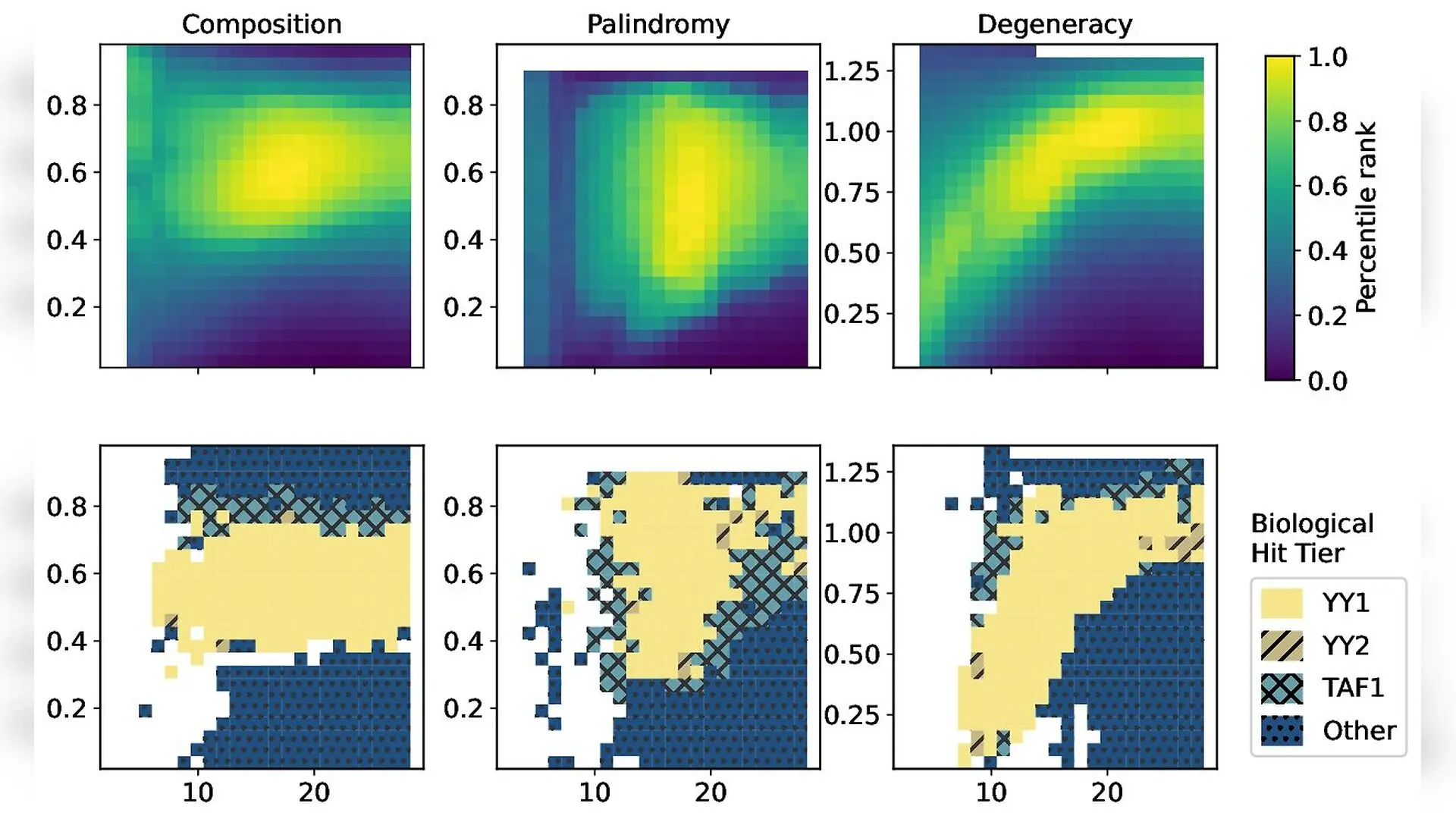
To overcome the challenge of unknown motif lengths and crowded competition landscapes, researchers Alejandro Medina and Mary Lauren Benton from Baylor University tested an algorithm called MAP-Elites, a quality-diversity optimization framework. Their study is published in arXiv. Instead of driving an entire population of digital candidates toward a single peak of mathematical fitness, quality-diversity algorithms divide a multi-dimensional behavioral space into a grid of cells, ensuring that unique structural variations survive even if their raw fitness scores are slightly lower than the dominant optimum.
The authors designed a variable-length motif genotype where an evolvable gate controls how much of a 30-position array is expressed. This setup allows candidate motifs of different lengths to compete within the same archive. Every generated motif was validated against the HOCOMOCO database using the TomTom comparison tool to check whether the search successfully isolated the true target protein rather than a confusing structural relative.
Comparing Diversity Preservation Against Traditional Elitist Baselines
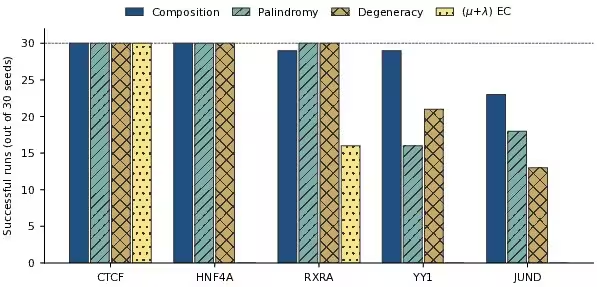
The team tested their approach on five human liver ChIP-seq datasets spanning complex confounder landscapes, including datasets for CTCF, JUND, YY1, HNF4A, and RXRA. To measure the exact contribution of diversity preservation, they compared MAP-Elites against a standard elitist evolutionary algorithm with identical settings except for survivor selection. Both methods evaluated 512 candidates per iteration over 5,000 generations.
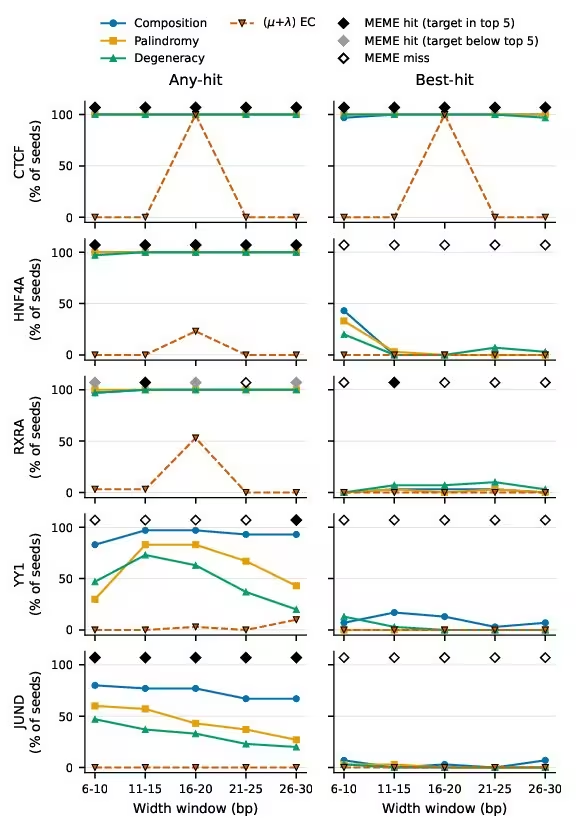
The results reveal a stark contrast between convergence and niche maintenance. The elitist baseline successfully solved the CTCF dataset where a single dominant preference exists, but completely failed to produce a correct best-hit on datasets like HNF4A, YY1, and JUND across all 30 random seeds. In contrast, the MAP-Elites archives successfully produced a best-hit in at least 13 of 30 seeds on every tested dataset, demonstrating robust performance even when faced with crowded family clusters.
What Happens When Search Archives Face Crowded Protein Families
While diversity preservation successfully rescued target signals where standard algorithms collapsed, the experiments also exposed persistent limitations in automated motif annotation. On difficult datasets involving nuclear receptors such as HNF4A and RXRA, both MAP-Elites and the established motif discovery tool MEME frequently ranked close relatives ahead of the exact target. This occurs because evolutionarily related proteins share highly overlapping binding domains that read nearly identical DNA sequences.
The authors suggest that while fitness optimization successfully points to the correct genomic region, distinguishing between closely related paralogs remains an open challenge for sequence-only computational tools. Future developments in computational genomics will likely focus on designing specialized behavioral descriptors and expanding benchmark evaluations across diverse biological tissues and organisms.
The study was posted to the arXiv preprint server on November 16, 2026.
This article has been fact checked for accuracy, with information verified against reputable sources. Learn more about us and our editorial process.
Last reviewed on .
Article history
- Latest version
Reference(s)
- Medina, Alejandro. “Diversity Preservation Recovers Transcription Factor Motifs Across Challenging Confounder Landscapes.” arXiv.org <http://arxiv.org/abs/2611.21859v1>.
Cite this page:
- Posted by Faisal Qureshi