Massive Galaxy Cluster Analysis Tests General Relativity Across Billions of Light-Years
Astronomers analyzed over 85,000 galaxy clusters to measure cosmic growth, finding strong agreement with standard gravity.
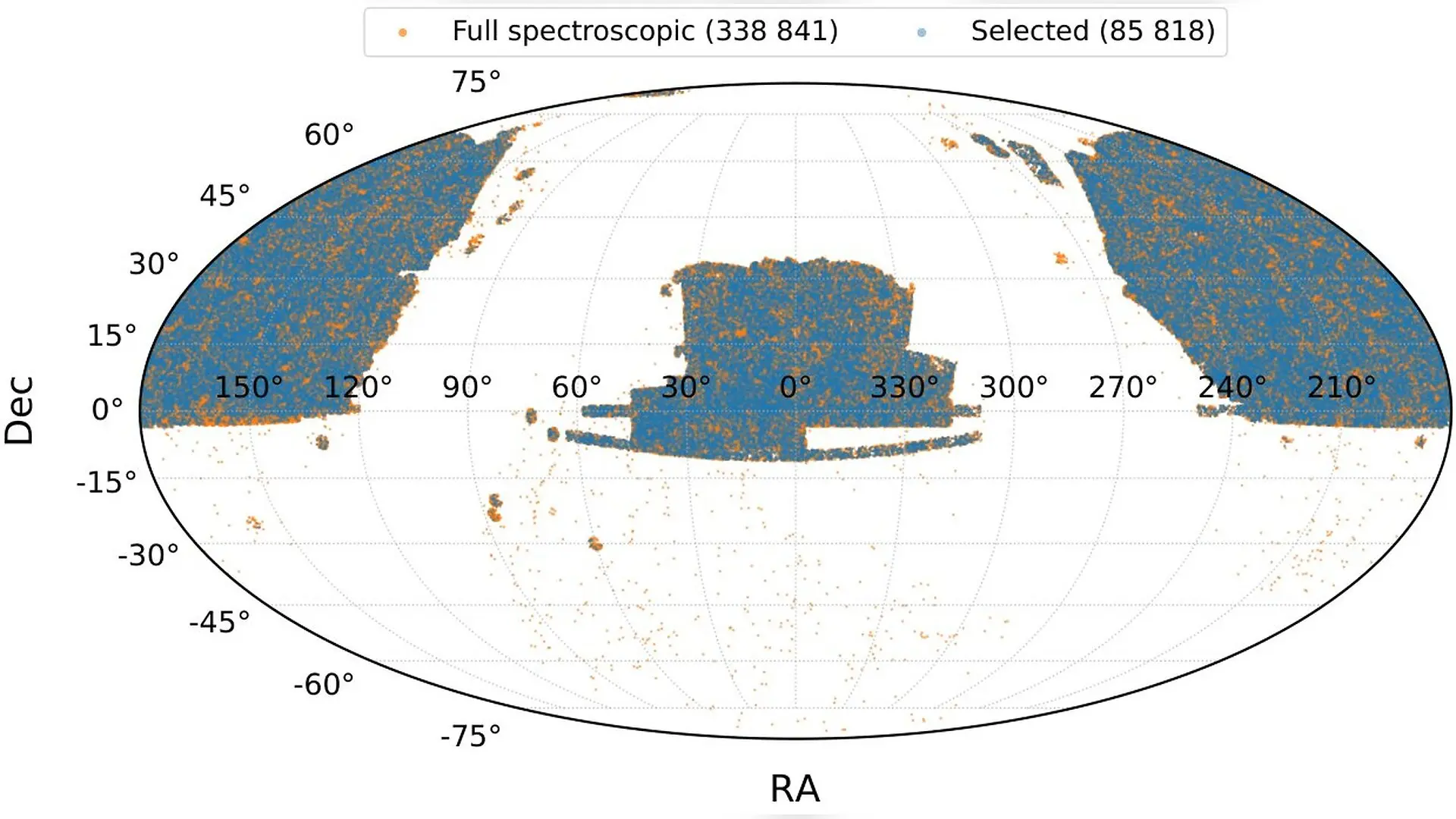
Astronomers analyzing 85,818 massive galaxy clusters have found that cosmic structure growth aligns closely with Albert Einstein’s theory of general relativity. The research centers on the cosmic web’s largest nodes across a spatial volume spanning billions of light-years, where researchers mapped the clustering patterns of clusters located between 1.3 and 4.3 billion light-years from Earth.
General relativity links gravity to the geometry of spacetime, but scientists have long investigated whether cosmic acceleration, often attributed to dark energy, requires modifications to gravity on vast cosmic scales. Galaxy clusters serve as ideal laboratories for these tests because their massive gravitational pull dictates how matter accumulates at the extreme high-mass end of cosmic structure formation. By measuring how these giant structures clump together across space, the team evaluated whether gravity behaves as predicted by standard cosmological models.
The analysis relied on a spectroscopic subsample drawn from a massive cluster catalog constructed using optical photometry from the DESI Legacy Imaging Surveys, combined with infrared data from unWISE and spectroscopic redshifts from multiple astronomical archives. The researchers selected clusters within a redshift range of 0.1 to 0.4 and richness thresholds ensuring robust mass estimates. To perform the measurement, the authors used the Landy-Szalay estimator to compute the monopole and quadrupole moments of the redshift-space two-point correlation function over comoving separations ranging from 10 to 150 megaparsecs, which correspond to tens of millions of light-years. The study is published on the arXiv preprint server.
How Galaxy Cluster Clustering Tests Gravity
To extract cosmological insights from cluster positions, the team developed specialized random catalogs and modeled the effective halo bias, which describes how clusters trace invisible clumps of dark matter. They accounted for observational selection effects by reconstructing the survey angular footprint and estimating radial selection functions directly from the data. The researchers then used a one-loop perturbation-theory model implemented in the velocileptors software package to jointly constrain the product of the linear growth rate and matter fluctuations, alongside geometric distortions known as Alcock-Paczynski parameters.
Under their fiducial configuration, which included baryon acoustic oscillation scales and broad geometric priors, the authors report a growth rate constraint of $f\sigma_8 = 0.45 \pm 0.08$ at an effective redshift of approximately 0.28. When the team applied tighter geometric priors and restricted the fitting range to exclude baryon acoustic oscillation scales, the growth rate measurement shifted to $0.52 \pm 0.03$, improving the precision to about 6 percent. Both outcomes show strong consistency with the standard Lambda cold dark matter cosmological model powered by general relativity.
Understanding Residual Anomalies and Model Limits
Despite the overall agreement with standard physics, the team identified subtle quirks in the data, including a coherent negative offset in the quadrupole measurement at separations exceeding 33 megaparsecs. Statistical tests using mock galaxy catalogs indicated that this deviation carries a modest significance of about 2.7 standard deviations, though it does not invalidate the broader cosmological conclusions. The researchers also tested alternative assumptions about quadratic halo bias, finding that fixing the bias to theoretical expectations slightly alters the inferred growth rate while maintaining overall consistency with general relativity.
Looking ahead, upcoming astronomical facilities will dramatically expand our view of the cosmos. Forthcoming photometric cluster samples from the Euclid space mission and the Vera C. Rubin Observatory will identify millions of galaxy clusters across wider and deeper cosmic volumes. Furthermore, proposed wide-field spectroscopic telescopes will gather spectra for vastly more clusters, allowing astronomers to trace structure growth across cosmic time with unprecedented precision and resolve lingering questions about the behavior of gravity on universal scales.
The study was posted to the arXiv preprint server on November 17, 2026.
This article has been fact checked for accuracy, with information verified against reputable sources. Learn more about us and our editorial process.
Last reviewed on .
Article history
- Latest version
Reference(s)
- Tsaprazi, Eleni. “Testing general relativity with galaxy cluster clustering from the DESI Legacy Imaging Surveys.” arXiv.org <http://arxiv.org/abs/2611.23104v1>.
Cite this page:
- Posted by Karan Das