Black Hole Ringdown Math Reveals Surprising Limits on Gravitational Waves
New research shows that mathematical wave sums can converge before signals even reach an observer, redefining how astrophysicists model black hole mergers.
When two massive black holes collide and merge, the resulting spacetime shudders, releasing gravitational waves that carry signatures of the newly formed remnant. Researchers analyzing these ripples often model the final stage, known as the ringdown, as a sum of damped oscillations called quasinormal modes. While adding more of these modes helps match computer simulations, a fundamental mathematical question has long remained about whether and when this series actually converges to the true physical response. A team of astrophysicists has now mapped out exact geometric limits governing when these sums become valid for spinning black holes.
The study, available on the arXiv preprint server, demonstrates that the convergence of these mode expansions is governed by a fierce competition between temporal decay and exponential amplitude growth. As individual modes are heavily damped, they fade away faster in time, but their mathematical amplitudes grow rapidly depending on the positions of both the source and the observer. The authors Davide Ciattaglia, Adrien Kuntz, and Enrico Barausse discovered that for a rotating black hole, known mathematically as a Kerr black hole, this breaking point carries a precise geometric meaning tied to specific bounce surfaces located near the event horizon.
Decoding the Mathematics of Rotating Spacetime
To understand why quasinormal mode sums can fail or succeed, physicists examine the retarded Green function, which describes how a disturbance travels from an impulse point to an observer. For a non-rotating Schwarzschild black hole, this convergence boundary forms a neat sphere located at a characteristic radius where mode amplitudes reach a minimum. Rotation complicates this picture significantly by coupling the radial and angular motions of the perturbations, splitting the modes into two distinct families.
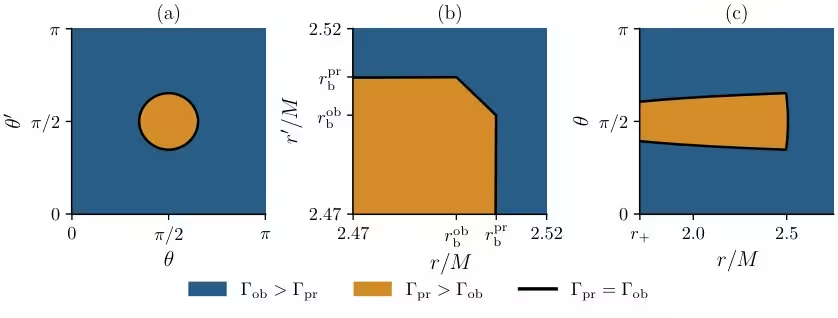
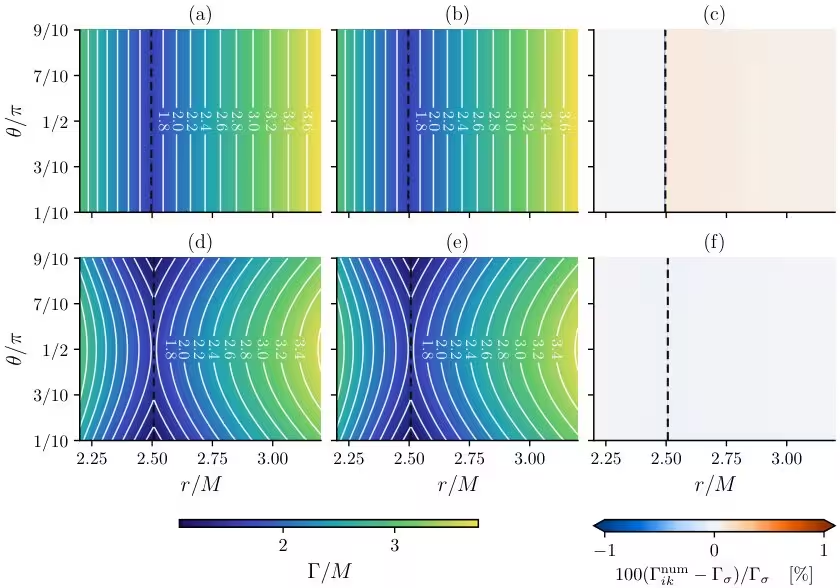
The researchers found that these two families, termed prolate and oblate modes, behave entirely differently under extreme damping. Prolate modes concentrate tightly around the equatorial plane, while oblate modes oscillate across the entire sphere of the black hole. Because of these distinct behaviors, the bounce radius expands into complex angle-dependent bounce surfaces. For a black hole with a spin parameter of $a/M = 0.7$, the team mapped these spatial dependencies and confirmed their analytical predictions against high-precision numerical computations to an accuracy better than one percent.
Why Convergence Timing Defies Common Intuition
One of the most striking findings of the work is that the mathematical convergence threshold does not necessarily coincide with the arrival of the first causal light ray. Depending on the angular position of the observer relative to the source, the quasinormal mode sum can reach absolute convergence before any physical signal even reaches the detector. For instance, in specific test scenarios examined by the authors, the convergence criterion is met at $0.78M$ after the event, whereas the causal lower bound for light arrival sits at $1.8M$.
This occurs because the spatial growth rate of the mode amplitudes is governed by special null rays traveling along the rotation axis for oblate modes and along the equatorial plane for prolate modes. The mathematical threshold requires that the elapsed time between source emission and observation exceeds a specific geometric quantity determined by the optical distances from these bounce surfaces. When observers or sources sit outside the prolate bounce radius, oblate modes ultimately dictate the overall convergence timeline.
Implications for Gravitational Wave Astronomy
As gravitational wave detectors grow increasingly sensitive, analyzing high-overtone quasinormal modes has become a central strategy for testing general relativity and probing the geometry of black hole remnants. However, if analysts include overtones too early in the signal waveform, before the mathematical sums have actually converged, the resulting parameter estimations can be biased or contaminated by unmodeled transient effects.
By establishing clear geometric limits for when these expansions hold true, the new framework provides theoretical grounding for analyzing ringdown data from loud events like GW250114. Future work will focus on extending these impulse-response findings to physical, extended sources such as plunging matter, helping researchers push the validity of black hole spectroscopy closer to the peak of the gravitational wave signal.
The study was posted to the arXiv preprint server on November 17, 2026.
This article has been fact checked for accuracy, with information verified against reputable sources. Learn more about us and our editorial process.
Last reviewed on .
Article history
- Latest version
Reference(s)
- Ciattaglia, Davide. “Convergence of the quasinormal-mode expansion of the Kerr Green function.” arXiv.org <http://arxiv.org/abs/2611.23110v1>.
Cite this page:
- Posted by Nida Rehman