Why Science Says Cold Has A Hard Limit Even If The Universe Is Infinite
Absolute zero sets an ultimate limit on cold. Discover why cosmic radiation continues to cool and if the universe can ever truly reach zero kelvin.
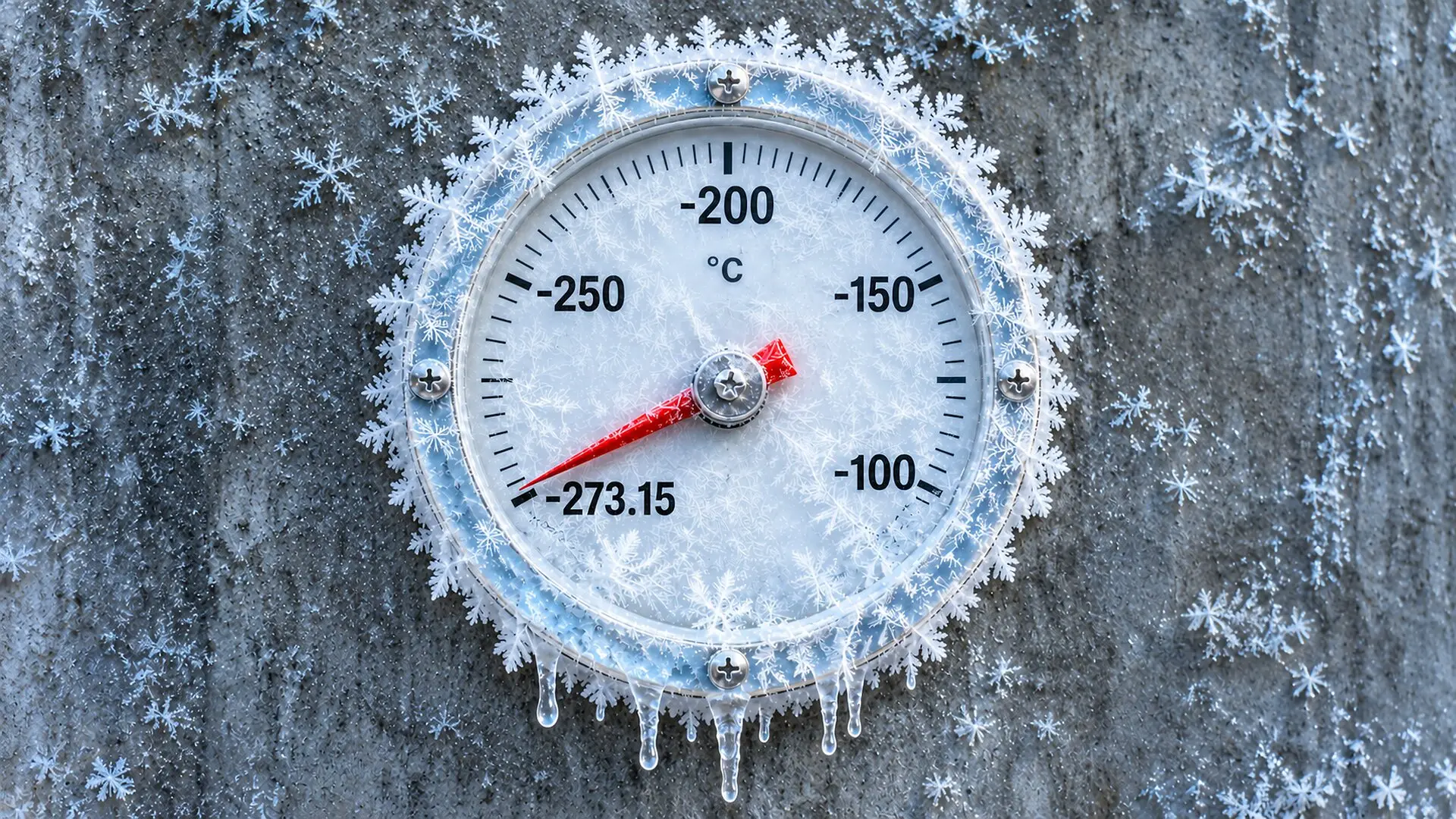
We rely on freezers to preserve food and industrial cryogenics to push the boundaries of physics, but a fundamental question persists: why can’t we simply keep cooling things indefinitely? While our number system stretches toward negative infinity, the physical reality of temperature is governed by a strict, non-negotiable floor known as absolute zero.
Set at −273.15 degrees Celsius (−459.67 degrees Fahrenheit), or 0 kelvin, absolute zero represents the state where a system reaches its minimum possible energy. Contrary to popular belief, it does not imply a total cessation of all activity. Instead, it marks the point where thermal energy—the chaotic, heat-driven movement of atoms—is entirely stripped away, leaving only the fundamental quantum motion inherent to the ground state.

The Physics of the Energy Floor
To understand why cooling stops at this threshold, one must view temperature as an energy extraction process. A refrigerator works by moving energy from an interior space to the warmer surroundings; it does not “inject” cold. By removing thermal energy, a system is nudged closer to its ground state. However, quantum mechanics dictates that a system can only exist in permitted energy states. Just as you cannot descend a staircase that has no steps below the bottom, a refrigerator cannot extract energy from a system that has already reached its lowest allowable state.
This reality was first hinted at by 18th-century physicist Guillaume Amontons, who observed that the pressure of a gas drops as it cools. By plotting these trends, scientists extrapolated that pressure would theoretically hit zero at a specific temperature. Later, Lord Kelvin formalized this into the absolute temperature scale we use today. While exotic “negative temperature” states can be achieved in specialized lab environments, these systems actually represent a population inversion—where higher energy states are more occupied than lower ones—making them technically hotter, not colder, than any positive-temperature system.

The Unattainability Principle
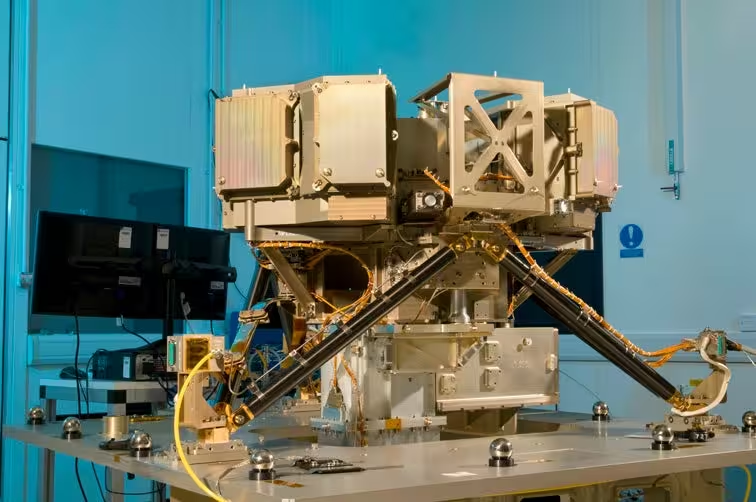
Even though we know where the boundary sits, the third law of thermodynamics creates a barrier to reaching it. Through finite physical processes, it is impossible to extract the final remnants of entropy to reach 0 K. We can approach it with incredible precision, as evidenced by researchers using ultracold atoms or the James Webb Space Telescope’s Mid-Infrared Instrument, which operates below 7 K, but we can never arrive at the destination.
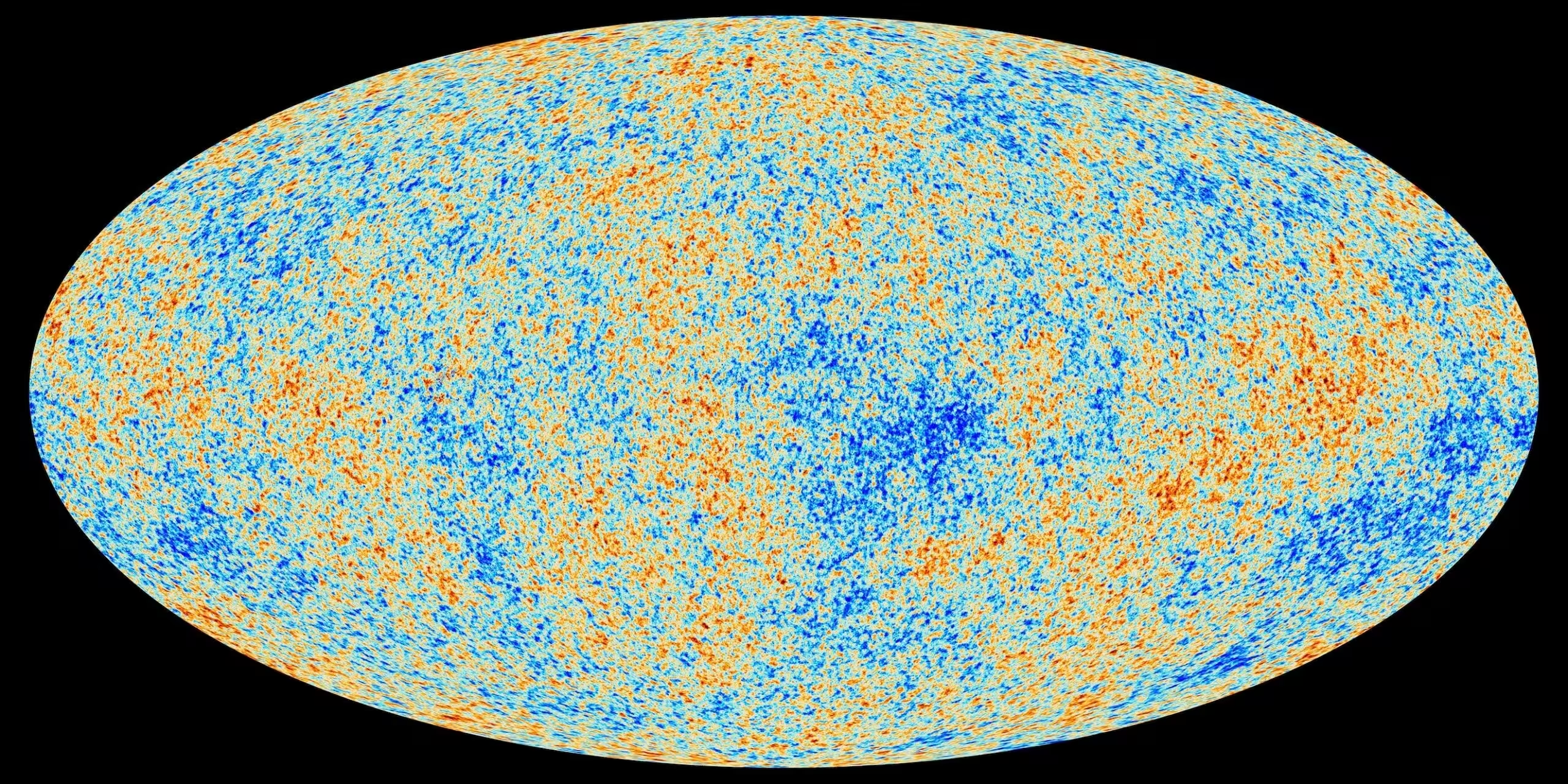
Interestingly, the universe itself is engaged in a massive cooling operation. The expansion of space acts as a cosmic refrigerator, stretching the wavelengths of the cosmic microwave background (CMB). As the fabric of space expands, the energy of these photons decreases, effectively lowering the background temperature of the cosmos. Yet, even in this grand expansion, the temperature asymptotically approaches zero without ever touching it. Every time the universe doubles in size, the temperature halves, but like the mathematical paradox of Zeno’s arrow, the distance to the floor remains unbridged.

A Complex Future
The long-term thermal fate of the universe is further complicated by the presence of dark energy. Research by Gary Gibbons and Stephen Hawking suggests that an accelerating universe creates a cosmic event horizon, which carries its own inherent temperature. If dark energy remains constant, the universe may not fade into a absolute-zero void, but rather stabilize at a low, nonzero temperature dictated by this horizon.
While heating theoretically lacks a known ceiling—at least until we reach the enigmatic Planck temperature where current physics breaks down—cold has a definitive, iron-clad boundary. We live in a universe where the floor is fixed, but the path toward it is infinite, ensuring that while the cosmos may continue to grow colder, it will never be truly “finished” with the process.
This article has been fact checked for accuracy, with information verified against reputable sources. Learn more about us and our editorial process.
Last reviewed on .
Article history
- Latest version
Reference(s)
- Gibbons, G. W.., et al. “Cosmological event horizons, thermodynamics, and particle creation.” Physical Review D, vol. 15, no. 10, May 15, 1977, pp. 2738-2751. American Physical Society (APS), doi: 10.1103/PhysRevD.15.2738. <https://journals.aps.org/prd/abstract/10.1103/PhysRevD.15.2738>.
Cite this page:
- Posted by Aisha Ahmed