Physicists Propose Five Dimensional Black Holes Could Solve The Dark Matter Mystery
New calculations suggest that primordial black holes existing in a five-dimensional universe could provide a key explanation for dark matter and neutrinos.
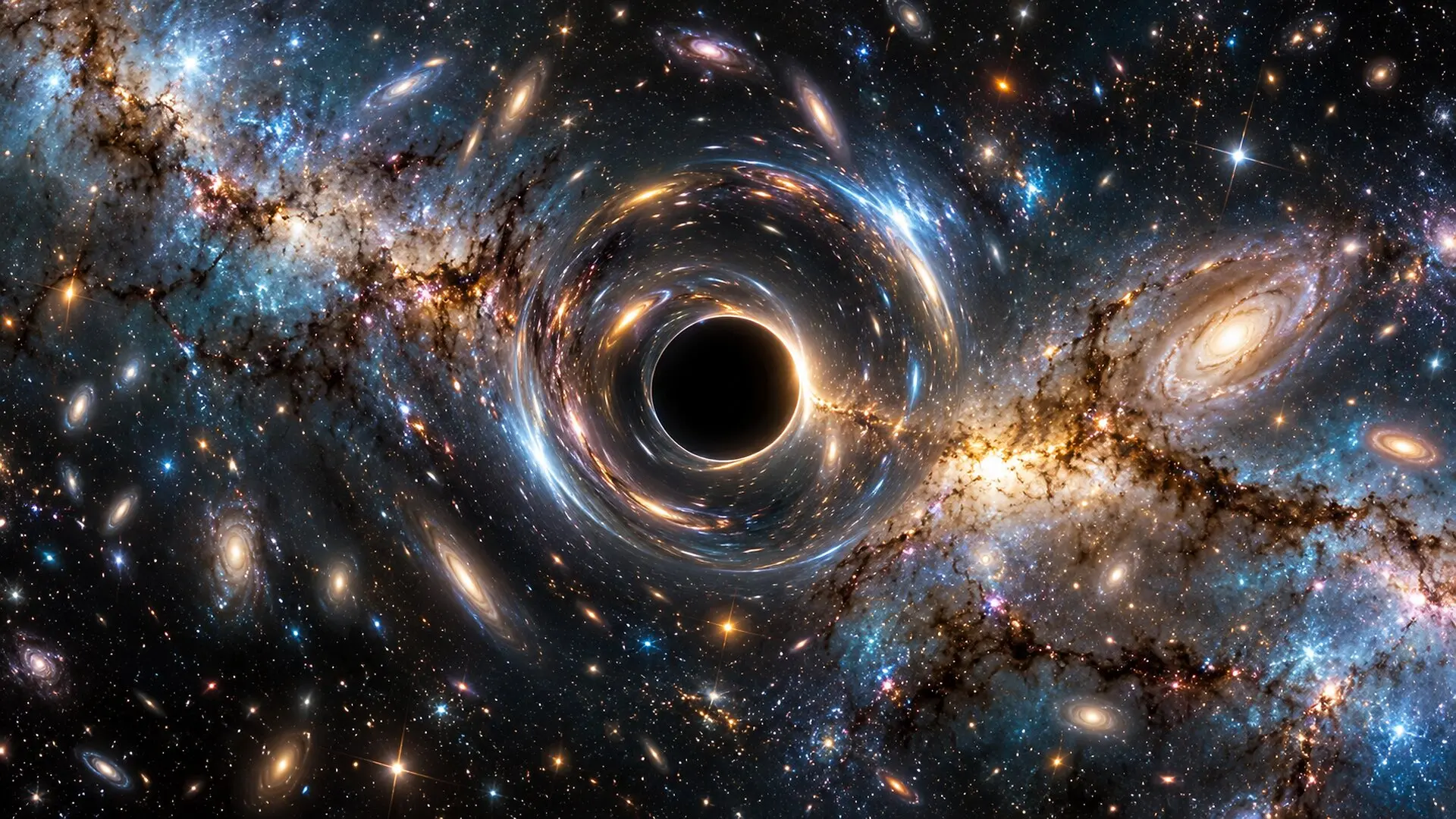
A fresh theoretical framework suggests that the early universe may have birthed five-dimensional black holes, a concept that could reshape our understanding of dark matter and high-energy cosmic phenomena. By incorporating a hidden extra spatial dimension, researchers have modeled how these ancient gravitational anomalies might have persisted far longer than their four-dimensional counterparts.
The study, published in Physical Review D, is the work of Luis Anchordoqui of Lehman College and the CUNY Graduate Center, Alek Bedroya of Princeton University, and Dieter Lüst of the Max Planck Institute for Physics and Ludwig Maximilian University of Munich. While the research provides a sophisticated look at the “dark dimension” scenario, the authors emphasize that this remains a mathematical model rather than an observation of physical objects.
Gravity in the Dark Dimension
In our standard model of the universe, spacetime consists of three spatial dimensions and one temporal dimension. The dark dimension proposal introduces a fifth dimension, roughly one micron in size, where gravity can exert influence. While ordinary matter is confined to our familiar four-dimensional spacetime, gravity’s ability to permeate this extra spatial layer alters how small black holes might form and evolve.
The concept relies on quantum gravity principles developed by researchers including Miguel Montero, Cumrun Vafa, and Irene Valenzuela. Their work explores theoretical frameworks that satisfy consistency requirements for quantum gravity, specifically postulating that a “dark dimension” may exist as a feature of the cosmic architecture.
From Cosmic Strings to Five-Dimensional Structures
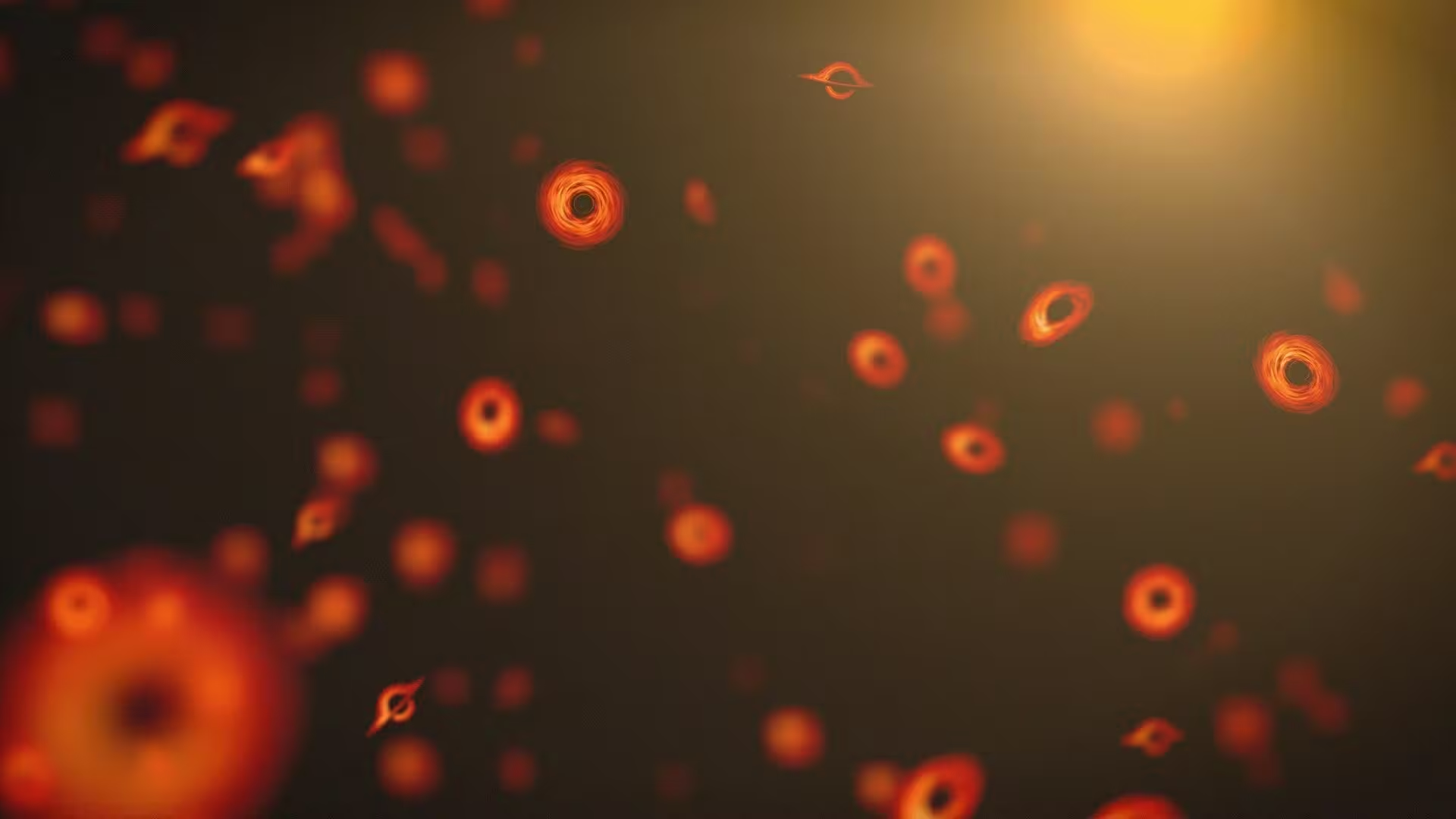
Primordial black holes (PBHs) differ significantly from the stellar-mass black holes created by collapsing stars today. If they formed shortly after the Big Bang, they would have emerged from regions of intense density. The researchers examined three primary formation theories—inflation, phase transitions, and cosmic strings—while noting that the inflation model faces tension with their specific quantum-gravity constraints.
When investigating phase transitions, the team discovered that black holes might initially appear as four-dimensional, only to evolve into five-dimensional configurations due to the Gregory–Laflamme instability as the surrounding space shifts. Conversely, black holes formed from the collapse of cosmic-string loops are projected to emerge as five-dimensional from their inception, regardless of when the extra dimension stabilizes.
Extended Lifetimes and Cosmic Signals
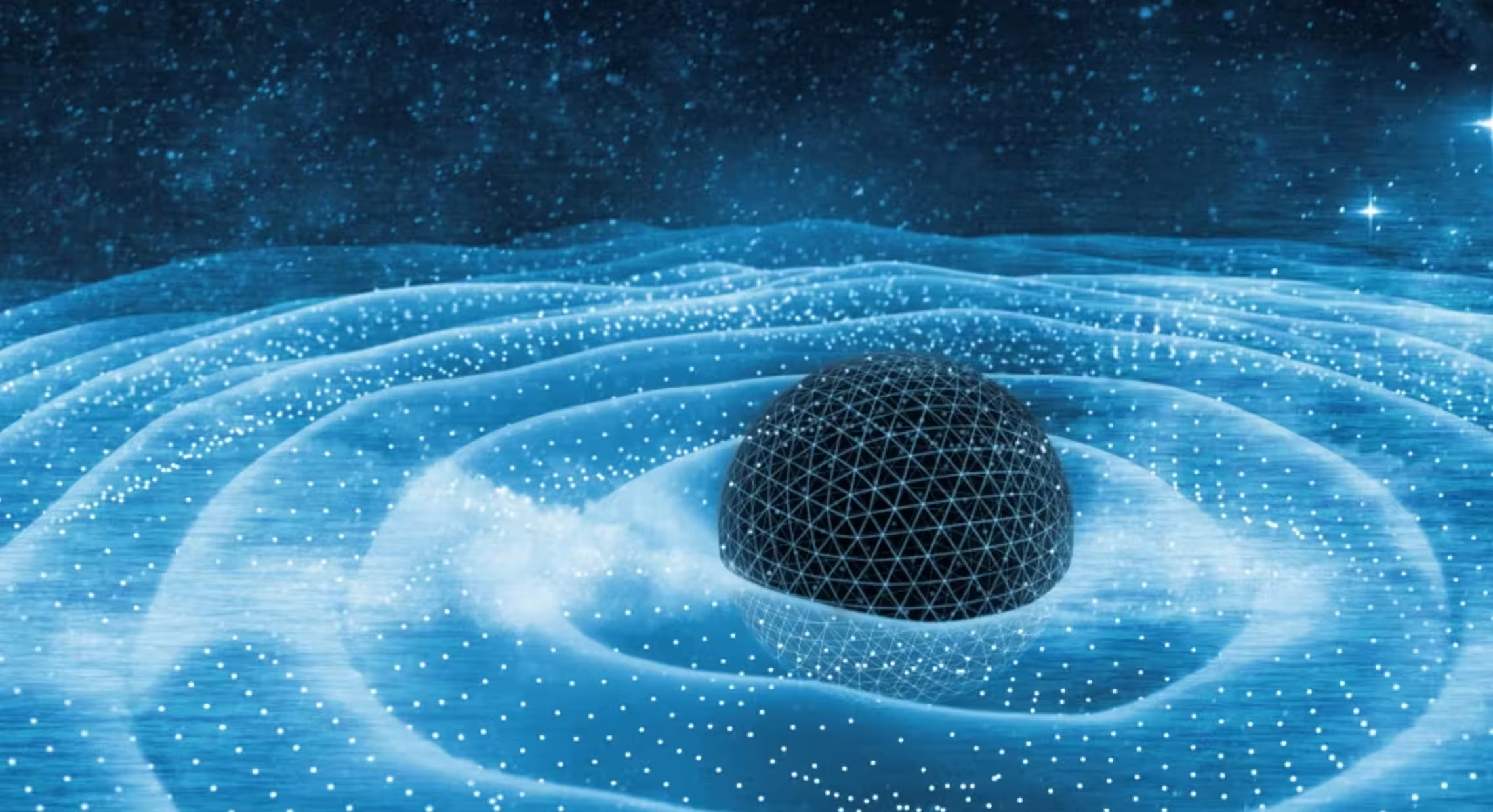
According to Hawking radiation, black holes gradually lose mass and evaporate. Crucially, the researchers found that five-dimensional black holes in this model are generally larger and colder than standard four-dimensional ones, leading to significantly longer lifespans. Some of these objects could theoretically survive for trillions of years, potentially serving as candidates for dark matter.
This increased stability provides a potential explanation for high-energy events such as the 220 petaelectronvolt neutrino detection known as KM3-230213A, recorded by the KM3NeT underwater detector in February 2023. The authors suggest that the evaporation of five-dimensional black holes could emit sterile neutrinos or other particles into the extra dimension, which might then convert into detectable signals without producing the high-energy gamma-ray signatures typically associated with standard black hole evaporation.
While the detection of such high-energy neutrinos is a real, documented phenomenon, linking it to five-dimensional black holes remains speculative. Future missions, such as the 2027 POEMMA-Balloon project, are expected to provide more precise data on ultra-high-energy neutrinos, potentially offering the evidence needed to constrain these complex theoretical models.
Further Reading
- The dark dimension and the Swampland, Journal of High Energy Physics (2023).
- Primordial black holes and their gravitational-wave signatures, Living Reviews in Relativity (2025).
- Observation of an ultra-high-energy cosmic neutrino with KM3NeT, Nature (2025).
- Prospects for PBR detection of KM3-230213A-like events, Proceedings of Science (2025).
- Particle creation by black holes, Communications in Mathematical Physics (1975).
This article has been fact checked for accuracy, with information verified against reputable sources. Learn more about us and our editorial process.
Last reviewed on .
Article history
- Latest version
Reference(s)
- Anchordoqui, Luis A.., et al. “Primordial black holes are five dimensional.” Physical Review D, vol. 114, no. 6, September 28, 2026 American Physical Society (APS), doi: 10.1103/g12h-93th. <https://journals.aps.org/prd/abstract/10.1103/g12h-93th>.
- Montero, Miguel., et al. “The dark dimension and the Swampland.” Journal of High Energy Physics, vol. 2023, no. 2, February 2, 2023 Springer Science and Business Media LLC, doi: 10.1007/JHEP02(2023)022. <https://doi.org/10.1007/JHEP02(2023)022>.
- Bagui, Eleni., et al. “Primordial black holes and their gravitational-wave signatures.” Living Reviews in Relativity, vol. 28, no. 1, January 23, 2025 Springer Science and Business Media LLC, doi: 10.1007/s41114-024-00053-w. <https://doi.org/10.1007/s41114-024-00053-w>.
- Aiello, S.. “Observation of an ultra-high-energy cosmic neutrino with KM3NeT - Nature.”, vol. 638, no. 8050, pp. 376-382. Nature, doi: 10.1038/s41586-024-08543-1. <https://www.nature.com/articles/s41586-024-08543-1>.
- Anchordoqui, Luis. “Prospects for PBR detection of KM3-230213A-like events.”, vol. 501, December 30, 2025, pp. 980, doi: 10.22323/1.501.0980. <https://pos.sissa.it/501/980/>.
- Hawking, S. W.. “Particle creation by black holes.” Communications In Mathematical Physics, vol. 43, no. 3, August 1, 1975, pp. 199-220. Springer Science and Business Media LLC, doi: 10.1007/BF02345020. <https://doi.org/10.1007/BF02345020>.
Cite this page:
- Posted by Aisha Ahmed