AI Coding Agents Can Now Design Fully Functional Multi-Fingered Robotic Hands From Scratch
Technology

AI Coding Agents Can Now Design Fully Functional Multi-Fingered Robotic Hands From Scratch

A new automated verification system turns text briefs into physical hand models that outperform traditional robotic platforms.
By James Whitmore
Published:
Email this Article
AI Coding Agents Can Now Design Fully Functional Multi-Fingered Robotic Hands From Scratch
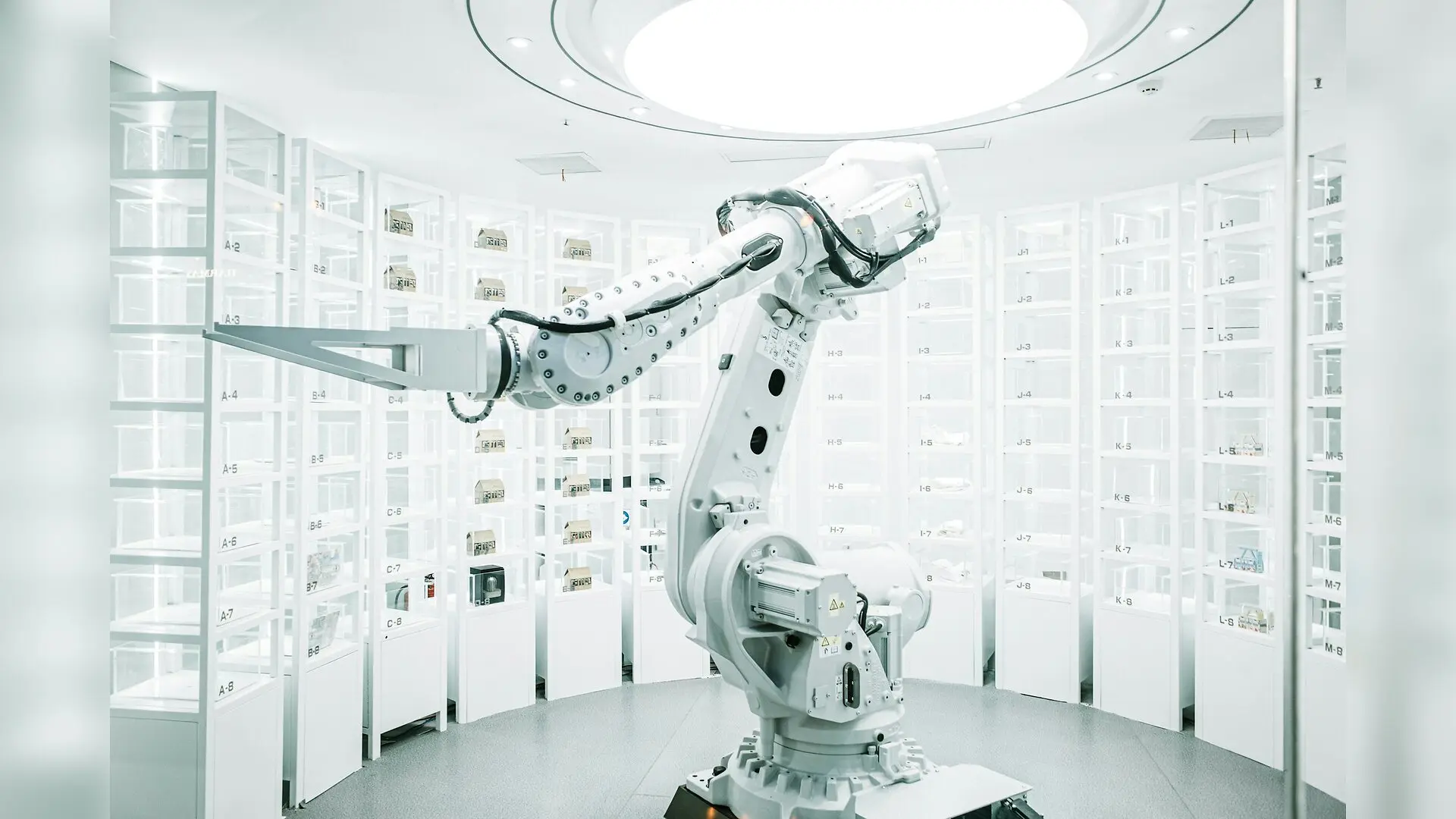
Photo by ZHENYU LUO on Unsplash

Robotic hands can now be designed entirely by artificial intelligence agents, transforming a brief description into a fully functional and physically tested robotic hand model. Researchers led by Haoyang Wang at the Beijing University of Chemical Technology developed a system called Task2Hand that automates the creation and validation of complex robotic hands.

Building a multi-fingered robotic hand traditionally requires weeks of meticulous expert work. Designers must juggle geometry, description code, collision debugging, and machine learning training to ensure the hand does not drop objects or break physical laws. The new AI workflow bypasses this bottleneck by routing every generated hand design through a series of automated verification gates.

How Do Automated Verification Gates Test Robot Physics?

The system evaluates candidate designs through seven sequential cost-ordered checks. These tests examine basic description validity, check for self-interference and unwanted physical contact, and simulate drop and retention capabilities. Only designs passing these physical checks advance to reinforcement learning training, which is detailed in a study available on the arXiv preprint server.
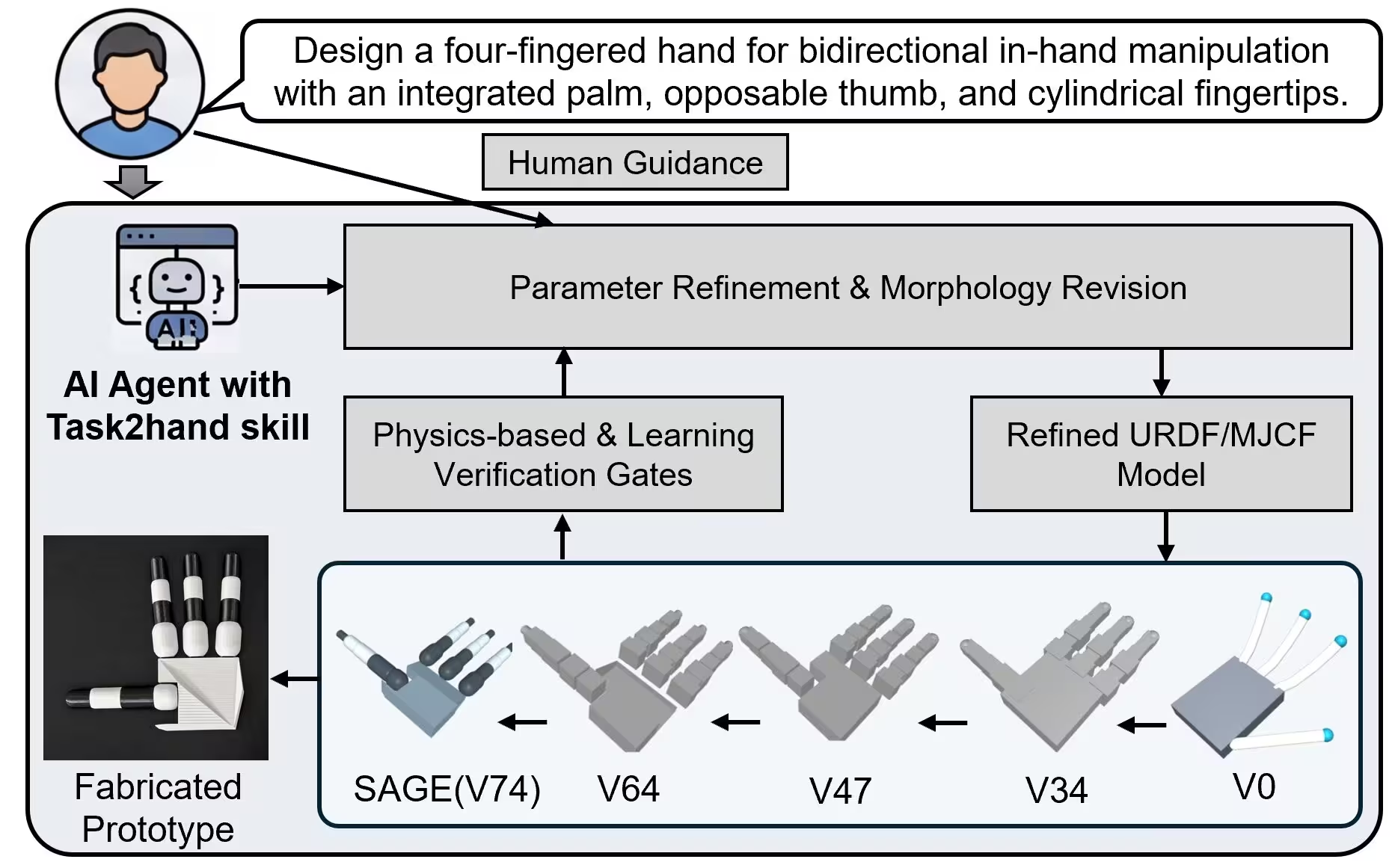
Fig. 1: Overview of the Task2Hand design loop. A human provides a functional manipulation brief and design guidance, and an AI coding agent equipped with the Task2Hand Skill generates parameterized hand-model candidates. Physics-based and learning verification gates evaluate each candidate, and failure evidence guides bounded parameter refinement and morphology revision. The design history depicts the resulting evolution toward the final design and a fabricated prototype.
Overview of the Task2Hand design loop. A human provides a functional manipulation brief and design guidance, and an AI coding agent equipped with the Task2Hand Skill generates parameterized hand-model candidates. Physics-based and learning verification gates evaluate each candidate, and failure evidence guides bounded parameter refinement and morphology revision. The design history depicts the resulting evolution toward the final design and a fabricated prototype. Credit: Haoyang Wang et al. / arXiv

When a candidate design fails a check, the system records the exact blocker, revises one specific parameter group, and reruns the cheaper tests. If the software encounters a design plateau or a conflicting trade-off it cannot resolve autonomously, it escalates the problem to a human supervisor who provides guidance before the AI resumes its automated loop.

What Makes the SAGE Hand Different From Standard Robotic Hands?

Using this iterative process, the AI generated a four-finger robotic hand with sixteen actuated degrees of freedom called the Skill-Aware Generative Embodiment hand, or SAGE Hand. It features an integrated guiding palm, compact roots, cylindrical fingertips, and a collision-cleared opposable thumb designed for complex in-hand rotation tasks.

In comparative evaluations across three distinct objects, the SAGE Hand outperformed established reference hands. On an asymmetric hexagonal prism, it reached forty-five point six percent task success compared to thirty-seven point three percent for the comparison hand. On a bicolor cylinder, success rates reached seventy point eight percent against fifty-one point six percent for the baseline.
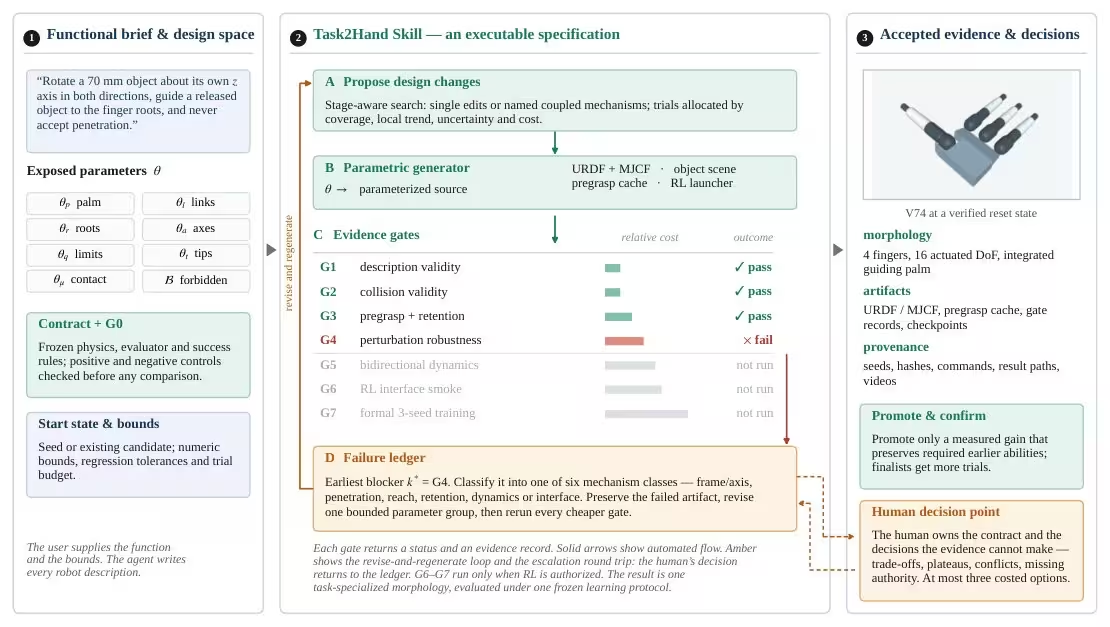
Fig. 2: The Task2Hand Skill. (1) The user writes a functional brief and exposes the parameter set θ\theta the agent may change; the contract, evaluator, and success rules are frozen before any comparison. (2) The Skill proposes one bounded edit, regenerates the whole model from θ\theta, and runs the cost-ordered gates G1–G7. Every gate returns a status and an evidence record, so the earliest blocker k∗k^{*} names a failing mechanism and the ledger identifies a parameter group for targeted revision. One group is revised, and every cheaper gate is rerun. Where the evidence poses a choice it cannot settle, the Skill escalates with at most three costed options; the decision returns to the ledger and the search resumes inside the approved scope. (3) An accepted candidate carries its artifacts and provenance. In the iteration shown k∗=G4k^{*}=\mathrm{G4}, so G5–G7 never ran and no training budget was spent.
The Task2Hand Skill. (1) The user writes a functional brief and exposes the parameter set θ\theta the agent may change; the contract, evaluator, and success rules are frozen before any comparison. (2) The Skill proposes one bounded edit, regenerates the whole model from θ\theta, and runs the cost-ordered gates G1–G7. Every gate returns a status and an evidence record, so the earliest blocker k∗k^{*} names a failing mechanism and the ledger identifies a parameter group for targeted revision. One group is revised, and every cheaper gate is rerun. Where the evidence poses a choice it cannot settle, the Skill escalates with at most three costed options; the decision returns to the ledger and the search resumes inside the approved scope. (3) An accepted candidate carries its artifacts and provenance. In the iteration shown k∗=G4k^{*}=\mathrm{G4}, so G5–G7 never ran and no training budget was spent. Credit: Haoyang Wang et al. / arXiv

Does Adding Simulated Touch Improve Object Handling?

The researchers also tested an upgraded version of the design equipped with seventy-four simulated tactile regions. While overall task success remained similar, the dense tactile input more than halved the object drop rate on cylindrical items, dropping it from over seven percent down to one percent in primary evaluations.

Control studies confirmed that the automated verification gates act as an essential regression guard during refinement. Without the gate system protecting earlier capabilities, hand designs rapidly degraded and lost the ability to securely capture objects during testing cycles.
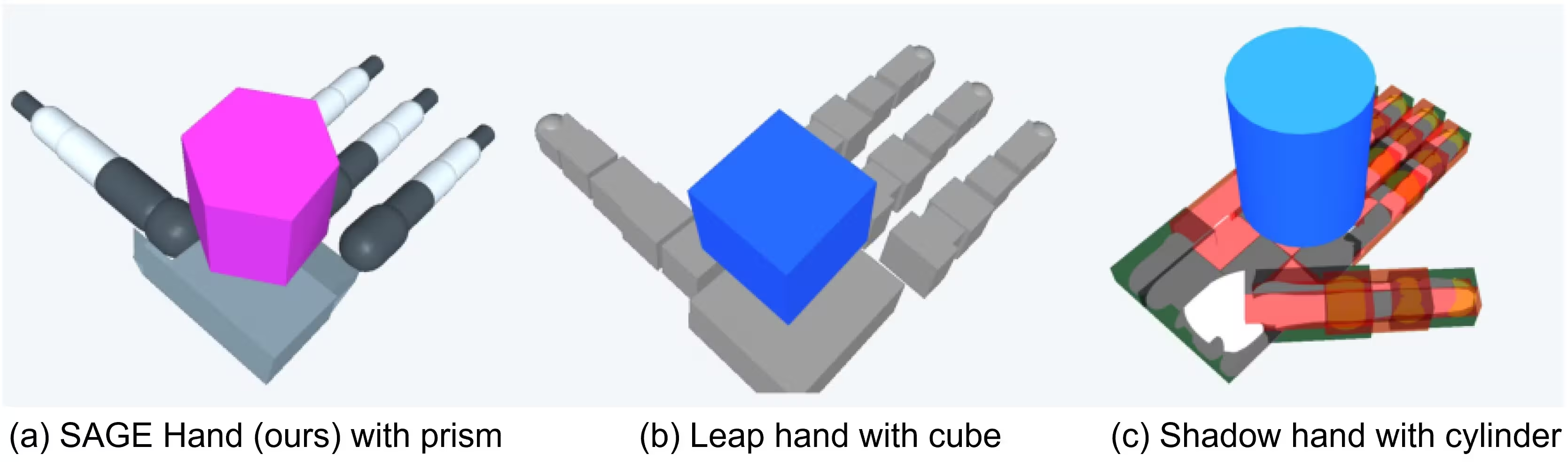
Fig. 3: Evaluation setup. Three hands at a verified reset state: (a) SAGE Hand, the morphology the Skill produced, with the hexagonal prism; (b) the LEAP hand with the cube; (c) the Shadow hand with the cylinder. Every hand is run on all three objects under the same physics, task definition, reward, and training budget.
Evaluation setup. Three hands at a verified reset state: (a) SAGE Hand, the morphology the Skill produced, with the hexagonal prism; (b) the LEAP hand with the cube; (c) the Shadow hand with the cylinder. Every hand is run on all three objects under the same physics, task definition, reward, and training budget. Credit: Haoyang Wang et al. / arXiv

What Challenges Remain Before These Hands Move Into the Real World?

Despite strong simulation performance, the current models exist entirely within computer simulations. The physics software used in the tests omits real-world manufacturing tolerances, mechanical backlash, cable compliance, and actuator thermal limits.

Future research will focus on transferring these computer-generated designs onto physical hardware to see if the reported performance advantages hold up in real-world environments. Researchers also plan to test whether direction-resolved evaluations show balanced gains across different movement axes.

The study was posted to the arXiv preprint server on November 20, 2026.

Fact Checked

This article has been fact checked for accuracy, with information verified against reputable sources. Learn more about us and our editorial process.

Last reviewed on .

Article history

  • Latest version

Reference(s)

  1. Wang, Haoyang. “Task2Hand: A Contact-Grounded Skill for Parametric Dexterous-Hand Morphology Design.” arXiv.org <http://arxiv.org/abs/2611.27967v1>.

Cite this page:

Whitmore, James. “AI Coding Agents Can Now Design Fully Functional Multi-Fingered Robotic Hands From Scratch.” BioScience. BioScience ISSN 2521-5760, 23 November 2026. <https://www.bioscience.com.pk/en/subject/technology/task2hand-a-contact-grounded-skill-for-parametric-dexterous-hand-morphology-design>. Whitmore, J. (2026, November 23). “AI Coding Agents Can Now Design Fully Functional Multi-Fingered Robotic Hands From Scratch.” BioScience. ISSN 2521-5760. Retrieved November 23, 2026 from https://www.bioscience.com.pk/en/subject/technology/task2hand-a-contact-grounded-skill-for-parametric-dexterous-hand-morphology-design Whitmore, James. “AI Coding Agents Can Now Design Fully Functional Multi-Fingered Robotic Hands From Scratch.” BioScience. ISSN 2521-5760. https://www.bioscience.com.pk/en/subject/technology/task2hand-a-contact-grounded-skill-for-parametric-dexterous-hand-morphology-design (accessed November 23, 2026).
End of the article