New Mathematical Method Solves Linear Regression Without Variance Assumptions
An innovative black-box reduction framework adapts standard regression tools to heavy-tailed noise without requiring prior parameter knowledge.

A new mathematical technique allows machine learning models and statistical systems to perform accurate linear regression even when the data contains extreme outliers and infinite variance, solving a long-standing challenge in heavy-tailed data analysis. Linear regression is a core computational tool used across technology and science to find relationships between variables, but standard algorithms frequently fail or become wildly inaccurate when the underlying noise distribution has extremely heavy tails.
To address this, a team of researchers composed of Artin Tajdini from the University of Washington, Jasper C. H. Lee from the University of California, Davis, Jonathan Scarlett from the National University of Singapore, and Kevin Jamieson from the University of Washington developed an algorithmic framework that effectively tames infinite-variance noise without requiring prior knowledge of the noise scale or moment parameters. The study is available on the arXiv preprint server.
How Can Black-Box Reductions Transform Standard Regression Routines?
The core innovation introduced by the authors is a black-box reduction method that converts standard finite-variance regression procedures into robust weak-moment procedures. Instead of designing an entirely new regression solver from scratch, their algorithm acts as a wrapper that takes existing, computationally efficient finite-variance estimation subroutines and adapts them to handle heavy-tailed errors.
The procedure relies on a technique called empirical residual pruning. Starting from an initial estimate computed via Least Absolute Deviations on independent subblocks of data, the algorithm estimates a dynamic threshold to filter out extreme sample points. By pruning residuals that exceed this data-driven threshold, the algorithm forces the sample distribution to behave as though it has a finite variance, allowing standard regression subroutines to operate safely.
What Makes This Approach Adaptable to Unknown Noise Levels?
In real-world data science applications, researchers rarely know the exact mathematical parameters governing the noise distribution, such as the moment exponent denoted as alpha, which typically ranges between one and two in heavy-tailed regimes. Traditional robust estimation methods often require precise tuning based on these unknown parameters.
The new reduction overcomes this limitation by estimating the pruning thresholds directly from independent blocks of data. Through an iterative refinement process, the algorithm computes residuals, prunes extreme outliers, and applies a correction term that progressively reduces estimation error. The authors proved mathematically that this data-driven approach achieves minimax optimal rates under standard fourth-moment covariate conditions, meaning no alternative estimator can perform asymptotically better across the worst-case scenarios defined by the model.
How Does Empirical Pruning Perform in Practice?
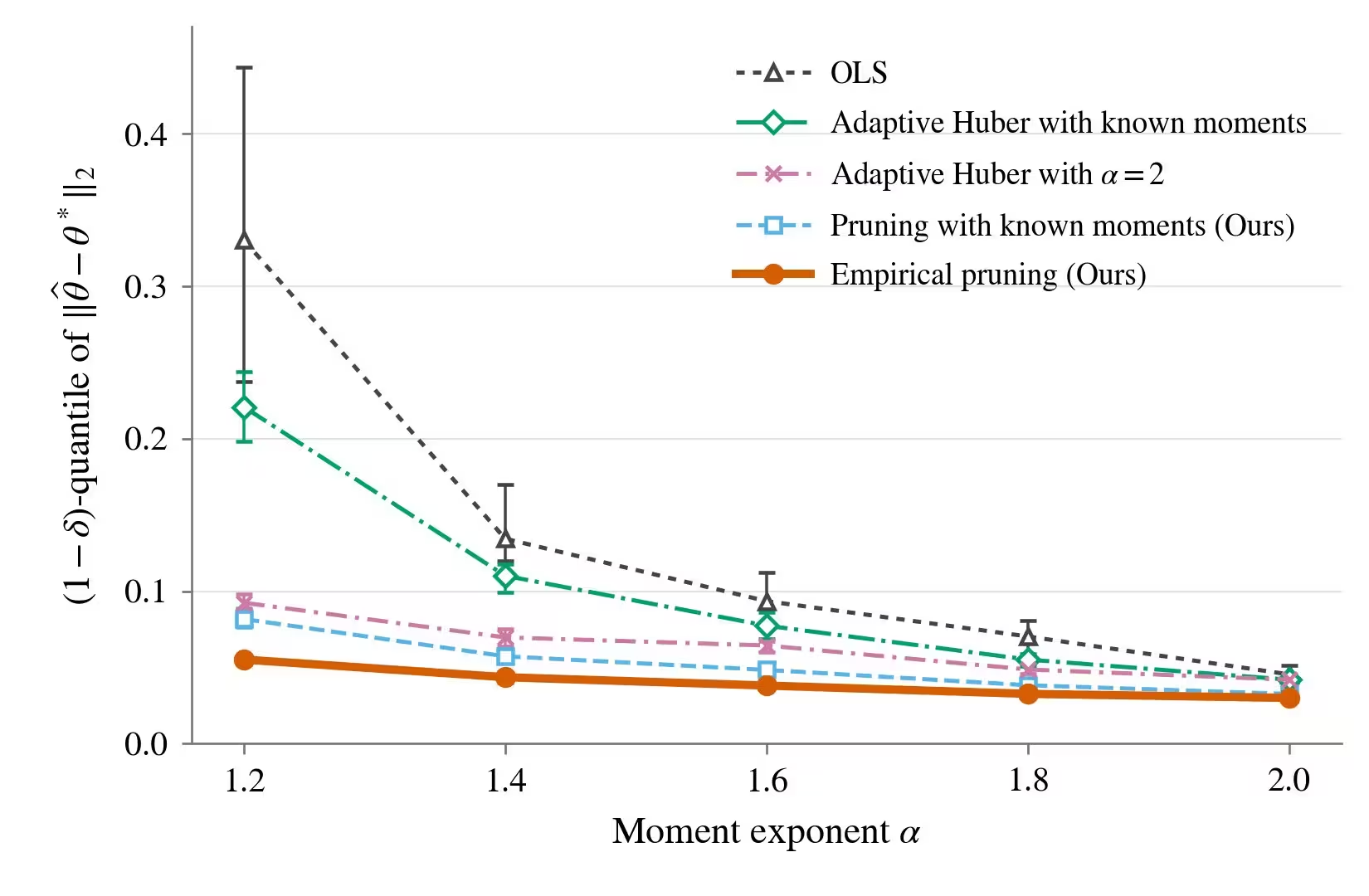
To validate their theoretical findings, the research team conducted proof-of-concept numerical experiments involving two thousand data samples across eight dimensions. They tested their empirical pruning algorithm against ordinary least squares and adaptive Huber regression under simulated heavy-tailed noise.
The results indicate that empirical pruning achieves lower estimation errors than traditional methods across every tested noise parameter, with the performance gap widening significantly as the noise distribution grew heavier. Furthermore, the empirical pruning strategy even outperformed pruning variants that were provided with the true, exact noise parameters, demonstrating the power of data-driven threshold estimation.
While the current theoretical guarantees rely on a finite fourth-moment assumption for the covariates, the authors note that open questions remain regarding whether this requirement can be further relaxed. Nevertheless, the new reduction framework provides a computationally efficient pathway for robust statistical estimation in complex machine learning environments plagued by extreme outliers.
The study was posted to the arXiv preprint server on November 20, 2026.
This article has been fact checked for accuracy, with information verified against reputable sources. Learn more about us and our editorial process.
Last reviewed on .
Article history
- Latest version
Reference(s)
- Tajdini, Artin. “Optimal Linear Regression Without a Variance.” arXiv.org <http://arxiv.org/abs/2611.27983v1>.
Cite this page:
- Posted by Asif Iqbal