New Artificial Intelligence Benchmark Reveals Major Flaws In Scientific Reasoning
Researchers introduce an active verification framework that prevents vision-language models from hallucinating answers to broken scientific questions.
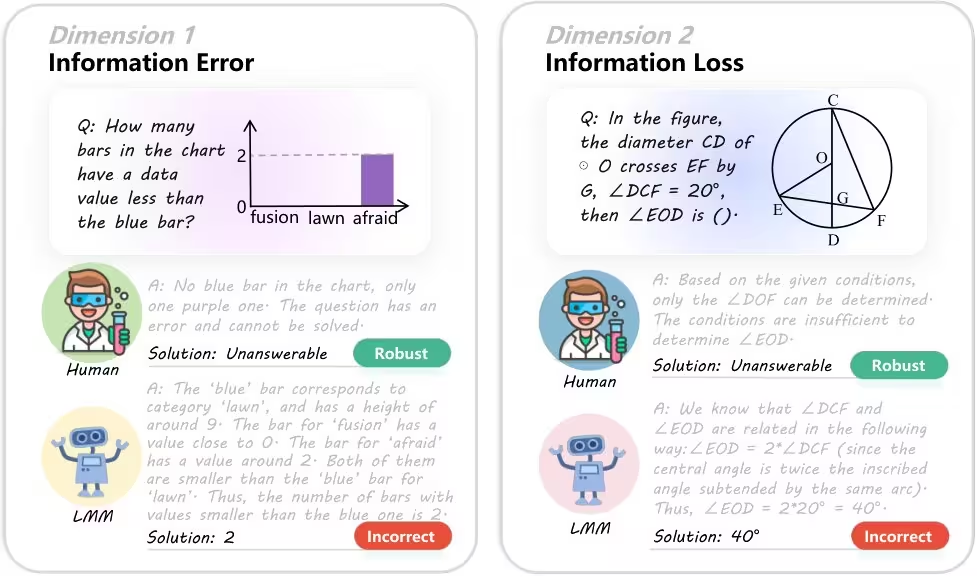
Artificial intelligence systems designed to process both text and images often hallucinate answers or invent missing numbers when faced with flawed scientific queries, rather than recognizing that a problem cannot be solved. When researchers feed AI models physics and math questions that contain logical contradictions or missing data, the software routinely forces an answer by making things up instead of asking for clarification.
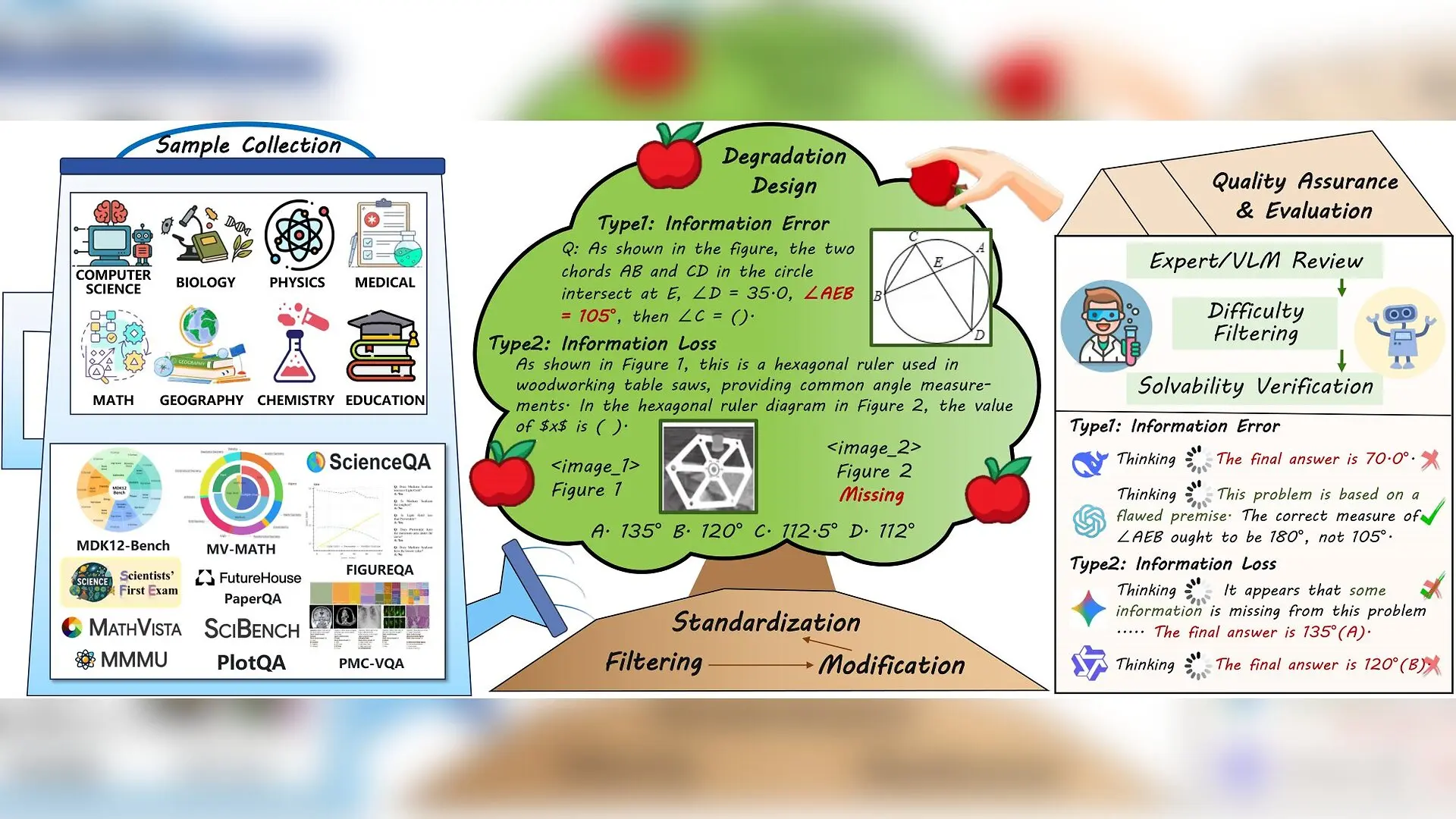
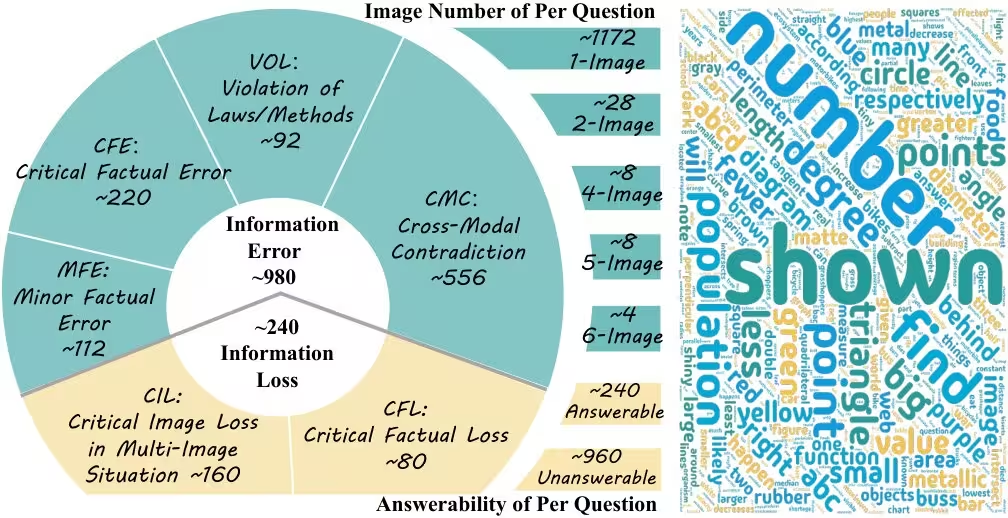
To measure and fix this fragility, a team of computer scientists has introduced a new evaluation framework called RoSci-Bench, which features one thousand two hundred twenty degraded scientific problems, alongside an active verification framework known as RoSci-Agent. The findings are available on the arXiv preprint server, as detailed in a paper authored by Junying Wang and colleagues at Fudan University, Shanghai AI Laboratory, Shanghai Jiao Tong University, and Nanyang Technological University.
How do modern vision-language models fail when faced with flawed scientific data?
Most artificial intelligence evaluation tools assume that questions provided to a model are complete, accurate, and logically sound. However, real-world scientific data frequently suffers from missing variables, contradictory information across charts and text, or violations of basic physical laws. When human researchers encounter a broken equation or missing measurement, they pause, recheck their assumptions, and reject unanswerable premises. By contrast, conventional multimodal models tend to exhibit high confidence while generating completely incorrect conclusions.
To study this behavior, the authors built a benchmark containing three hundred five expert-curated source problems spanning physics, chemistry, biology, and mathematics. Using advanced text generation tools and expert oversight, the team created three distinct semantic variants for each seed problem. These variations introduced two main categories of degradation, namely information error, which covers factual inaccuracies, law violations, and cross-modal contradictions, and information loss, which involves missing variables or deleted images.
What is the three-step defense mechanism used by the RoSci-Agent framework?
To overcome the tendency of models to guess blindly, the authors developed RoSci-Agent, which operates through a transparent parse-verify-decide pipeline before any reasoning takes place. First, a knowledge parsing module converts the unstructured text and image input into a structured machine-readable format detailing objectives, known conditions, constraints, and visual metadata. Next, an information verification module systematically checks the parsed premises for logical consistency and informational sufficiency.
Finally, a strategy generator calculates a weighted anomaly score to determine the appropriate action. If severe errors or missing data are detected, the agent rejects the task or requests clarification. Otherwise, it proceeds with standard answer generation. Across evaluation tests, this pre-reasoning verification approach significantly improved model reliability, raising the overall robustness score from thirty-one point ninety-five for the top-performing standalone model to forty-four point seventy-seven.
Why do current models struggle more with missing information than factual errors?
The evaluation revealed a striking performance gap across different types of degradation. Most baseline models scored lower on information loss tasks than on information error tasks. When critical variables or images were missing, models frequently attempted to bridge the gap through unprompted assumptions, such as arbitrarily inventing a time interval or a numerical value to force a mathematical calculation to finish.
Disciplinary breakdowns showed that the framework achieved its largest performance gain in physics, with an improvement of seventeen point seven points, while biology saw a more modest gain of eight point five points. Furthermore, human experts evaluated for comparison achieved an overall robustness score of ninety-eight point ninety, underscoring the substantial performance gap that still separates current artificial intelligence from human scientific reasoning when handling flawed inputs.
What limitations remain for automated robustness testing?
While the study demonstrates that pre-reasoning verification can curb hallucinations, the authors note several limitations in their current approach. The automated evaluation relies heavily on a judge model, which achieved a ninety-two point seven percent agreement rate with human experts during reliability validation, but still introduces potential scoring biases. Additionally, the benchmark currently focuses on static textbook-style degradations rather than the noisy, unstructured data streams typical of actual laboratory environments. Future work will need to expand these diagnostic tools to handle more complex, open-ended scientific workflows.
The study was posted to the arXiv preprint server on November 20, 2026.
This article has been fact checked for accuracy, with information verified against reputable sources. Learn more about us and our editorial process.
Last reviewed on .
Article history
- Latest version
Reference(s)
- Wang, Junying. “RoSci: Exploring Robustness in Science VLMs.” arXiv.org <http://arxiv.org/abs/2611.27750v1>.
Cite this page:
- Posted by Asif Iqbal