AI Robot Controllers Recover From Half Their Errors
A new action-level analysis of frontier multimodal models reveals surprising self-correction abilities alongside persistent physical grasping bottlenecks.
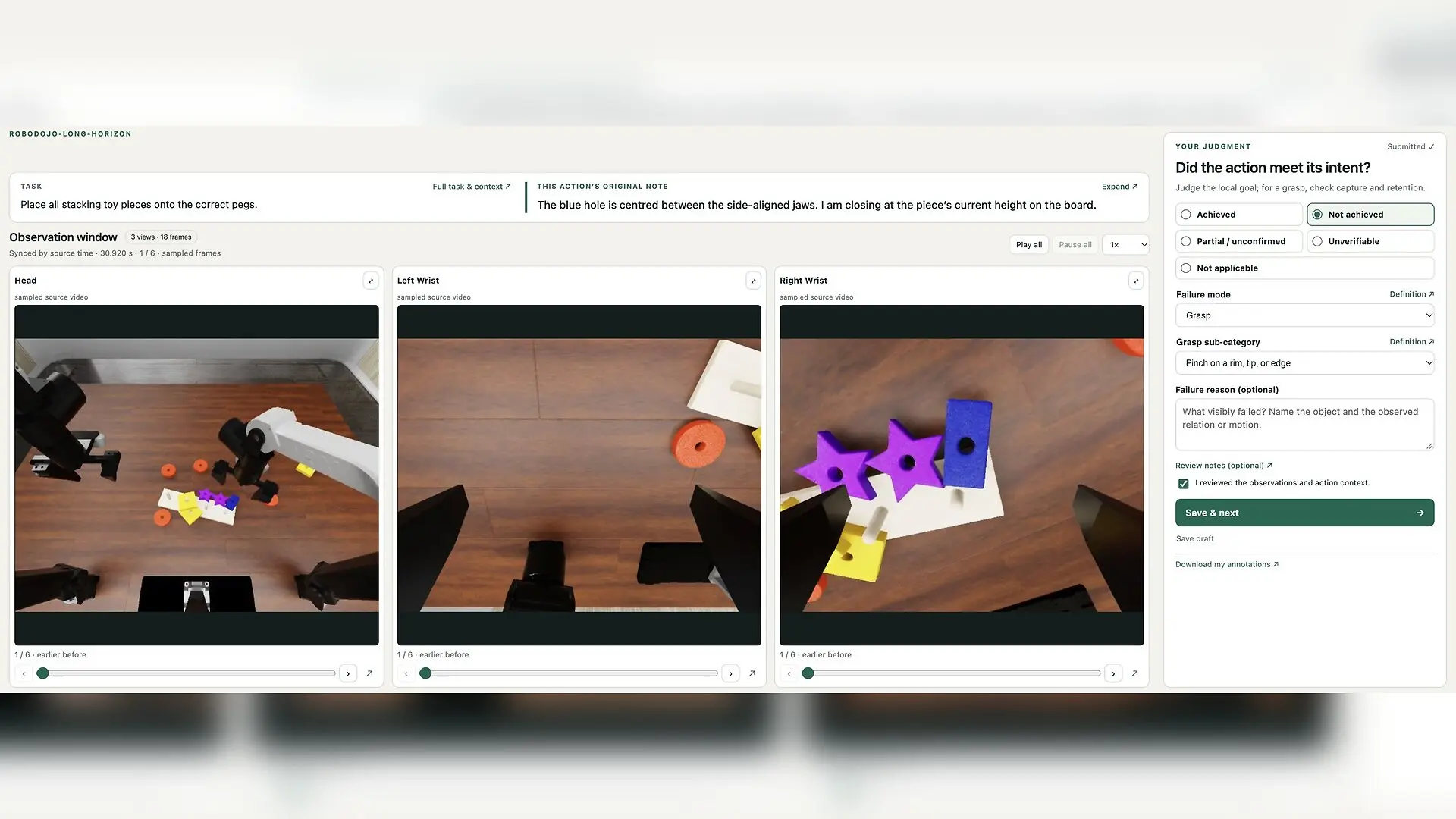
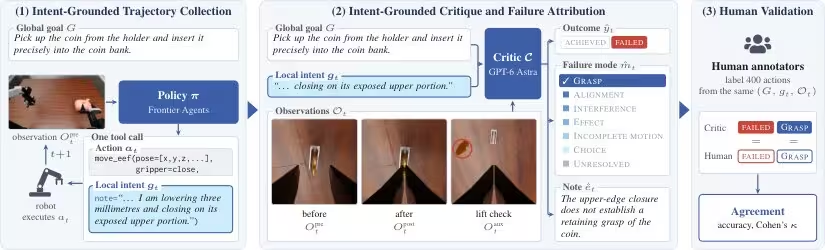
Frontier multimodal language agents can control robotic arms directly using low-level numerical actions instead of relying on high-level pre-programmed routines, achieving high zero-shot success rates across diverse manipulation tasks. However, traditional benchmark evaluations only report binary episode-level success rates, making it impossible to determine how these systems succeed or where they break down during execution. To address this blind spot, a team of researchers from Carnegie Mellon University, the University of Illinois at Urbana-Champaign, and Bosch Research North America introduced AgentRoboCritic, an intent-grounded evaluation framework that analyzes robotic performance at the individual action level.
The study, available on the arXiv preprint server, evaluated frontier models such as OpenAI’s GPT-6 Astra across 12 different robot manipulation benchmarks encompassing more than 12,000 annotated actions. Because robotic manipulation is inherently multimodal, meaning multiple distinct physical trajectories can successfully achieve the same goal, evaluating an isolated action requires knowing what the robot intended to do. The authors solved this ambiguity by having the policy agent state a brief local intent alongside every command, establishing a verifiable contract for each step.
How Frontier AI Models Recover From Execution Failures
Traditional imitation-trained robot policies often suffer from covariate shift, where a single physical error pushes the robot outside its training distribution and causes cascading failures until the task aborts. In contrast, the action-level analysis revealed that frontier language agents frequently recover from local execution failures and still complete the overarching task. The data showed that nearly 50 percent of successful episodes achieved by these agents contained at least one failed action that was subsequently corrected.
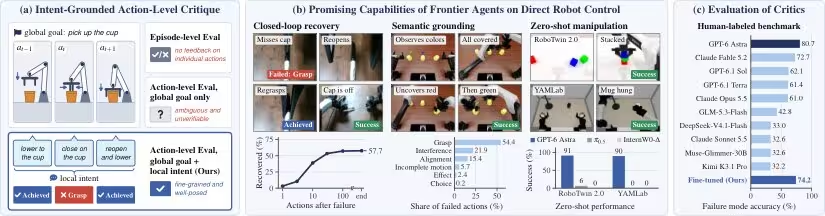
Furthermore, the evaluation demonstrated that frontier models possess reliable semantic grounding across visually diverse scenes. When confronted with novel object instances or background distractors, the agents consistently acted on the correct objects and categories specified in their local intents. Semantic selection errors accounted for only 0.2 percent of all failed actions across the 12 tested benchmarks.
Physical Bottlenecks and Grasping Failures in Direct Control
Despite their strong zero-shot generalization capabilities, frontier agents face distinct physical execution bottlenecks that shift depending on task geometry. In general tabletop and bimanual manipulation suites, object acquisition and retention, labeled as grasping failures, formed the primary obstacle and accounted for the highest share of failures across nine non-tactile benchmarks. When the evaluation shifted to tight-tolerance assembly and insertion tasks in vision-only visuo-tactile environments, the primary failure mode shifted to spatial alignment as the models struggled to resolve millimeter-scale mating tolerances from vision alone.
A granular breakdown of grasping failures revealed that 60 percent of these errors occur at the exact moment of closure, before the object is fully secured. The most frequent closure errors involved pinching only a rim or edge, or closing beside and above the object due to minor 3D localization offsets. Once an object was successfully captured, accidental losses during carrying accounted for additional failures, while actions issued with an already empty gripper indicated that models occasionally failed to notice when an object had slipped away.
Open-Source Critic Models for Scalable Robotic Analysis
To enable low-cost action analysis without relying entirely on expensive proprietary APIs, the authors curated a dataset of 12,844 annotated actions and fine-tuned an open-source vision-language model named Muse-Glimmer-30B. While unadapted open-source models struggled to correctly identify failure modes, fine-tuning raised the failure-mode attribution accuracy from 32.58 percent to 74.24 percent, bringing its performance close to that of proprietary frontier systems while operating at a fraction of the inference cost.
The study was posted to the arXiv preprint server on November 19, 2026.
This article has been fact checked for accuracy, with information verified against reputable sources. Learn more about us and our editorial process.
Last reviewed on .
Article history
- Latest version
Reference(s)
- Du, Yiyang. “AgentRoboCritic: Understanding the Capability of Frontier Agents on Direct Robot Control.” arXiv.org <http://arxiv.org/abs/2611.26613v1>.
Cite this page:
- Posted by Asif Iqbal