New Framework Learns To Select Optimal Data Subsets Across Diverse Machine Learning Tasks
By decoupling value estimation from redundancy control, a new framework matches or beats hand-crafted selection rules across computer vision, spectroscopy, and genomics.
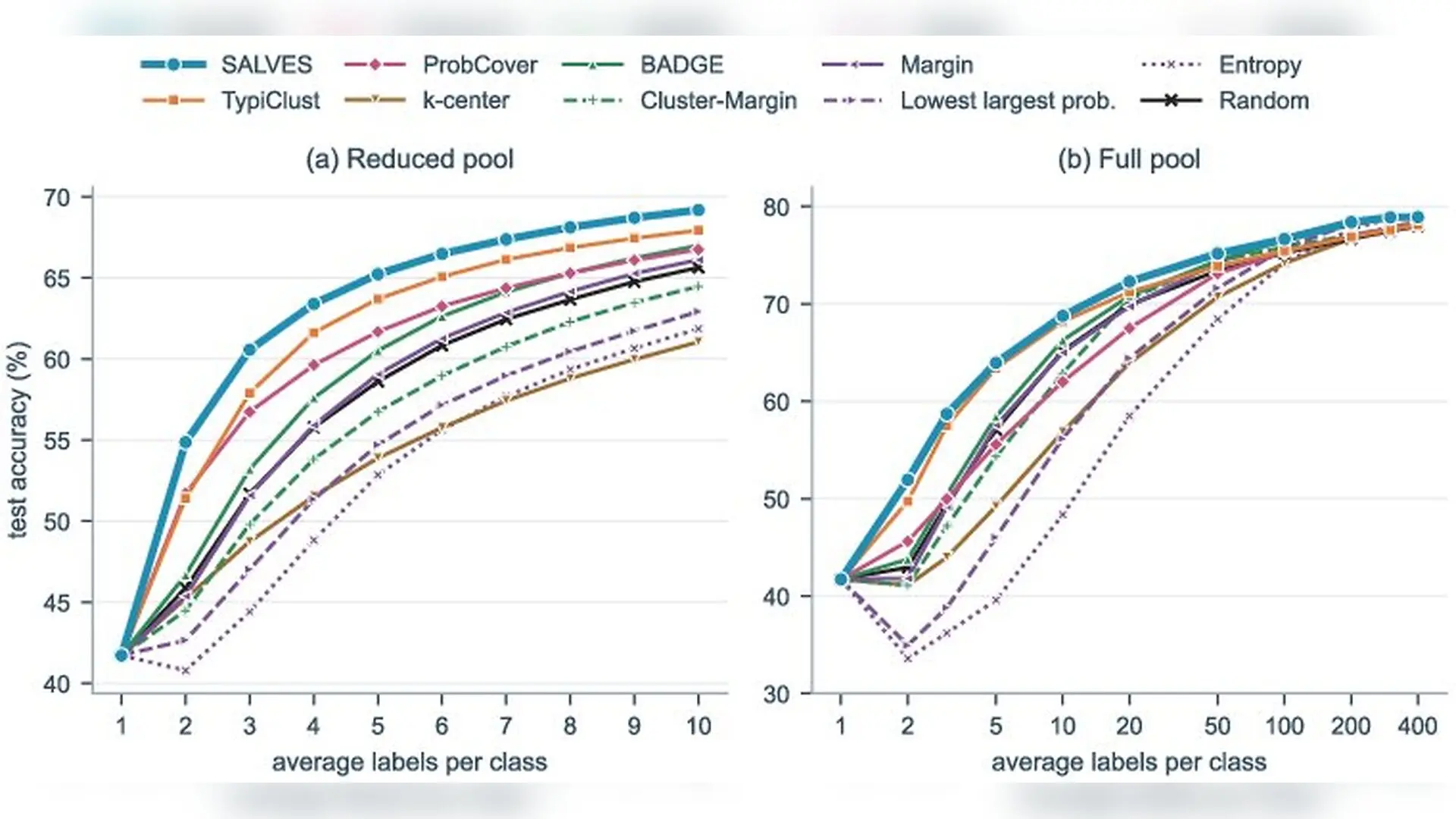
Choosing the best data points or variables from massive datasets usually requires painstaking manual design for each new problem, but a new machine learning framework automates this process by learning candidate utility from past tasks. By training a model on solved data problems, researchers can apply learned value estimates to entirely new domains without starting from scratch.
The new method, named Subset Acquisition with Learned Value Estimates and Search (SALVES), was developed by Jade Lejeune Herman, Johan A. K. Suykens, and Peter Goos from KU Leuven, and is available on the arXiv preprint server (2026). Selecting informative subsets is a fundamental bottleneck across artificial intelligence, statistics, and engineering. Whether an algorithm needs to pick the most useful images to label for a computer vision model, select spectral wavelengths from satellite imagery, or filter biomedical variables, it faces a combinatorial explosion of possible combinations. Furthermore, the true value of any candidate is often hidden until after it is chosen and evaluated.
How Does Learning Candidate Value Bypass The Need For Hand-Crafted Rules?
Traditional approaches rely on fixed heuristics, such as measuring the uncertainty of a classifier or calculating correlations between variables. However, no single rule works consistently across different datasets and selection budgets. The authors designed SALVES to decouple subset selection into two explicit components, a learned value model and a diversity mechanism. First, a machine learning model is trained on historical tasks where the hidden information is fully known, allowing it to accurately predict the utility gain that adding a specific candidate will provide. Second, an optimization step, such as simulated annealing or exact group constraints, selects a batch of candidates that maximizes predicted value while penalizing redundancy.
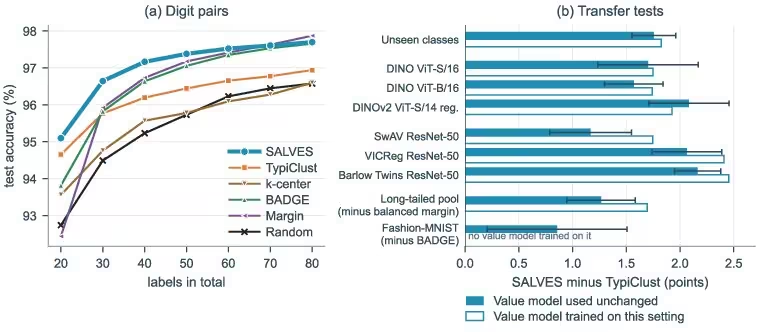
The team tested their framework across four distinct application domains involving between two thousand and six hundred forty thousand candidates. In batch active learning tasks on ImageNet and MNIST digit pairs, the framework outperformed standard baseline methods at small labeling budgets. When label scarcity makes traditional uncertainty estimates unreliable, the learned value model provided a performance advantage of more than three percentage points over conventional techniques.
Can A Model Trained on Synthetic Data Transfer Successfully to Real-World Problems?
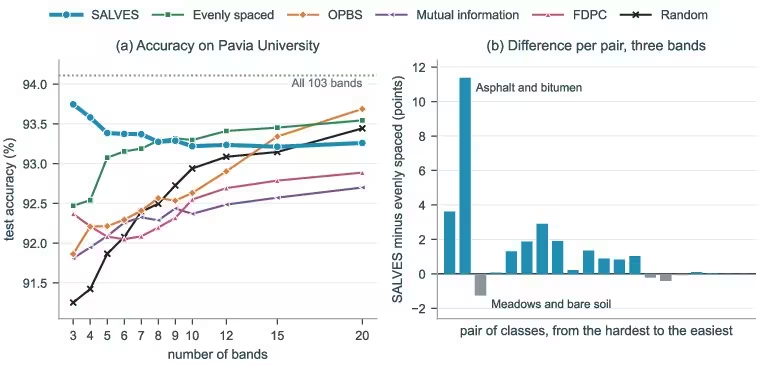
One of the most notable challenges in machine learning is ensuring that models generalize beyond their training distribution. The researchers evaluated zero-shot transfer across new object classes, different neural network architectures, and even entirely new sensor types. In hyperspectral band selection experiments, a value model trained on two specific airborne scenes transferred successfully to a third scene captured with a completely different sensor. Using just three spectral bands, the framework achieved classification accuracies comparable to using all one hundred three available bands.
Similarly, for tabular input selection, the value model was trained entirely on synthetic datasets containing known informative variables, and then deployed directly onto five real-world biomedical and benchmark datasets. Across these tests, SALVES matched or outperformed established feature selection algorithms while avoiding the domain-specific tuning that usually plagues such pipelines. Ablation studies confirmed that combining both learned value estimates and diversity controls is essential, as removing either component significantly degraded performance.
What Are The Current Limits of Automated Subset Selection?
Despite its broad utility, the authors noted specific boundaries where the framework provides little benefit. When selection budgets grow large and standard metrics like classifier margin become highly reliable, classical rules leave very little room for further improvement. Additionally, the computational cost shifts to the initial training phase, which requires access to solved historical tasks or reliable simulation generators. Nevertheless, the work demonstrates that candidate evaluation does not need to be reinvented from scratch for every new scientific challenge.
The study was posted to the arXiv preprint server on November 20, 2026.
This article has been fact checked for accuracy, with information verified against reputable sources. Learn more about us and our editorial process.
Last reviewed on .
Article history
- Latest version
Reference(s)
- Herman, Jade. “Budgeted Subset Selection with a Transferable Learned Value Model.” arXiv.org <http://arxiv.org/abs/2611.27751v1>.
Cite this page:
- Posted by James Whitmore