How A Sudden Tap On A Tube Of Water Launches Microjets One Hundred Times Faster
Researchers discover that fast-acting chemical additives can accelerate liquid microjets and shrink droplet sizes by forty percent.
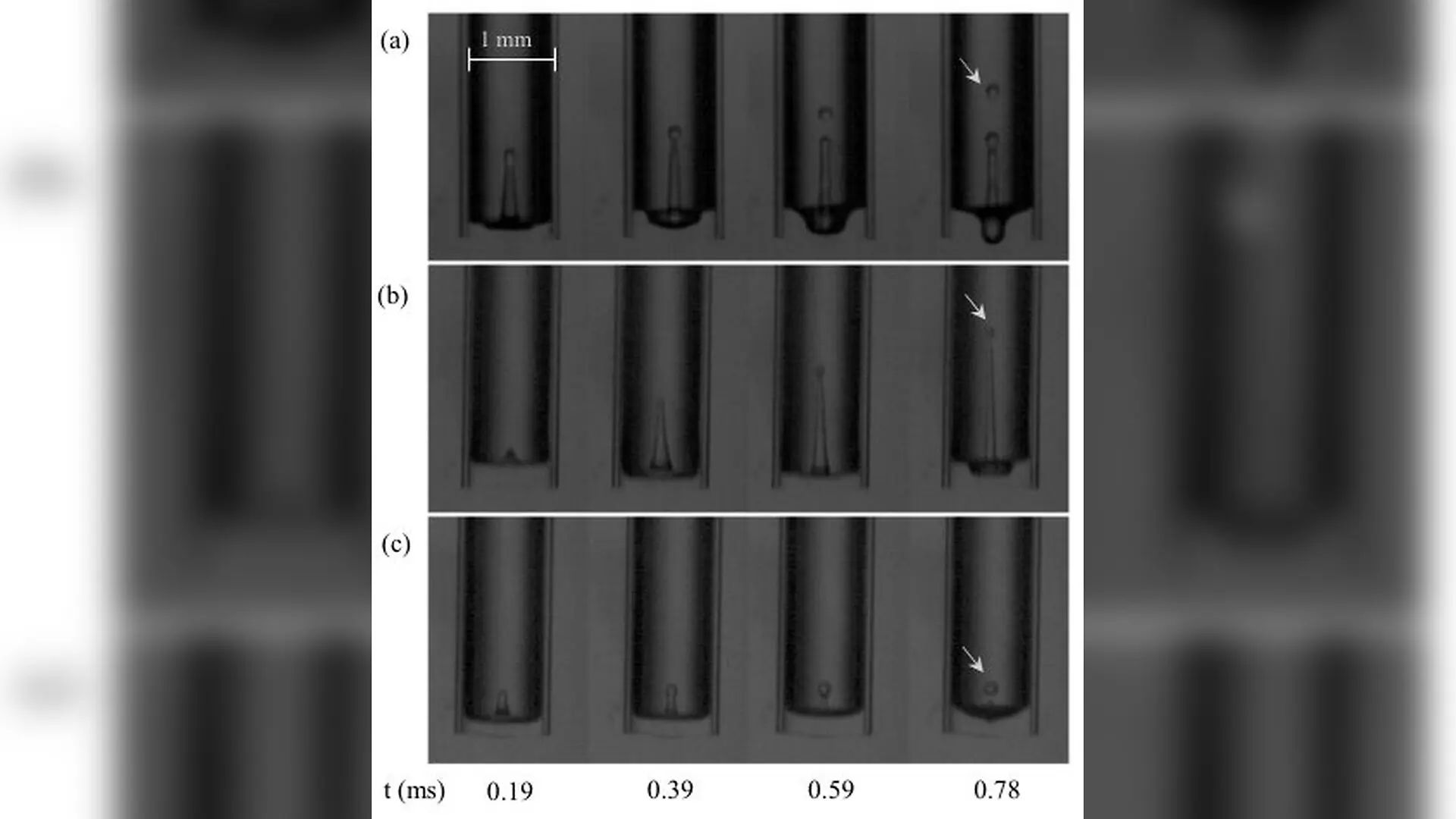
Striking the bottom of a liquid-filled glass tube can launch a microscopic jet of water traveling up to one hundred times faster than the initial impact, a physical effect that researchers have now found can be significantly boosted by adding specific soap-like molecules. When a mechanical shaker strikes a narrow container holding water and a specialized chemical additive known as a surfactant, the fluid forms a concave surface that focuses momentum inward and upward. This rapid squeezing action shoots out an ultra-thin liquid thread that pinches off a tiny droplet at speeds reaching several meters per second.
The experimental work, led by T. González-Rubio and colleagues at the University of Extremadura in Spain, is available on the arXiv preprint server. The authors investigated how different chemical additives alter the creation of these high-speed Worthington jets, which are valuable for needle-free drug delivery and high-resolution printing technologies where viscous fluids must be deposited precisely without heating or chemical solvents.
How Can A Gentle Tap Launch A Supersonic Microjet?
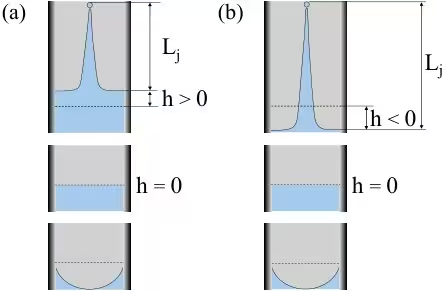
When an electrodynamic shaker delivers a sharp mechanical blow to the base of a borosilicate glass tube with an inner radius of 6.9 millimeters and a central capillary of 0.5 millimeters, an initial disturbance travels upward through the liquid at speeds under one meter per second. As this wave moves, the liquid meniscus at the bottom flattens and undergoes flow focusing, concentrating the kinetic energy into a much smaller cross-section. This geometric squeezing forces the resulting jet to accelerate dramatically, achieving velocities up to two orders of magnitude higher than the baseline impact speed.
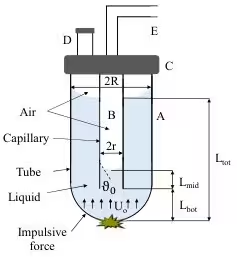
The team discovered that without any additives, surface tension acts as a major momentum sink, consuming energy as the liquid interface deforms and creating an unwanted cavity at the base of the jet that disrupts the focusing mechanism. At sufficiently high impact velocities, however, fluid inertia completely dominates the process. In this inertial regime, the jet velocity becomes largely independent of fluid viscosity and surface tension, meaning water and thick water-glycerine mixtures behave similarly once past a certain energy threshold.
Why Do Some Chemical Additives Make Liquid Jets Faster While Others Slow Them Down?
Adding soluble surfactants changes the interfacial physics drastically, but the outcome depends entirely on how fast the molecules diffuse and adsorb onto newly created surfaces. The researchers tested two non-ionic surfactants at twice their critical micelle concentration: Surfynol 465 and Triton X-100. Surfynol 465 possesses exceptionally fast adsorption kinetics, allowing it to quickly replenish the stretching interface and suppress the disruptive cavity that normally forms at the jet base.
In contrast, Triton X-100 has much slower adsorption dynamics. Because new liquid surfaces form in fractions of a millisecond, roughly one ten-thousandth of a second, slower molecules cannot cover the expanding interface evenly. This uneven distribution creates localized surface tension gradients known as Marangoni stresses, which generate resistance and partially immobilize the fluid interface. Consequently, Surfynol 465 lowered the impact velocity threshold required to emit a water jet and produced faster jets than pure water, whereas Triton X-100 largely hindered jet formation at lower speeds.
What Happens To The Droplets When Fast-Acting Additives Are Mixed Into Water?
Beyond increasing jet velocity, the presence of these soluble compounds significantly altered the physical dimensions of the ejected droplets. Across all tested impact velocities, both surfactants reduced the overall diameter of the jet and the resulting droplets. At the highest impact velocities examined, adding Surfynol 465 shrank the first-emitted droplet diameter by about 40 percent compared to clean water.
The researchers attribute this drastic reduction to surfactant molecules being forcefully convected toward the tip of the growing jet during its earliest stages of formation, a mechanism independent of regular adsorption timing. Interestingly, when the team compared the Surfynol-laden water to a glycerine-water mixture possessing a nearly identical Ohnesorge number, a dimensionless parameter relating viscous forces to inertial and surface tension forces, the surfactant-loaded jet was still faster than the clean mixture. This indicates that fast surfactants accelerate jet emission beyond what can be achieved simply by lowering equilibrium surface tension, pointing to complex interactions between fluid dynamics and molecular transport at microscopic scales.
The study was posted to the arXiv preprint server on November 20, 2026.
This article has been fact checked for accuracy, with information verified against reputable sources. Learn more about us and our editorial process.
Last reviewed on .
Article history
- Latest version
Reference(s)
- González-Rubio, T.. “Impulsive ejection of Worthington jets by flow focusing. Influence of a soluble surfactant.” arXiv.org <http://arxiv.org/abs/2611.27709v1>.
Cite this page:
- Posted by Nida Rehman