Mysterious Little Red Dots Spotted by Webb Telescope Could Be the Universe’s First Black Holes
New research offers fresh insights into the formation of elusive primordial black holes, potentially uncovering evidence for these mysterious cosmic objects.
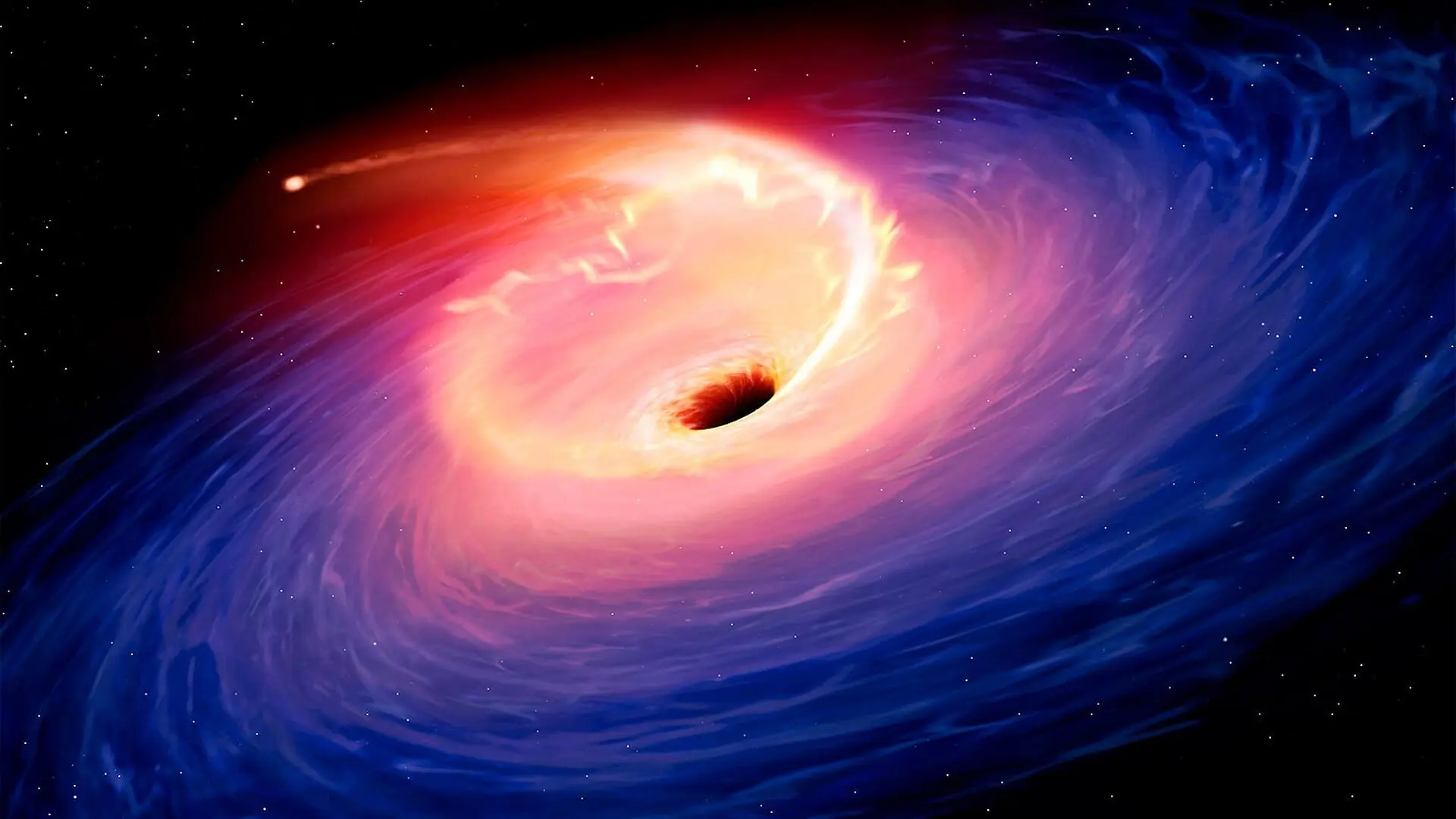
New Research Probes Mysterious Cosmic Objects as Potential Primordial Black Holes
Astrophysicists are scrutinizing enigmatic, compact celestial objects known as “little red dots” in a bid to uncover evidence of primordial black holes—hypothetical entities that may have emerged during the dawn of time, long before the first stars ignited.
Recent analysis led by researchers at Johns Hopkins University, utilizing high-resolution data from the James Webb Space Telescope (JWST), has centered on a specific candidate dubbed QSO1. The study, published in Physical Review Letters, investigates whether such objects could represent the elusive remnants of the very early universe, rather than the standard black holes formed from the gravitational collapse of massive stars.
Unlike conventional black holes, which rely on stellar death for their creation, primordial black holes are theorized to have formed during the rapid, exponential expansion of the universe in its infancy. “They come from the physics of the early universe that predate the first stars,” explains Valerio De Luca, a postdoctoral researcher at Johns Hopkins. “The mechanisms for creating them are entirely different.”
The quest to identify these objects has been a focal point of theoretical physics since Stephen Hawking first postulated their existence in the 1970s. Scientists are currently distinguishing between astrophysical black holes and their primordial counterparts by analyzing the hot, swirling discs of gas and energy that surround these distant, dim light sources observed by the JWST.
QSO1 provides a unique case study due to its composition and age. Existing just 700 million years after the Big Bang, the object lacks the heavier elements typically forged in later generations of stars, consisting almost exclusively of primordial hydrogen and helium. This chemical signature makes it a primary candidate for deeper inspection.
To determine if a primordial black hole could evolve into a structure matching the size and characteristics of QSO1, the team modeled three distinct evolutionary scenarios. Their findings suggest that a smaller primordial black hole could indeed accumulate surrounding gas and energy over time to reach the observed mass of QSO1. “The door was open on this theory,” notes co-author and postdoctoral researcher Loris Del Grosso. “We have now cracked it open a little further by showing some scenarios are more likely than others.”
Despite these insights, definitive proof remains elusive. Confirming the existence of a primordial black hole would require identifying a mass too small to be formed by stellar collapse or finding evidence that definitively predates the first generation of stars.
The research team intends to broaden their scope, applying their modeling techniques to the catalog of roughly 100 little red dots identified by the JWST to estimate how many might share these primordial origins. If verified, the discovery would reshape our understanding of the immediate aftermath of the Big Bang and provide a rare window into the physics of the nascent cosmos.
This article has been fact checked for accuracy, with information verified against reputable sources. Learn more about us and our editorial process.
Last reviewed on .
Article history
- Latest version
Reference(s)
- De Luca, Valerio., et al. “Primordial-Black-Hole-Based Pathways to Little Red Dots.” Physical Review Letters, vol. 136, no. 23, June 12, 2026 American Physical Society (APS), doi: 10.1103/6y1w-87pd. <https://doi.org/10.1103/6y1w-87pd>.
Cite this page:
- Posted by Deepak Malhotra