Mathematical Model Predicts New Scientific Partnerships Before They Form
A hybrid framework mapping researcher networks and text semantics successfully forecasts hidden collaboration opportunities.

A sweeping new computational study reveals that mathematical models mapping academic collaboration and research topics can successfully predict new scientific partnerships before researchers even meet. By tracking 1,229 computer science scholars over a 45-year period in Italy, the investigation mapped how individual publication histories and social networks intertwine to drive the evolution of modern technology research.
The study is published in PLOS Complex Systems and addresses a longstanding flaw in how universities and funding agencies measure academic output. Traditional metrics like the h-index rely entirely on citation counts, reducing a researcher’s complex intellectual identity to a single flat number. This reductionist approach overlooks critical behaviors, such as how certain researchers act as bridges between entirely different fields or how they strategically time their contributions to emerging topics.
Combining Collaboration Networks with Text Semantics
To capture the true multidimensional nature of scientific work, the research team constructed a hybrid 896-dimensional feature space. This mathematical framework fuses three distinct layers of data to represent each scholar. First, it uses graph embeddings to map local network neighborhoods and co-authorship patterns. Second, it utilizes transformer-based language models to generate semantic representations of research abstracts and titles. Third, it applies density-based clustering to categorize macro-thematic alignments across thousands of publications.
By normalizing these heterogeneous features, the authors prevented semantic text data from overwhelming structural network signals. The resulting combined vector space allows algorithms to calculate cosine similarities that simultaneously capture collaborative proximity and intellectual affinity. To make the computer-generated topic clusters understandable to human administrators, the researchers deployed a two-stage pipeline using large language models to generate clean, scientifically coherent labels for each research group.
How Semantic Proximity Predicts Future Teamwork
One of the most striking findings involves the predictive validity of the hybrid framework. When the researchers tested whether high cosine similarity in the combined embedding space could predict future co-authorship among scholars with no prior collaboration history, the results were definitive. Author pairs with high semantic similarity and zero prior joint papers formed a collaborative edge within three years at a rate 9.4 times higher than randomly selected pairs.
A pilot test at the University of Genoa operationalized this discovery by introducing 15 pairs of researchers flagged by the system as having high latent affinity. Four of those pairs initiated joint projects within six months, representing a 27 percent conversion rate that far exceeds traditional networking event outcomes. This proves that shared intellectual ground quietly pulls distinct research groups together before social ties are ever formally established.
Three Waves of Technological Evolution
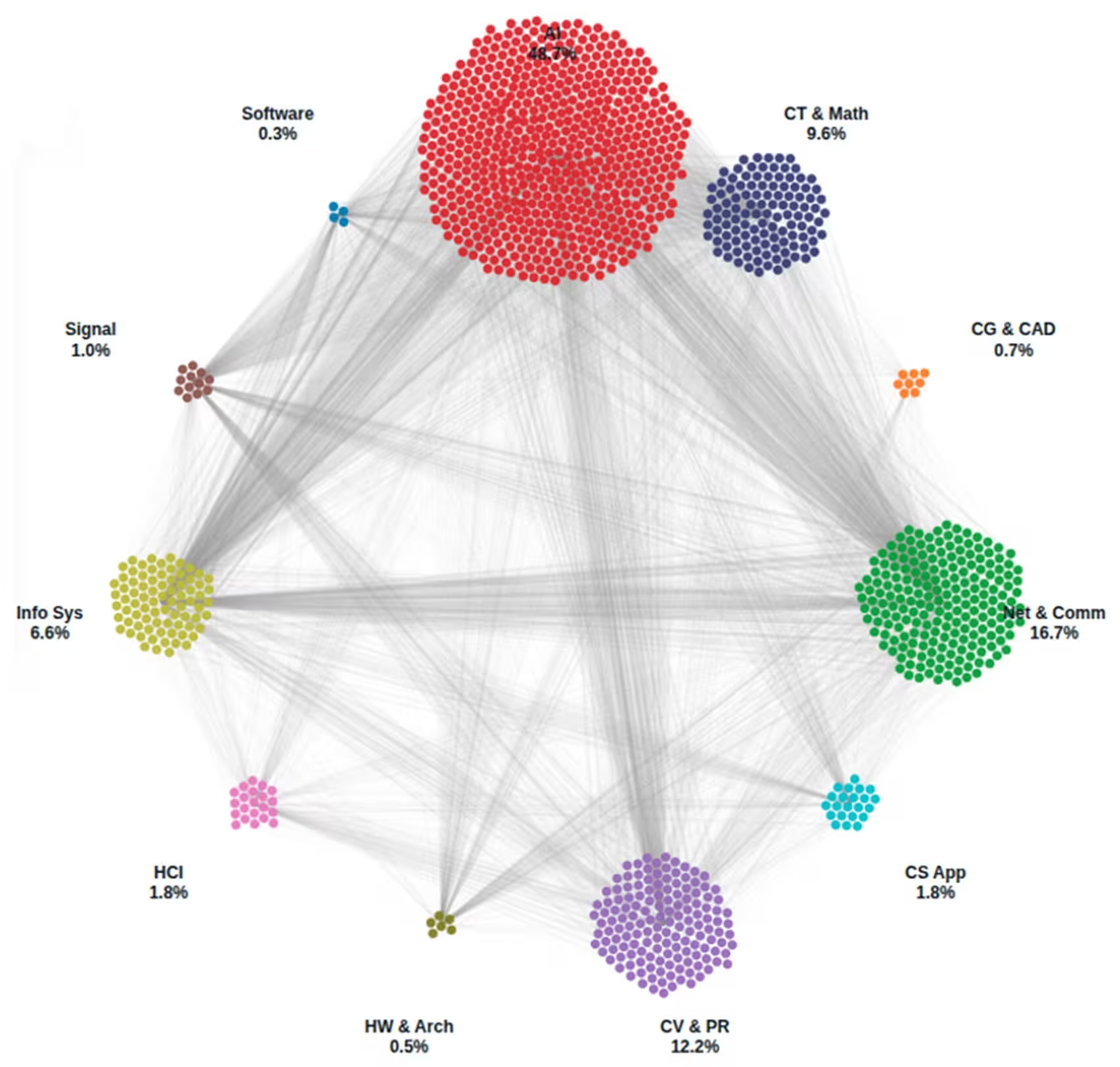
The longitudinal analysis uncovered three distinct waves of innovation within the Italian computer science community between 1980 and 2025. The first wave, spanning 1990 to 2005, focused on foundational computing, formal verification, and high-performance systems. The second wave, from 2000 to 2015, marked a methodological shift toward computer vision, machine learning, and data science. The final wave, covering 2015 to 2025, shows explosive growth in artificial intelligence, deep learning, natural language processing, and health informatics.
To avoid misclassifying ordinary volume growth as emergence, the team developed a percentile-based detection algorithm using moving historical baselines. This technique successfully identified when complex fields like quantum computing in 1987 or blockchain in 2024 transitioned from obscurity to mainstream visibility. The temporal maps also confirmed that artificial intelligence acts as a massive structural and semantic hub, contributing over half of computer science participation in disciplines like biochemistry, genetics, and medicine.
Limitations and What Comes Next
The authors note several limitations that should temper broad generalizations. The dataset is currently restricted to Italian academic rosters, meaning national evaluation structures and localized funding mechanisms could influence collaboration norms. Furthermore, missing abstracts in roughly 44 percent of historical records create a slight bias toward recent English-language journal publications, while indexing lag introduces right-censoring for the most recent years.
Despite these constraints, the work provides a powerful new lens for science policy and institutional management. By identifying thousands of unrealized collaboration opportunities and mapping the exact pathways of interdisciplinary convergence, the framework offers a roadmap for moving beyond flat metrics and toward a deeper understanding of how scientific knowledge actually grows.
The research was published in PLOS Complex Systems on November 20, 2026.
This article has been fact checked for accuracy, with information verified against reputable sources. Learn more about us and our editorial process.
Last reviewed on .
Article history
- Latest version
Reference(s)
- Pretolesi, Daniele., et al. “Quantifying impact and innovation in scientific publications: A structural–semantic framework combining co-authorship and research topics in Italian computer science.” PLOS Complex Systems, vol. 3, no. 11, November 20, 2026, pp. e0000142 Public Library of Science (PLoS), doi: 10.1371/journal.pcsy.0000142. <https://doi.org/10.1371/journal.pcsy.0000142>.
- Posted by John Williams