Shoe-Connecting Springs Cut Running Energy Cost at Faster Speeds
Musculoskeletal simulations and human trials reveal how passive exotendons reduce metabolic demand, though stability adjustments limit some designs.
Running faster without burning extra energy could soon become easier thanks to a lightweight, passive cable device that connects a runner’s shoes. Researchers tested whether this spring-like gadget, known as an exotendon, can lower metabolic costs at higher speeds than previously proven possible.
Engineered wearable assistive devices are increasingly deployed in sports to shave precious fractions of a percent off an athlete’s energy expenditure. While previous experiments showed that passive extension springs linking the feet can cut the metabolic cost of running by 6 to 8 percent at a moderate speed of 2.7 meters per second, their efficacy at faster paces remained a mystery. Testing every possible combination of spring stiffness and length through trial and error would demand exhausting physical testing from human participants. To bypass this bottleneck, a team of biomechanics researchers developed a computational muscle-driven simulation framework to predict how different configurations would perform at a brisk 4 meters per second.
Predicting Optimal Spring Stiffness and Length via Simulation
The research team built their predictive models using OpenSim Moco software, incorporating a generalized musculoskeletal skeleton equipped with 18 Hill-type lower-limb muscles. By simulating 25 distinct combinations of spring stiffness ranging from 30 to 240 Newtons per meter and slack lengths spanning 6.25 to 50 percent of leg length, the computer model mapped out expected metabolic savings. The simulations indicated that most tested configurations would successfully reduce energetic costs during a 4-meter-per-second run, with predicted savings peaking at 12 percent for a long, stiff design configuration.
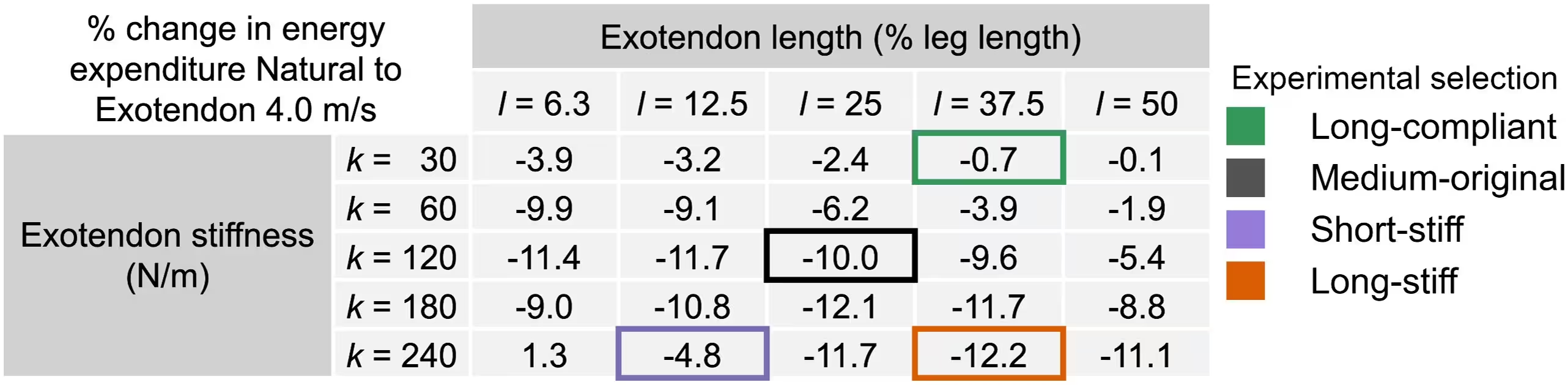
To validate these computational forecasts, the investigators recruited 11 healthy, experienced runners to test four specific exotendon configurations selected from the simulation grid. Following laboratory and at-home familiarization periods totaling hours of running adaptation, the participants returned for treadmill trials. As detailed in the study published in PLOS Computational Biology, the original medium-original design reduced participants’ net energetic cost by an average of 5.7 percent during treadmill running at 4 meters per second.
Why Certain Device Designs Failed to Help Runners
Although computer simulations predicted strong metabolic benefits from the long, stiff spring design, human runners experienced no statistically significant energy savings with that configuration. Motion capture analysis revealed that athletes wearing the stiffer, longer springs adopted noticeably shorter and wider steps. This subconscious widening of the stance width serves as a typical biomechanical strategy to enhance postural stability, but the compensatory muscle activity required to widen the stride counteracts the energetic benefits provided by the spring.
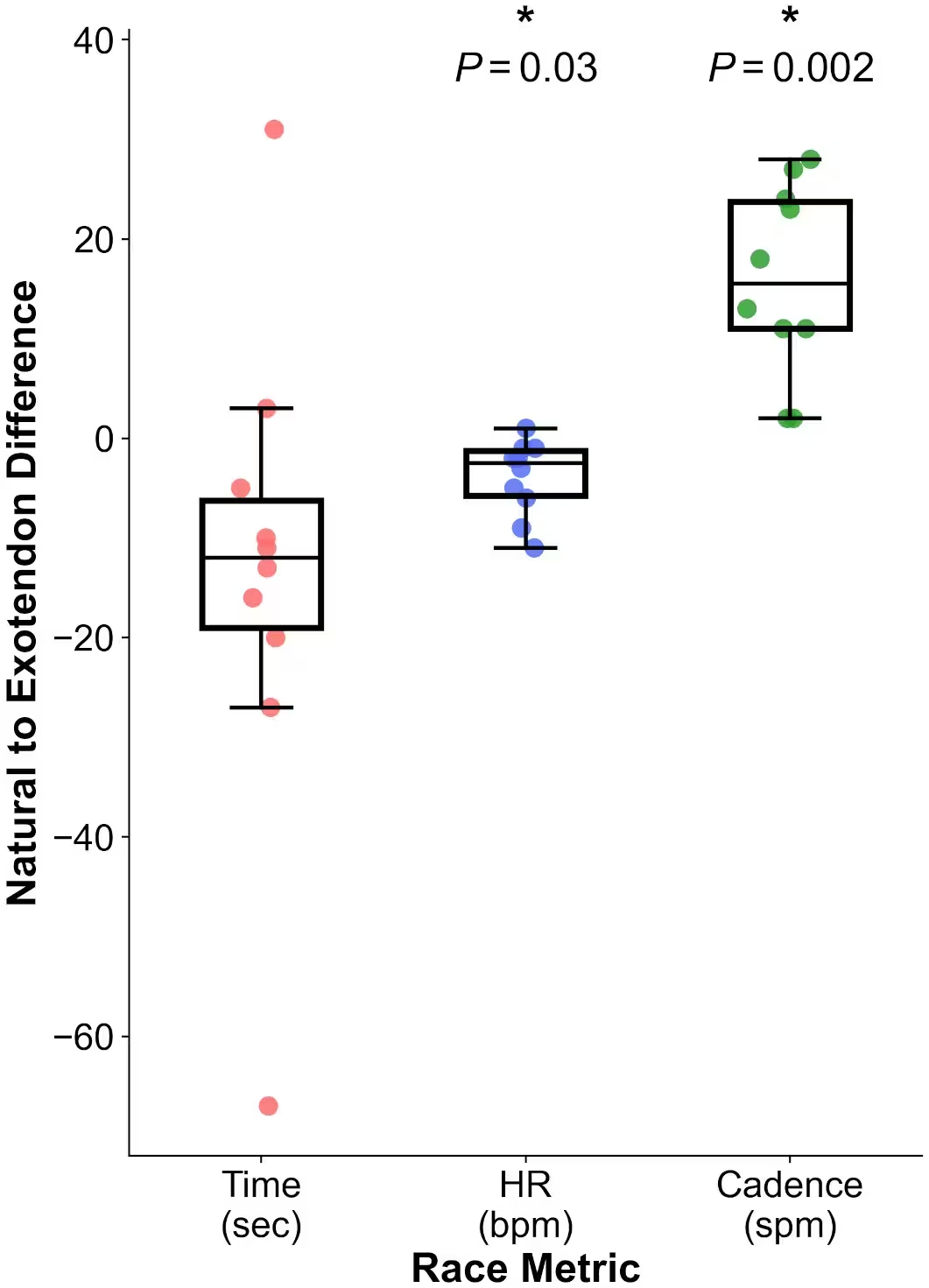
The divergence between computer predictions and human responses highlights a key lesson for wearable robotics development. Energy storage capacity alone does not guarantee performance gains if the device forces the user into awkward movement compensations. Furthermore, when ten of the participants completed a 5-kilometer time trial wearing their individual best-performing exotendons, overall race times did not significantly drop on average, though heart rates decreased significantly by roughly 3.9 beats per minute and step cadence increased.
Next Steps for Personalized Assistive Technologies
The study provides a blueprint for streamlining the creation of wearable sports technology by coupling predictive musculoskeletal models with targeted human trials. By narrowing down 25 design variations in silico, the workflow spared human subjects from grueling hours of physical testing. Future iterations of these simulation frameworks could incorporate subject-specific muscle models and account for stability metrics to better capture why individual runners respond uniquely to identical assistive hardware.
The research was published in PLOS Computational Biology on November 20, 2026.
This article has been fact checked for accuracy, with information verified against reputable sources. Learn more about us and our editorial process.
Last reviewed on .
Article history
- Latest version
Reference(s)
- Stingel, Jon., et al. “Simulation-guided design of exotendons to reduce the energetic cost of running.” PLOS Computational Biology, vol. 22, no. 11, November 20, 2026, pp. e1014203 Public Library of Science (PLoS), doi: 10.1371/journal.pcbi.1014203. <https://doi.org/10.1371/journal.pcbi.1014203>.
Cite this page:
- Posted by Rohan Kumar