Asymmetric Astigmatism Reveals Surprising Vision Results After Cataract Surgery
A new clinical study evaluates how artificial lens implants perform in eyes with uneven bowtie corneal shapes compared to symmetric ones.
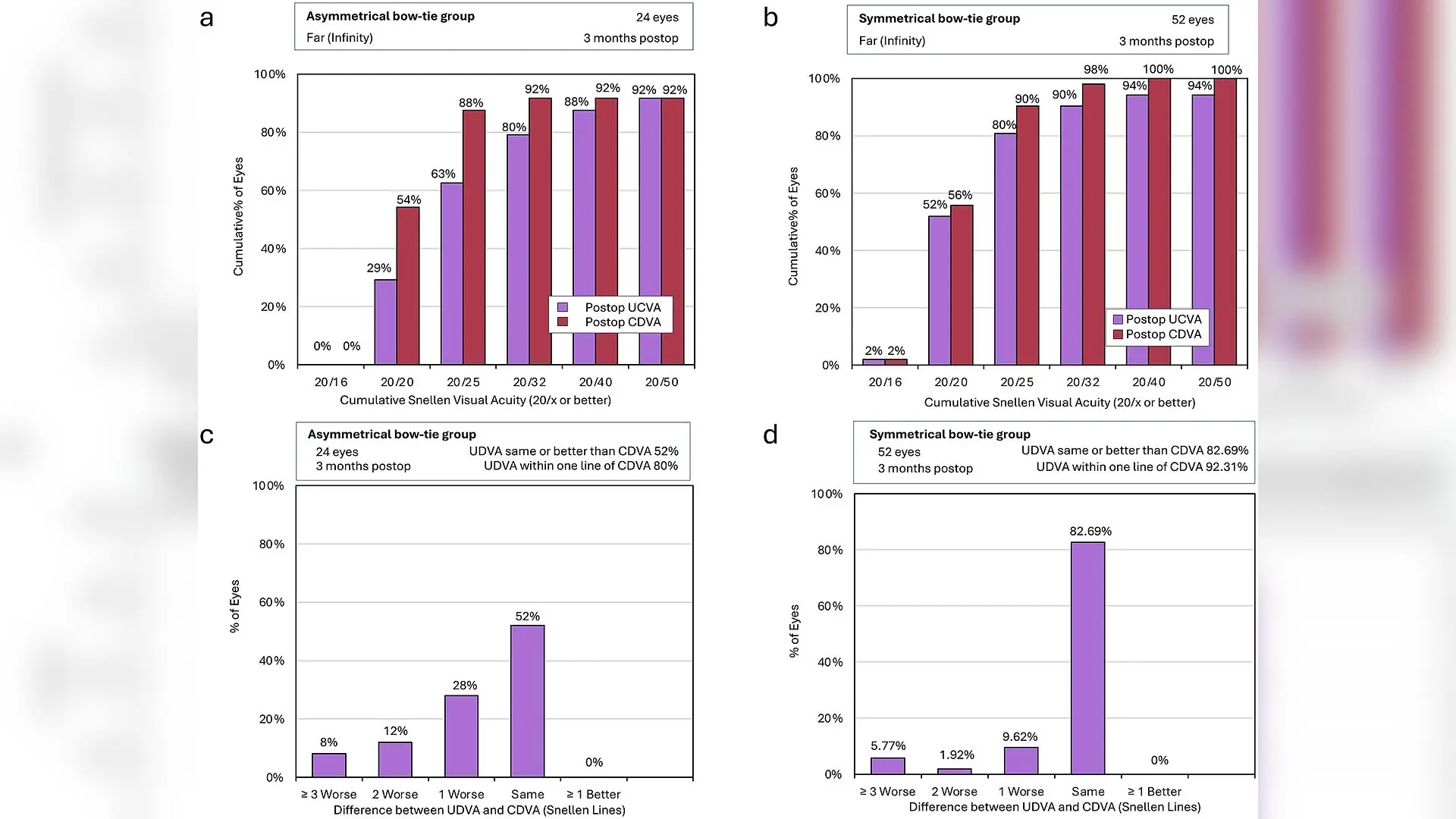
Cataract surgery patients with unevenly shaped corneas often achieve high rates of spectacle independence despite leaving behind slightly more residual astigmatism than those with perfectly symmetrical eyes. A retrospective chart review of 76 eyes from 60 patients published in PLOS One evaluated how well specialized artificial lenses correct vision when the front surface of the eye displays an asymmetric bowtie pattern compared to a symmetric layout.
Comparing Two Distinct Corneal Astigmatism Patterns
Astigmatism occurs when the cornea is curved more steeply in one direction than another, often resembling a bowtie shape on topographic scans. While symmetric bowtie astigmatism features evenly balanced curves, asymmetric bowtie patterns show marked differences between the superior and inferior halves or skewed radial axes. Researchers led by Natpachara Emmaneerat and colleagues at King Chulalongkorn Memorial Hospital set out to determine if standard toric intraocular lenses, which are artificial lenses built to correct astigmatism during cataract removal, perform equally well across both corneal shapes.
The study analyzed 24 eyes with asymmetric bowtie astigmatism and 52 eyes with symmetric bowtie astigmatism treated between December 2021 and February 2024. All participants underwent standard phacoemulsification, a modern surgical technique where the cloudy natural lens is broken up using ultrasound and replaced with a clear artificial lens. Visual outcomes, residual refractive errors, and the rate of spectacle independence were assessed at a three-month postoperative follow-up mark.
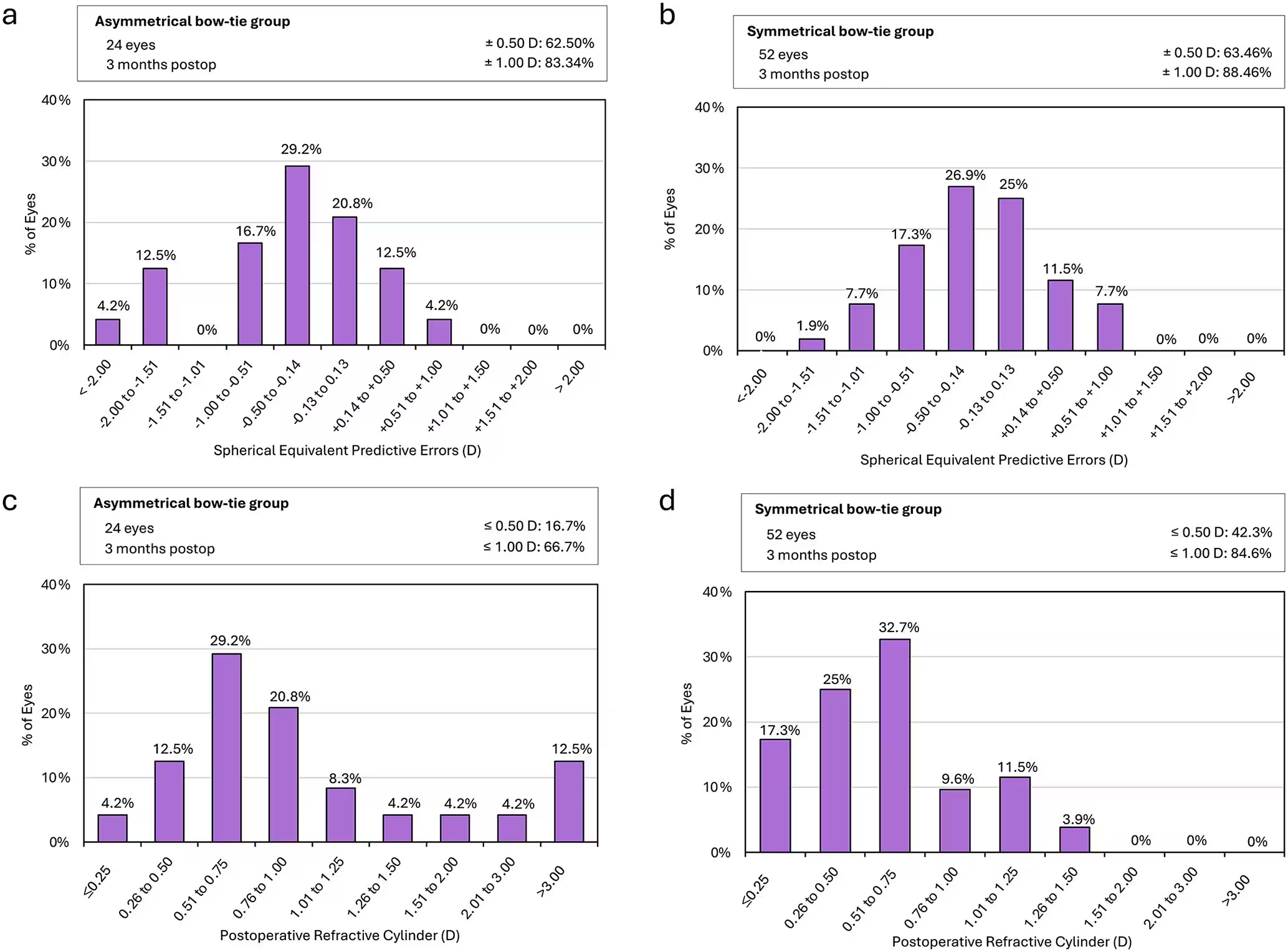
Visual Acuity and Residual Refractive Differences
At three months post-surgery, patients with symmetric bowtie astigmatism achieved a median uncorrected distance visual acuity of 0.00 logMAR, while those in the asymmetric group registered a median of 0.10 logMAR. Furthermore, roughly 52 percent of the symmetric group achieved 20/20 vision or better without glasses, compared to about 29 percent of the asymmetric group. The median residual astigmatism measured −0.70 diopters in the symmetric cohort and −1.39 diopters in the asymmetric cohort.
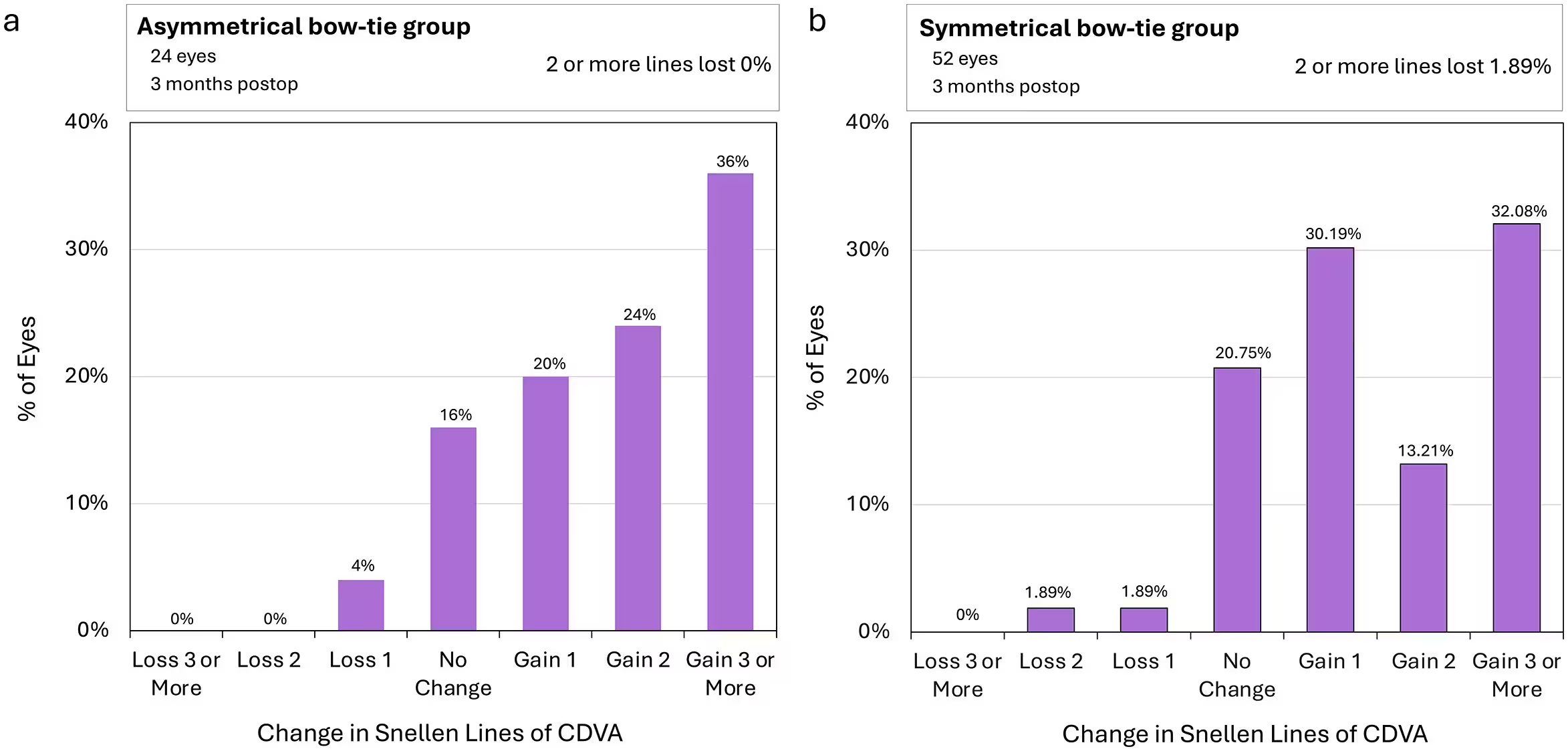
Despite these numeric differences in uncorrected vision and residual cylinder power, other important metrics remained remarkably similar. Corrected distance visual acuity, efficacy indices, and overall safety measures showed no statistically significant divergence between the two patient populations. Most importantly, spectacle independence reached 88.89 percent in the asymmetric group and 81.82 percent in the symmetric group, demonstrating that most individuals no longer required glasses for distance viewing regardless of their initial corneal topography.
Understanding the Limitations and Future Research
The authors noted several important limitations to their findings, primarily the retrospective design and the reliance on manifest refraction-derived residual astigmatism rather than systematic postoperative verification of actual intraocular lens axis position. Without direct slit-lamp axis photography, it remains difficult to determine whether the higher residual astigmatism in asymmetric eyes stems from true lens rotation, posterior corneal astigmatism, or uncorrected higher-order aberrations like coma. Additionally, the relatively short three-month follow-up window does not account for potential long-term changes or late lens shifts.
Future prospective investigations incorporating wavefront aberrometry and dedicated alignment photography will help clarify how higher-order aberrations influence visual quality in asymmetric corneas. Nonetheless, the current clinical data indicates that toric lens implantation remains a safe and highly effective option for patients with asymmetric bowtie astigmatism, delivering excellent functional vision and high freedom from spectacles.
The research was published in PLOS One on November 13, 2026.
This article has been fact checked for accuracy, with information verified against reputable sources. Learn more about us and our editorial process.
Last reviewed on .
Article history
- Latest version
Reference(s)
- Emmaneerat, Natpachara. “Evaluating toric intraocular lens outcomes: A comparison between asymmetric and symmetric bowtie astigmatism.” PLOS ONE, vol. 21, no. 11, pp. e0362262, doi: 10.1371/journal.pone.0362262. <https://doi.org/10.1371/journal.pone.0362262>.
Cite this page:
- Posted by Robert Brown