Can a Single iPad Camera Really Replace a Motion Capture Lab
A new study reveals that tablet-based video tracking can measure walking speed reliably, but stumbles on finer movement details.
A single iPad camera can capture walking speed almost as accurately as a roomful of expensive motion-tracking gear, but measuring every aspect of human movement with just one lens remains surprisingly tricky. Researchers studying the mechanics of human locomotion found that while a basic tablet setup delivers reliable readings for overall walking speed, it struggles to track subtle timing changes in individual steps. The work, published in PLOS One, offers a clear-eyed look at what simplified video analysis can and cannot achieve when compared to professional biomechanical laboratories.
How One Camera Compares to Eight
Traditional gait analysis requires specialized laboratory infrastructure, expensive multi-camera arrays, and reflective markers taped to anatomical landmarks on the body. To test a more accessible alternative, investigators examined 36 healthy adults with an average age of 18.7 years as they walked back and forth along a 10-meter indoor walkway. Every participant was recorded simultaneously by an eight-camera reference system and a single 11-inch iPad Pro recording at 30 frames per second. The evaluation included 458 paired walking trials across three different conditions, consisting of normal walking, carrying a 4.5-kilogram backpack, and using a mobile phone.
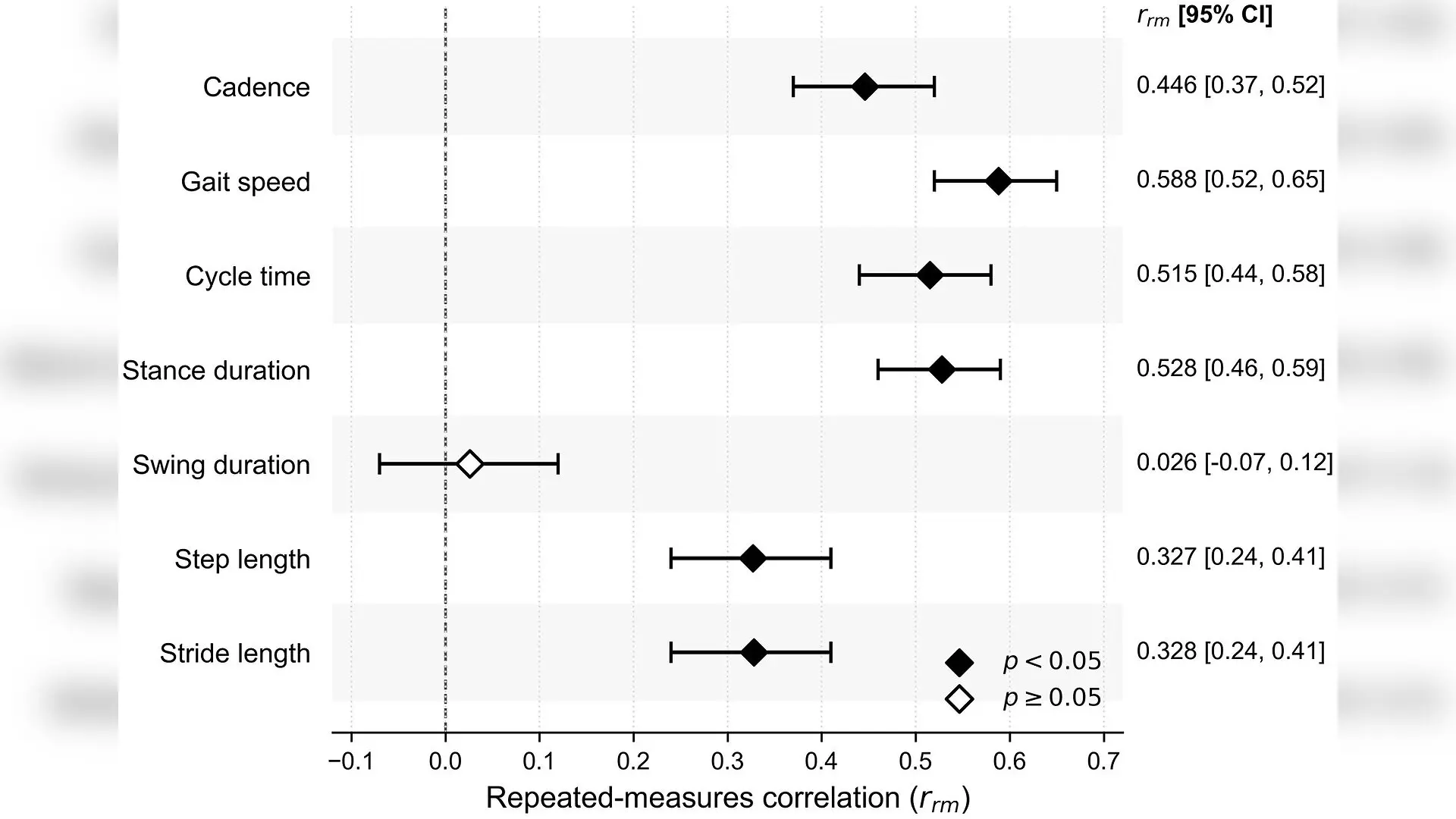
The single-camera setup processed video using artificial intelligence pose estimation software to extract the coordinates of the heels, toes, and hips from two-dimensional footage. When the team ran the numbers, gait speed showed a strong within-participant association with the eight-camera gold standard. The iPad-based setup underestimated walking speed by an average of just 0.019 meters per second, proving that everyday mobile devices can capture gross forward progression remarkably well.
The Hidden Catch in Step Timing and Swing Duration
Despite the strong performance for overall speed, other walking metrics proved far more challenging for the single-camera approach. Swing duration, which measures the fraction of a stride when the foot is off the ground, showed a near-zero correlation with the reference system despite having a tiny average difference. Because the iPad camera recorded at 30 frames per second, successive frames were separated by about 33 milliseconds. That temporal gap is simply too coarse to capture fast-moving foot transitions with the precision of a 100-hertz laboratory system.
The analysis also revealed significant proportional bias across all seven measured variables, meaning the discrepancies between the two systems grew larger at faster or slower walking speeds. Furthermore, spatial measurements like step length and stride length relied on a flat checkerboard reference placed in the background rather than true three-dimensional depth mapping. Because the checkerboard sat at a different distance from the camera than the walking path, perspective distortion crept into the spatial calculations.
What These Results Mean for Future Mobile Health Tools
Test-retest reliability across four separate visits two weeks apart showed that the single-camera system was highly dependent on the specific metric being observed. Gait speed demonstrated good reliability across all walking conditions, while cadence and stance duration scored in the moderate-to-good range. However, swing duration scored poorly, highlighting the inherent limits of low-framerate video for micro-timing events.
The authors emphasize that these findings apply specifically to young, healthy adults tested under pristine laboratory conditions with fixed camera angles. Translating this technology to older adults, individuals with neurological conditions, or patients using assistive devices will require much more rigorous testing. For now, the research suggests that single-camera pose estimation is a powerful tool for measuring basic walking speed, but clinicians should remain cautious before relying on it for detailed asymmetry or fine temporal diagnostics.
The research was published in PLOS One on November 20, 2026.
This article has been fact checked for accuracy, with information verified against reputable sources. Learn more about us and our editorial process.
Last reviewed on .
Article history
- Latest version
Reference(s)
- Weber, Bethany., et al. “Comparative evaluation of single and multiple camera-based pose estimation methods for gait spatiotemporal parameter estimation.” PLOS One, vol. 21, no. 11, November 20, 2026, pp. e0363369 Public Library of Science (PLoS), doi: 10.1371/journal.pone.0363369. <https://doi.org/10.1371/journal.pone.0363369>.
Cite this page:
- Posted by Priya Sharma