Strange Black Hole Discovery Breaks Universal Entropy Rules
New calculations reveal multi-horizon black holes with entropy products that defy standard physics and refuse to reach an extremal state.
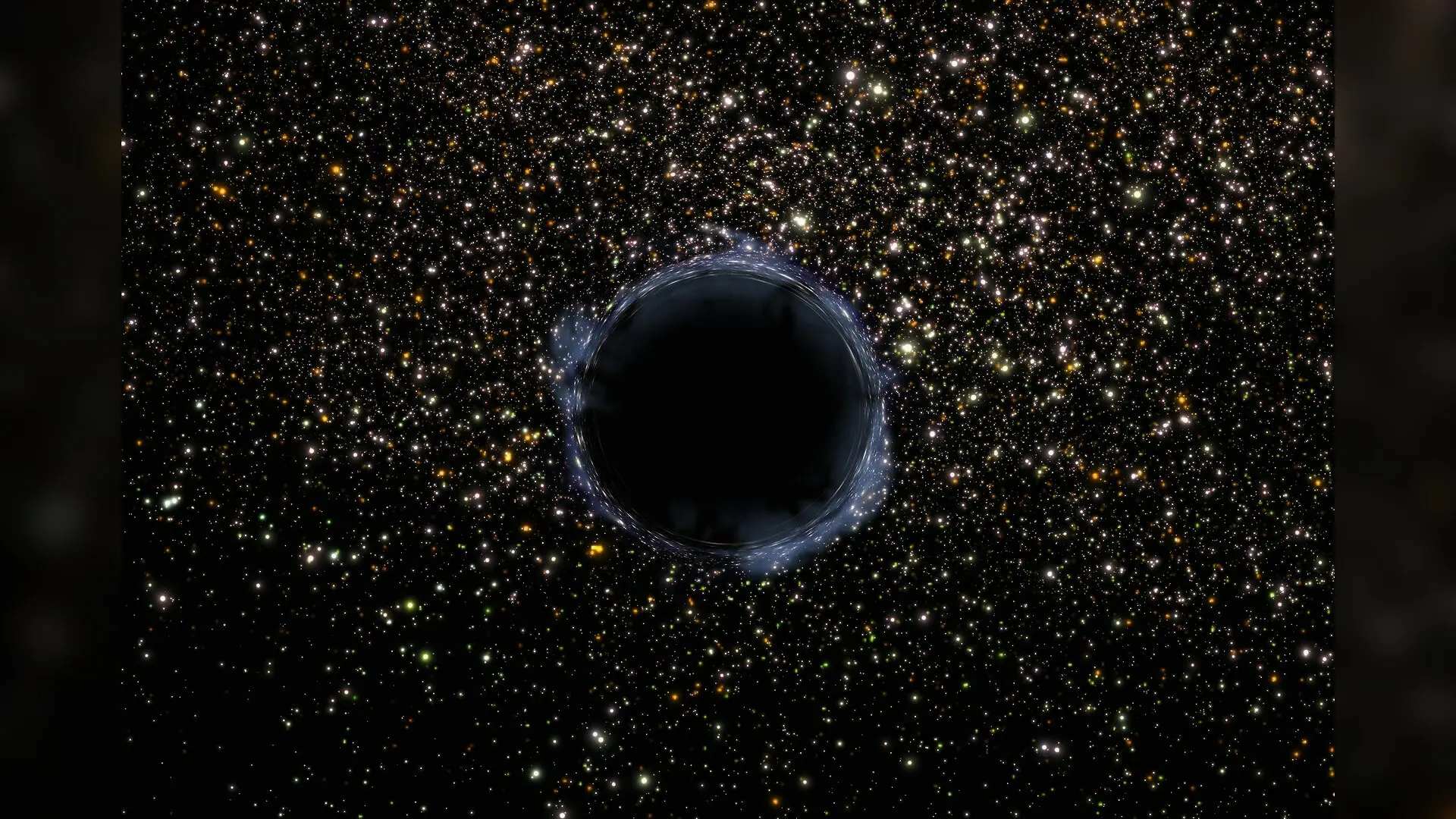
A new theoretical investigation reveals that certain multi-horizon black holes harbor entropy values that defy standard universal rules, refusing to reach the expected extremal state even under extreme physical conditions. Physicists have long relied on the principle that the product of the areas of a black hole’s inner and outer event horizons is strictly fixed by its fundamental charges and coupling constants. However, recent calculations show this rule breaks down across disconnected regular branches in specific theoretical frameworks.
When investigating four-dimensional Einstein-Maxwell-scalar theory—a framework combining gravity, electromagnetic fields, and a neutral scalar field—the researchers constructed asymptotically flat black hole solutions with entropy products sitting either above or below the squared extremal entropy. The study, available on the arXiv preprint server, demonstrates that exact inner horizon regularity selects isolated scalar values, allowing distinct families of black holes to share identical charges and couplings while maintaining different horizon area products and masses.
Why Standard Universal Formulas Fall Short
For decades, physicists understood that charged black holes governed by the attractor mechanism obey a neat product rule linking the inner and outer horizons to the entropy of an extremal black hole. This relationship acted as a finite-temperature equivalent of the attractor mechanism, holding true across broad classes of solutions. The new work indicates that this constancy is a localized feature rather than a universal law across all possible configurations.
By analyzing non-constant scalar profiles, the authors—Kevin Goldstein, Vishnu Jejjala, and Suresh Nampuri—found that scalar gradients compete directly with displacement from the standard attractor value. These competing forces cause the horizon area product to shift above or below the traditional baseline. Specifically, numerical follow-ups across various scalar node counts revealed entropy deficits exceeding 10 percent and excesses surpassing 20 percent.
The Extremal Limit That Never Arrives
One of the most striking aspects of these newly mapped branches is their behavior at extreme limits. As these black hole systems evolve toward what should conceptually become an extremal state, the expected smooth transition never materializes. Instead, the spacetime encounters a strict geometric obstruction preventing horizon coalescence.
At the finite-area boundary of each orbit, the temperature drops to zero while the total mass and asymptotic scalar field diverge to infinity. The inner and outer horizon areas remain distinctly unequal, and the system fails to reach a regular extremal limit because the asymptotically flat boundary conditions degenerate. Rather than collapsing into a standard cold extremal black hole, the configuration experiences a runaway scalar modulus where physical properties scale wildly.
What This Means for Black Hole Thermodynamics
These findings highlight that knowing a black hole’s mass, charges, and coupling constants is sometimes insufficient to determine its complete thermodynamic profile. The specific regular branch or history of the black hole must also be specified to know its exact entropy product. While these theoretical models involve idealized scalar fields rather than astrophysical black holes observed in our universe, they deepen the theoretical understanding of internal black hole mechanics and the boundaries of gravitational thermodynamics.
The study was posted to the arXiv preprint server on November 19, 2026.
This article has been fact checked for accuracy, with information verified against reputable sources. Learn more about us and our editorial process.
Last reviewed on .
Article history
- Latest version
Reference(s)
- Goldstein, Kevin. “Entropy Products and the Extremal Limit That Never Comes.” arXiv.org <http://arxiv.org/abs/2611.26628v1>.
Cite this page:
- Posted by Nida Rehman