Astronomers Detect Most Distant Blazar Ever Seen Pointing Straight at Earth
Astronomers have detected record-breaking light from a distant supermassive black hole, offering new insights into cosmic evolution and intergalactic space.
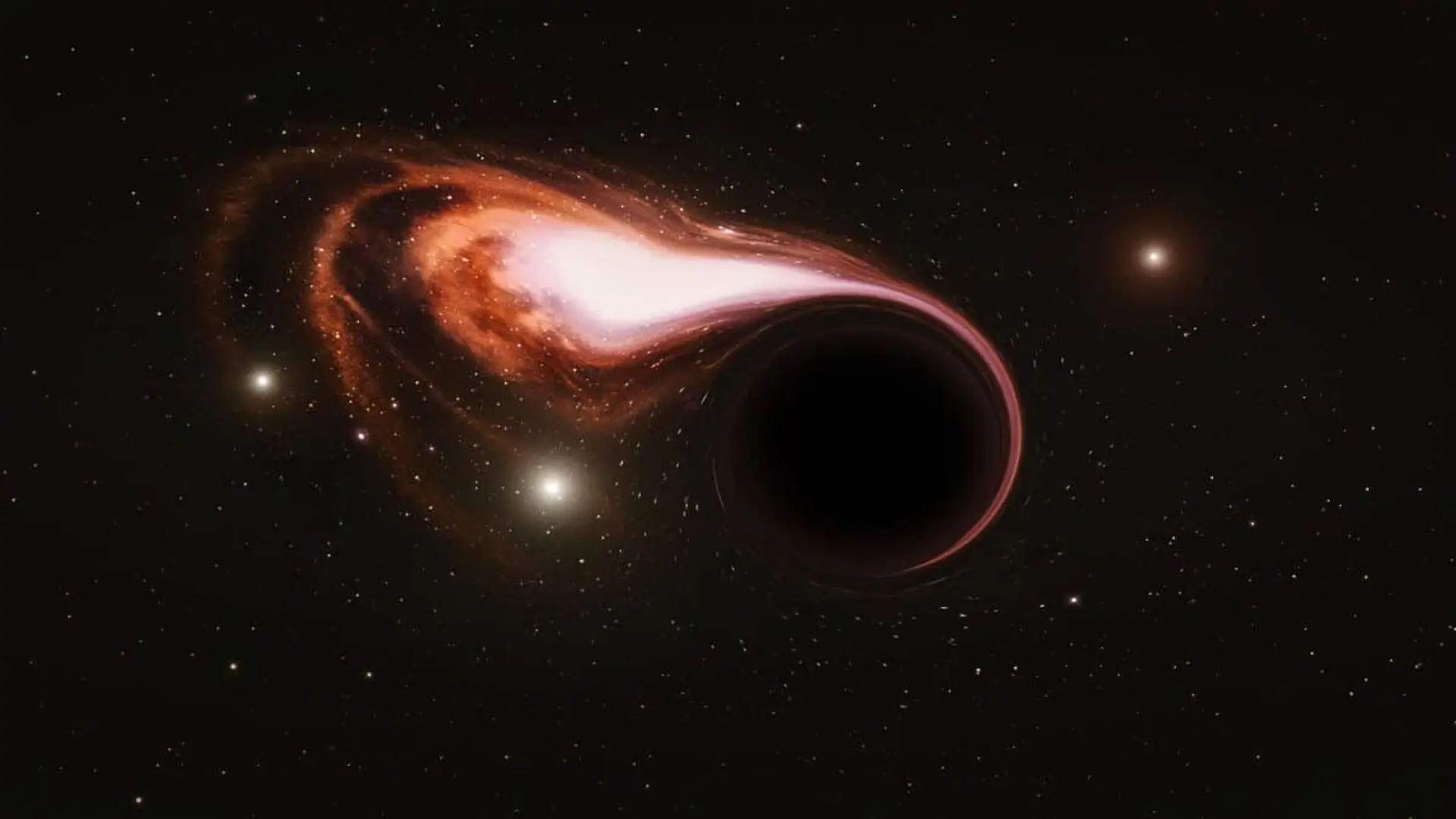
Astronomers have identified a record-breaking blazar, marking the most distant object of its kind ever observed at extreme gamma-ray energy levels. Known as OP 313, this cosmic powerhouse features a central supermassive black hole that launches a high-speed jet of plasma directly toward our solar system. The radiation detected by researchers originated roughly 8 billion years ago, providing a window into the universe when it was only about 5 billion years old.
Blazars represent some of the most energetic phenomena in the cosmos. They are fueled by supermassive black holes that actively consume surrounding gas and dust. During this process, a fraction of that matter is accelerated into jets moving at near-light speed. Because these jets are pointed squarely at Earth, observers can detect their intense radiation even across vast, light-spanning distances.
A Journey Across Eight Billion Years
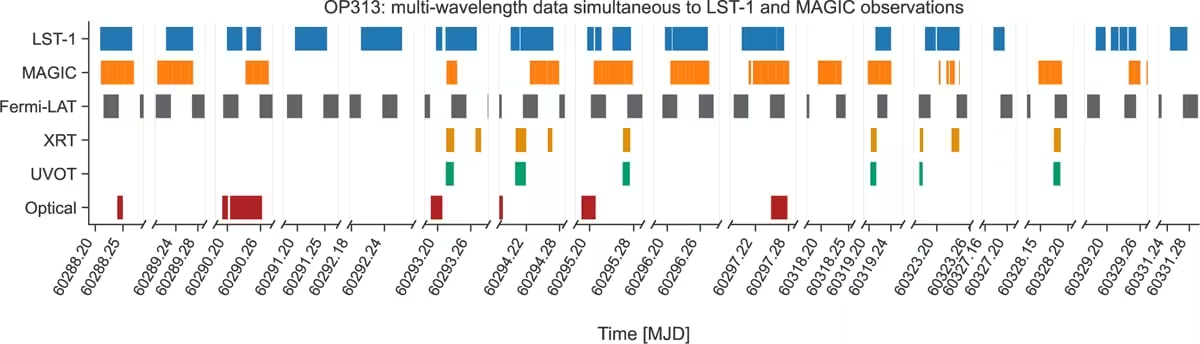
The discovery began in late 2023 when high-energy radiation from the direction of OP 313 was first flagged. To confirm the source and analyze its properties, scientists utilized the Large-Sized Telescope prototype (LST-1) and the Major Atmospheric Gamma-ray Imaging Cherenkov (MAGIC) telescopes. Both installations are situated at the Roque de los Muchachos Observatory on La Palma, Spain, where they serve as vital tools for deep-space monitoring.
The data confirmed that the gamma rays reached Earth after an 8-billion-year transit. This observation is particularly significant because it captures the universe during a transitional phase following the era of “cosmic noon,” a time roughly 11 billion years ago marked by the peak of star and galaxy formation. As research team member Axel Arbet-Engels noted in a university statement, the signal dates back to when the universe began shifting from a period of frantic activity toward a more mature, stable evolutionary path.

Mechanisms Behind the Extreme Output
The intense radiation emanating from OP 313 is attributed to a “leptonic scenario.” Researcher Domenico Della Volpe explains that the jet contains a dense population of relativistic electrons. As these particles collide with lower-energy photons in the vicinity of the black hole, they transfer their kinetic energy to the photons, effectively “upgrading” them into the high-energy gamma-ray spectrum. This interaction allows astronomers to probe the chaotic environment immediately surrounding the supermassive black hole.
Interactions With Extragalactic Background Light
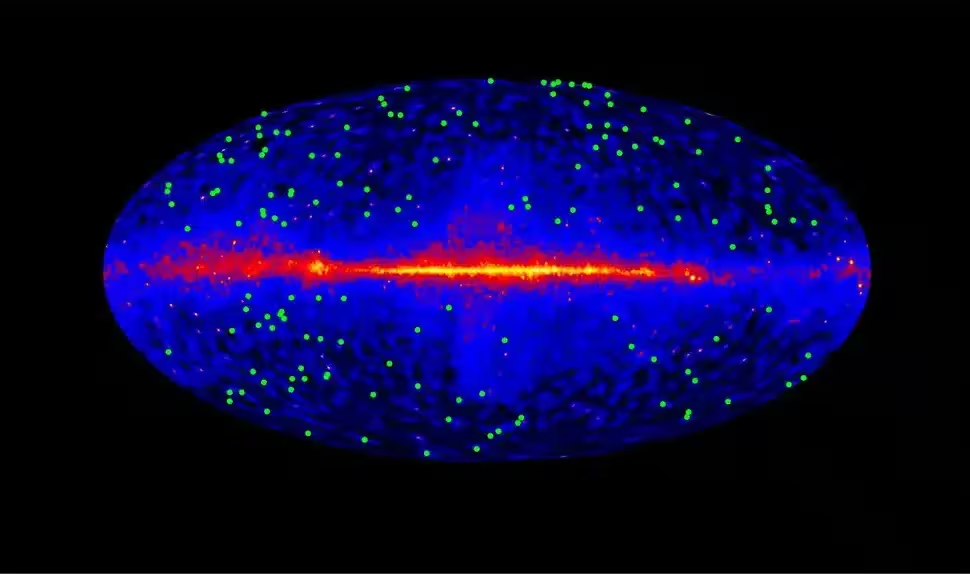
The journey of these photons was not unimpeded. Throughout their multi-billion-year trek, the gamma rays encountered the extragalactic background light (EBL)—a pervasive field of radiation composed of the cumulative light emitted by all stars and galaxies across history. When high-energy gamma rays collide with EBL photons, they can undergo pair production, a process that converts the photon into an electron and a positron. This interaction inevitably depletes the number of high-energy gamma rays that ultimately reach our detectors.
By analyzing the specific patterns of this attenuation, as detailed in the study published in Astronomy & Astrophysics, the team was able to gain deeper insights into both the nature of the blazar’s emission and the composition of the light-filled void between the source and Earth.
This article has been fact checked for accuracy, with information verified against reputable sources. Learn more about us and our editorial process.
Last reviewed on .
Article history
- Latest version
Reference(s)
- “INSPIRE.” <https://inspirehep.net/authors/1748744>.
- “A cosmic beacon detected at the edge of the Universe - Medias - UNIGE.”, October 6, 2026 <https://www.unige.ch/medias/en/2026/un-phare-cosmique-detecte-aux-confins-de-lunivers>.
- “Domenico DELLA VOLPE.” <https://www.unige.ch/dpnc/en/groups/domenico-della-volpe/>.
- <https://www.aanda.org/articles/aa/full_html/2026/08/aa58646-25/aa58646-25.html>.
Cite this page:
- Posted by Farah Siddiqui