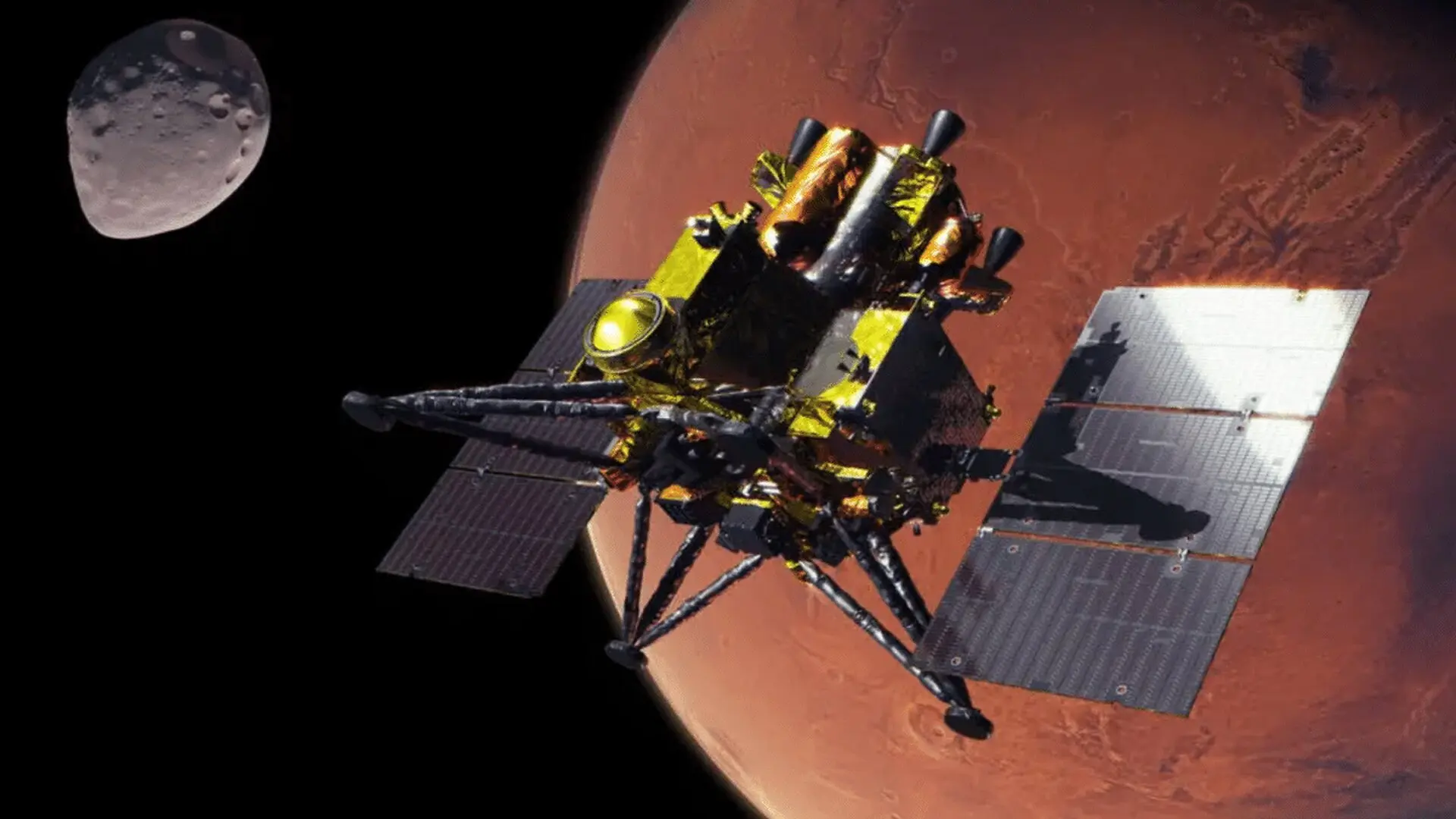
An artist’s concept of JAXA’s (Japan Aerospace Exploration Agency) Martian Moons eXploration (MMX) spacecraft at Mars.
Credit: JAXA | Dungrela Publishing
An ambitious international space endeavor is gearing up for a historic voyage to the Martian moons, with NASA playing a pivotal role in the mission’s technical success. The Japanese-led Martian Moons eXploration (MMX) mission is currently in its final stages of preparation, aiming to conduct an unprecedented study of Phobos and Deimos before returning physical samples from the Martian system to Earth by 2031.
A Strategic Partnership for Deep Space Exploration
Developed by the Japan Aerospace Exploration Agency (JAXA), the MMX spacecraft is slated for lift-off from the Tanegashima Space Center on October 20, 2026, Japan Standard Time (October 19 in the Eastern United States). Unlike traditional rover missions that land directly on the Red Planet, this craft is designed to orbit and eventually touch down upon its two enigmatic satellites.
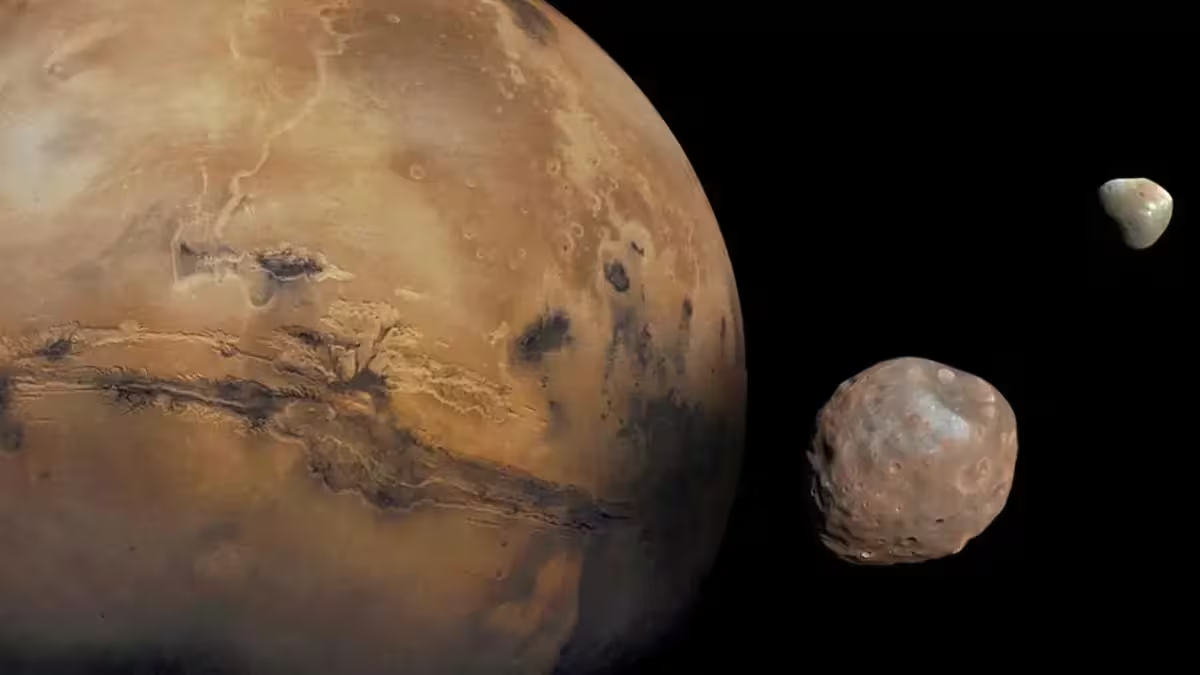
Phobos, the larger and closer of the two moons, has long been a subject of intense scientific debate. Spanning roughly 22 kilometers, it remains a mystery whether the moon is a captured asteroid or the result of a monumental collision between an ancient, larger body and Mars itself. MMX represents the best opportunity yet to resolve this decades-old planetary origin story.
On August 13 at Tanegashima Space Center,
The Martian Moons eXploration (MMX) spacecraft was unveiled.
Activity Report mini
#JAXA #MMX #Tanegashima
▼Related information is here
https://t.co/SFHoGfErq8 https://t.co/u9g8ZI7laj
— JAXA(Japan Aerospace Exploration Agency) (@JAXA_en) September 14, 2026
The spacecraft is projected to reach the Martian system by August 2027. Following a comprehensive survey of both moons, the mission will enter its most critical phase: descending to the surface of Phobos to retrieve samples, a feat never before achieved in space exploration.
Advanced American Technology Drives the Mission
According to NASA, the agency is contributing critical hardware and expertise to bolster the mission’s scientific output. Among these contributions is the Mars-moon Exploration with Gamma-rays and Neutrons (MEGANE) instrument, engineered by the Johns Hopkins Applied Physics Laboratory. By detecting gamma rays and neutrons, MEGANE will provide essential data on the chemical composition of Phobos, offering a window into the building blocks of its surface.
Furthermore, NASA has provided a specialized pneumatic sampling system from Honeybee Robotics. Given the moon’s negligible gravity, standard mechanical scoops are ineffective; the gas-driven system will allow the spacecraft to capture loose regolith safely and reliably. Beyond hardware, the Deep Space Network will serve as the mission’s lifeline, providing the necessary communication infrastructure to navigate the spacecraft across the millions of kilometers separating Earth and Mars.
Credits: NASA/JPL-Caltech/GSFC/Univ. of Arizona
Navigating the Challenges of Low-Gravity Surface Operations
The mission’s success hinges on overcoming the physical constraints of the Martian moons. After arriving in 2027, the spacecraft will spend months surveying potential landing zones, with actual surface sampling currently penciled in for no earlier than December 2028. The environment near Phobos is exceptionally complex, characterized by unpredictable gravity and erratic orbital dynamics that demand high-precision navigation.
Upon completing the sample collection, the craft will begin its return trip to Earth. The arrival of these extraterrestrial samples in 2031 will mark a monumental shift in planetary science, allowing researchers to utilize high-end laboratory equipment to analyze the composition of a Martian moon with unprecedented accuracy.
Unlocking the History of the Solar System
The insights gained from MMX may resonate far beyond the study of the moons themselves. By determining whether Phobos and Deimos are remnants of a massive, ancient impact, scientists could gain a deeper understanding of the volatile history of Mars and the early development of the inner solar system. These findings could potentially bridge the gaps in our current theories regarding planetary formation.
To discuss these contributions and the broader implications of the mission, NASA has scheduled a media teleconference on October 15, 2026, at 4 p.m. EDT. As the launch window opens, the international scientific community watches with anticipation, hopeful that the tiny grains of Phobos will finally solve the riddle of the Red Planet’s mysterious companions.
Fact Checked
This article has been fact checked for accuracy, with information verified against reputable sources. Learn more about us and our editorial process.
Siddiqui, Farah. “NASA Is Helping Japan Launch A Bold Mission To Bring Pieces Of A Martian Moon Back To Earth.” BioScience. BioScience ISSN 2521-5760, 09 October 2026. <https://www.bioscience.com.pk/en/subject/physics/nasa-is-sending-new-technology-to-mars-mysterious-moons-and-the-mission-could-rewrite-their-history>.
Siddiqui, F. (2026, October 09). “NASA Is Helping Japan Launch A Bold Mission To Bring Pieces Of A Martian Moon Back To Earth.” BioScience. ISSN 2521-5760. Retrieved October 09, 2026 from https://www.bioscience.com.pk/en/subject/physics/nasa-is-sending-new-technology-to-mars-mysterious-moons-and-the-mission-could-rewrite-their-history
Siddiqui, Farah. “NASA Is Helping Japan Launch A Bold Mission To Bring Pieces Of A Martian Moon Back To Earth.” BioScience. ISSN 2521-5760. https://www.bioscience.com.pk/en/subject/physics/nasa-is-sending-new-technology-to-mars-mysterious-moons-and-the-mission-could-rewrite-their-history (accessed October 09, 2026).