Astronomers Discover Star That Has Been Gently Eating Its Companion for Billions of Years
Astronomers have discovered a star stripping material from a brown dwarf in a bizarre, record-breaking 87-minute orbit marked by a strange triangular signal.
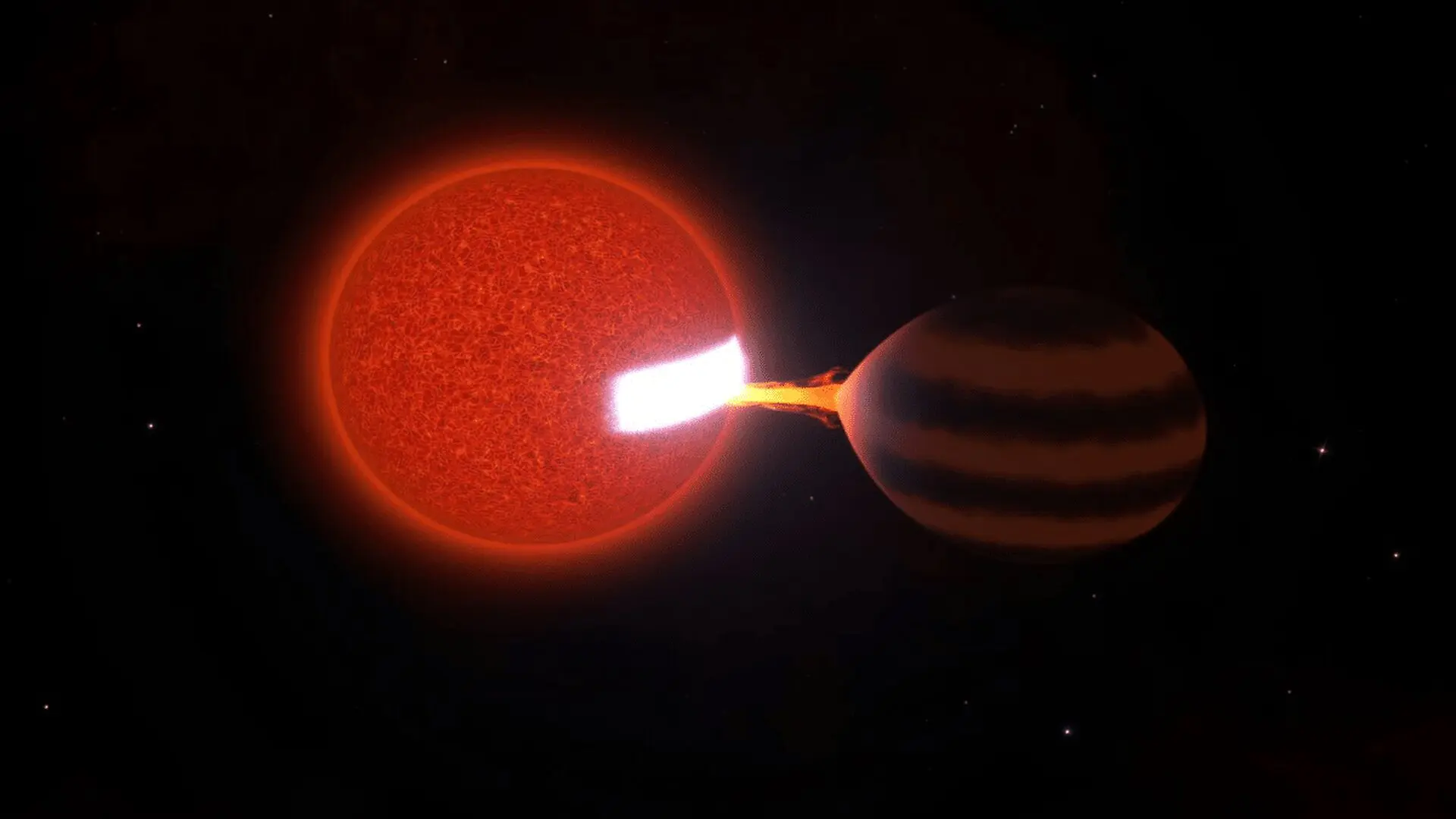
Astronomers have discovered a rare cosmic feeding cycle unfolding just 300 light-years from Earth, where a low-mass star is slowly siphoning material from a brown dwarf. This ongoing celestial interaction, identified in the system known as ZTF J0440+2325, offers a look at a process that deviates sharply from the violent, explosive consumption events typically associated with stellar binaries. The findings were detailed in a study published in Nature Astronomy.
Defying the Usual End-of-Life Scenarios
In most binary systems, planetary companions or brown dwarfs face a grim fate: they either maintain a stable, distant orbit or eventually spiral inward to be shredded and devoured by their host. ZTF J0440+2325 exists in a unique middle ground. Instead of a catastrophic collapse, the system is characterized by a steady, prolonged transfer of matter that may persist for hundreds of thousands of years or longer.
Kevin Burdge, an assistant professor of physics at MIT, notes that the discovery challenges the standard expectation that stellar interaction always leads to total destruction. “When we think of stars interacting with planets or brown dwarfs, the picture is always that the star eventually swallows the other thing,” Burdge explains. “This is what will happen to the Earth when the sun becomes a red giant. But here, we’ve found an alternative: Instead of swallowing the thing up, the star can gradually eat it, for billions of years.”
Decoding an Unexplained Triangular Signal
The mystery of the system first emerged from the Zwicky Transient Facility (ZTF) at the Palomar Observatory in California. While surveying the sky for brightness fluctuations, researchers noticed a source displaying a peculiar, triangular-shaped light curve. The pattern did not align with the typical behavior of variable stars, prompting further investigation.
Initially, the team hypothesized that the system might be a “black widow” binary—a configuration where a high-energy, rapidly spinning neutron star slowly erodes a light companion. However, subsequent data contradicted this. If a massive, dense neutron star were present, the gravitational influence would cause the companion to “whip” back and forth, producing a distinct motion that was entirely absent in this case. The lack of that extreme gravitational signature suggested a much lower-mass pairing.
An Intense 87-Minute Orbital Dance
To confirm the nature of the system, MIT graduate student Aaron Householder and Burdge combined the ZTF data with follow-up observations from several other telescopes. The results revealed an incredibly tight orbit, with the brown dwarf completing a full circuit around the star every 87 minutes. Despite the short period, the system fits within a space smaller than the diameter of the Sun.
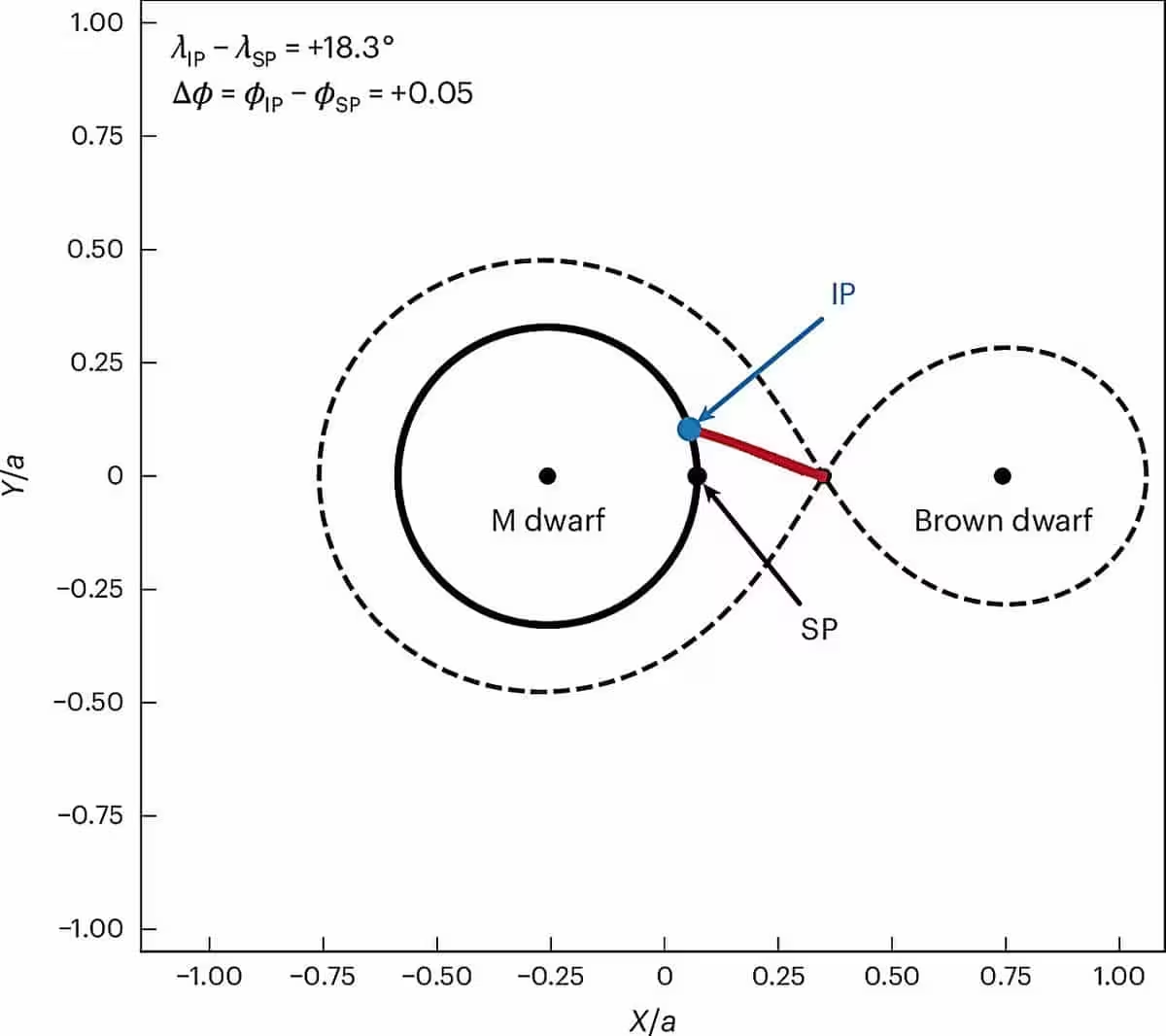
The components are significantly lighter than the objects found in typical accreting binaries: the central star is roughly 85 times the mass of Jupiter, while the companion brown dwarf is approximately 25 times the mass of Jupiter. Because the receiving star is physically large, the material stripped from the brown dwarf does not form a traditional accretion disk. Instead, the gas streams directly onto the stellar surface.
“The difference here is: The thing absorbing matter is not a tiny black hole but a star, which is relatively big in size,” says Burdge. “So matter just pummels directly onto the surface, at very high speeds, like an asteroid hitting the moon.”
This direct bombardment creates a localized hot spot on the surface of the star. As the system rotates, this intense region periodically comes into view, creating the strange triangular light pattern that first alerted astronomers to this extraordinary, long-lived cosmic relationship.
This article has been fact checked for accuracy, with information verified against reputable sources. Learn more about us and our editorial process.
Last reviewed on .
Article history
- Latest version
Reference(s)
- Householder, Aaron. “Stable mass transfer from a substellar object onto an M dwarf - Nature Astronomy.”, October 5, 2026, pp. 1-10. Nature, doi: 10.1038/s41550-026-02992-6. <https://www.nature.com/articles/s41550-026-02992-6>.
Cite this page:
- Posted by Farah Siddiqui