Astronomers Just Detected the First Radio Signal Coming Directly From an Exoplanet
Astronomers have detected auroral radio bursts from a gas giant 63 light-years away, enabling the first direct measurement of an exoplanet’s magnetic field.
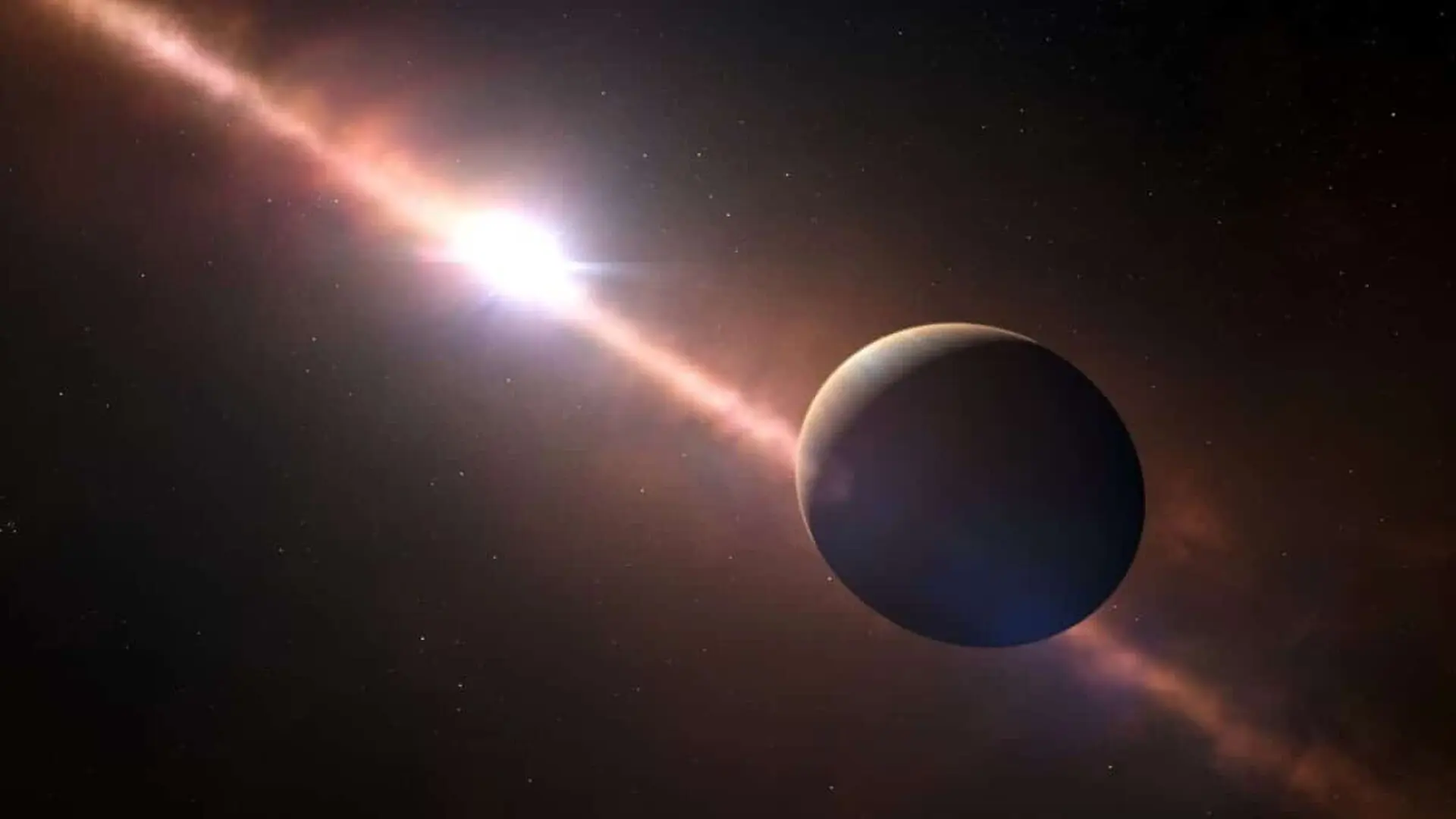
Astronomers have achieved a breakthrough in planetary science by detecting radio emissions directly from an exoplanet for the first time. The signal, which originates from the gas giant Beta Pictoris b, provides the first direct measurement of a magnetic field surrounding a world outside our solar system.
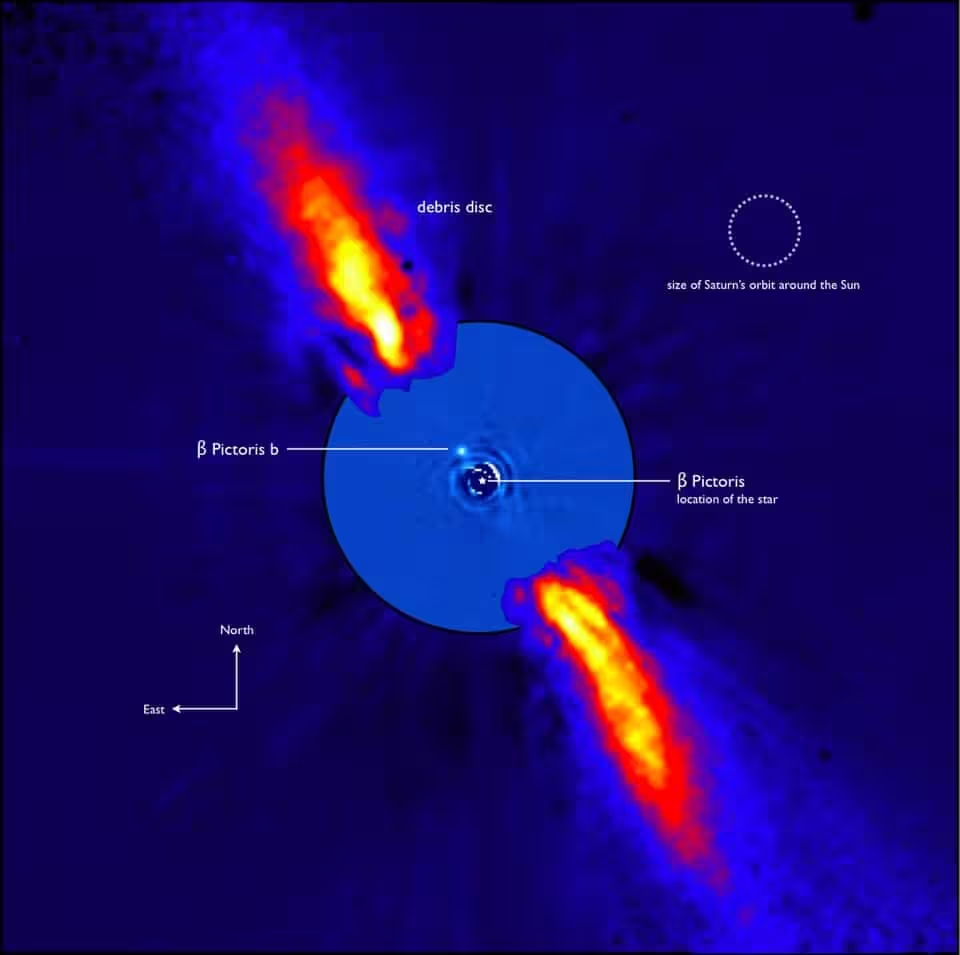
Located approximately 63 light-years away in the constellation Pictor, the Beta Pictoris system is a cosmic laboratory for studying planetary formation. At just 23 million years old, the system is exceptionally young, hosting a massive debris disk and at least two other planets. Beta Pictoris b, first discovered in 2008 by the European Southern Observatory’s Very Large Telescope, is a behemoth with a mass roughly 9 to 13 times that of Jupiter, orbiting its host star at about eight times the distance between Earth and the Sun.
Decoding Auroral Radio Bursts
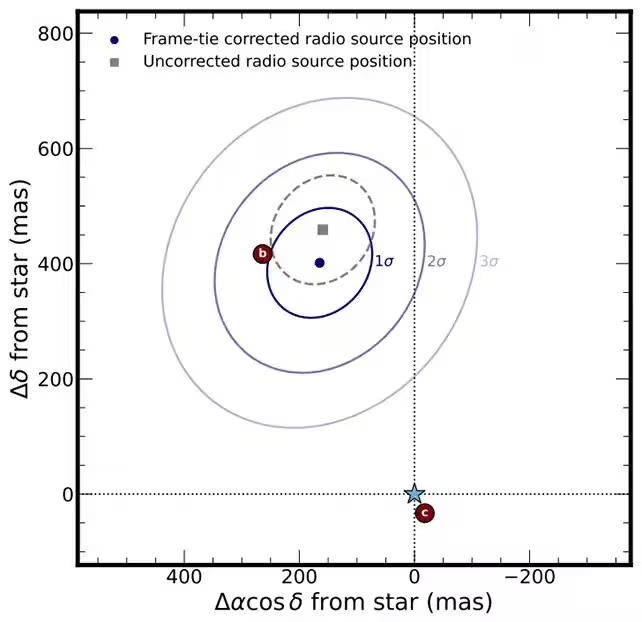
The discovery was made using the MeerKAT radio telescope array in South Africa. A research team led by Kevin Ortiz Ceballos of the Center for Astrophysics | Harvard & Smithsonian successfully isolated radio bursts emanating from the planet itself, distinguishing them from the background noise of the host star. This achievement marks the first instance where such an emission has been definitively linked to an exoplanet.

The emissions are the result of electron cyclotron maser instability, a process identical to the one that powers auroras on Jupiter, Saturn, Uranus, Neptune, and even Earth. In these environments, interactions between the planetary magnetosphere and ionosphere accelerate charged particles, which then release energy in the form of radio waves.
Measuring the Invisible
Because the frequency of these radio signals is tethered to the intensity of the magnetic field at the source, the researchers were able to calculate the magnetic strength of Beta Pictoris b. Their analysis yielded a minimum field strength of 1.25 kilogauss, a value several thousand times more powerful than the magnetic field generated by Earth.
The study, which aligns with theoretical predictions of dynamo scaling for massive young planets, validates existing models on how internal convection cycles build magnetic environments in giants. Beyond the specific finding, the detection provides astronomers with a sophisticated new diagnostic tool. By observing these radio signatures, researchers can now probe the internal structure and magnetic fields of exoplanets without relying exclusively on atmospheric or reflected-light analysis.
This article has been fact checked for accuracy, with information verified against reputable sources. Learn more about us and our editorial process.
Last reviewed on .
Article history
- Latest version
Reference(s)
- “Kevin Ortiz Ceballos | Center for Astrophysics | Harvard & Smithsonian.”, January 11, 2023 <https://www.cfa.harvard.edu/people/kevin-ortiz-ceballos>.
- Ceballos, Kevin. “Discovery of radio emission from the exoplanet $β$ Pictoris b.” arXiv.org <https://arxiv.org/abs/2609.16720v1>.
Cite this page:
- Posted by Farah Siddiqui