Astronomers May Have Found a Massive Giant Planet Orbiting an Unusual Pulsating Star
Astronomers have detected a faint signal in a star’s pulse that could reveal a hidden exoplanet, offering a rare glimpse into an elusive planetary system.

Astronomers have leveraged the rhythmic pulsations of a rare class of stars to hunt for elusive planetary companions, unveiling a potential gas giant in the process. By analyzing data from NASA’s Transiting Exoplanet Survey Satellite (TESS), researchers investigated the behavior of Delta Scuti stars, which oscillate with a regularity that acts as a cosmic metronome, allowing for the detection of gravitational disturbances caused by orbiting bodies.
The study, recently detailed in The Astrophysical Journal, centered on HD 156295, a bright A-type star roughly nine times more luminous than the Sun and possessing a surface temperature of 7,500 degrees Celsius. Within this system, scientists identified a candidate object, designated HD 156295 b, with an estimated mass approximately six times that of Jupiter. This potential world orbits its host at a distance of nearly 4 astronomical units, completing a full revolution in about 2,200 days. While the discovery remains a candidate with a roughly 50 percent probability of being a genuine planet, its location is particularly intriguing, as it sits within the system’s habitable zone and receives about 60 percent of the solar irradiation that reaches Earth.
Innovative Pulsation Timing Reveals Hidden Worlds
Traditional exoplanet searches typically rely on observing the dimming of a star as a planet crosses its face, but this team utilized a technique known as pulsation timing. By monitoring minute fluctuations in the arrival time of a star’s light pulses, researchers can infer the presence of an unseen companion whose gravity subtly tugs the star back and forth.
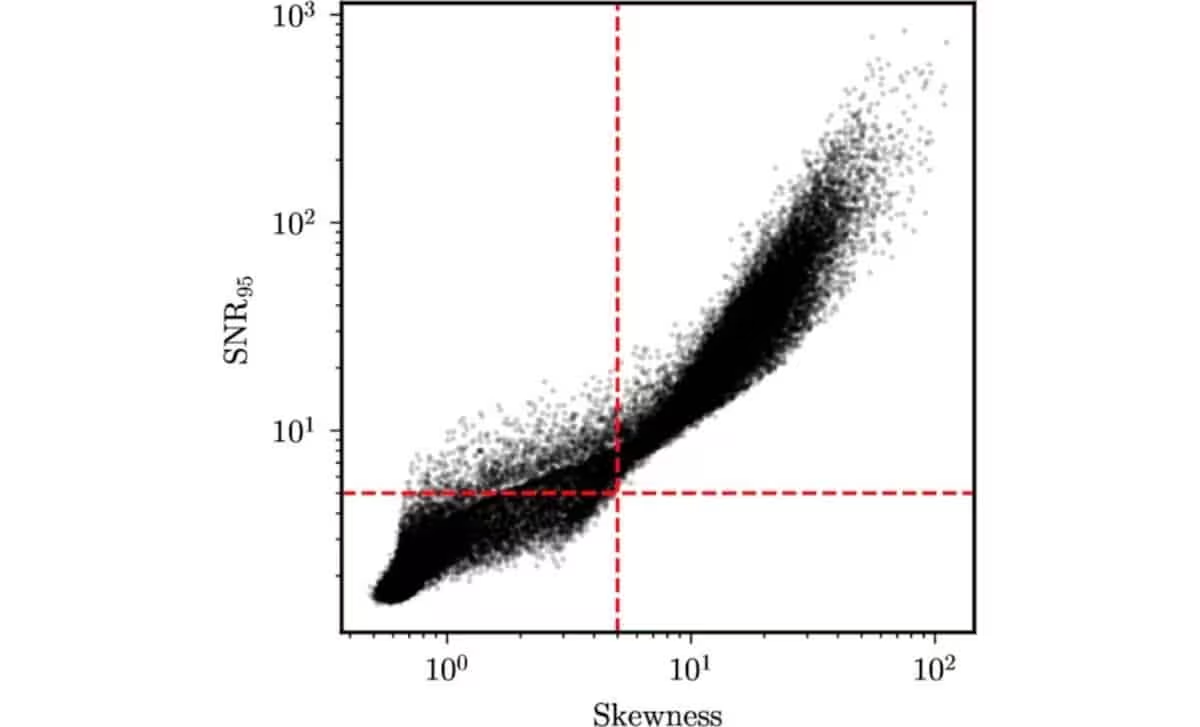
This approach is essential for identifying systems that remain invisible to standard transit methods. However, the authors noted that these signals push the current limits of TESS data. As the study authors emphasized, “The pulsation timing variations presented here are at the boundary of what should be detectable given the TESS data.”
Broadening the Search for Brown Dwarfs
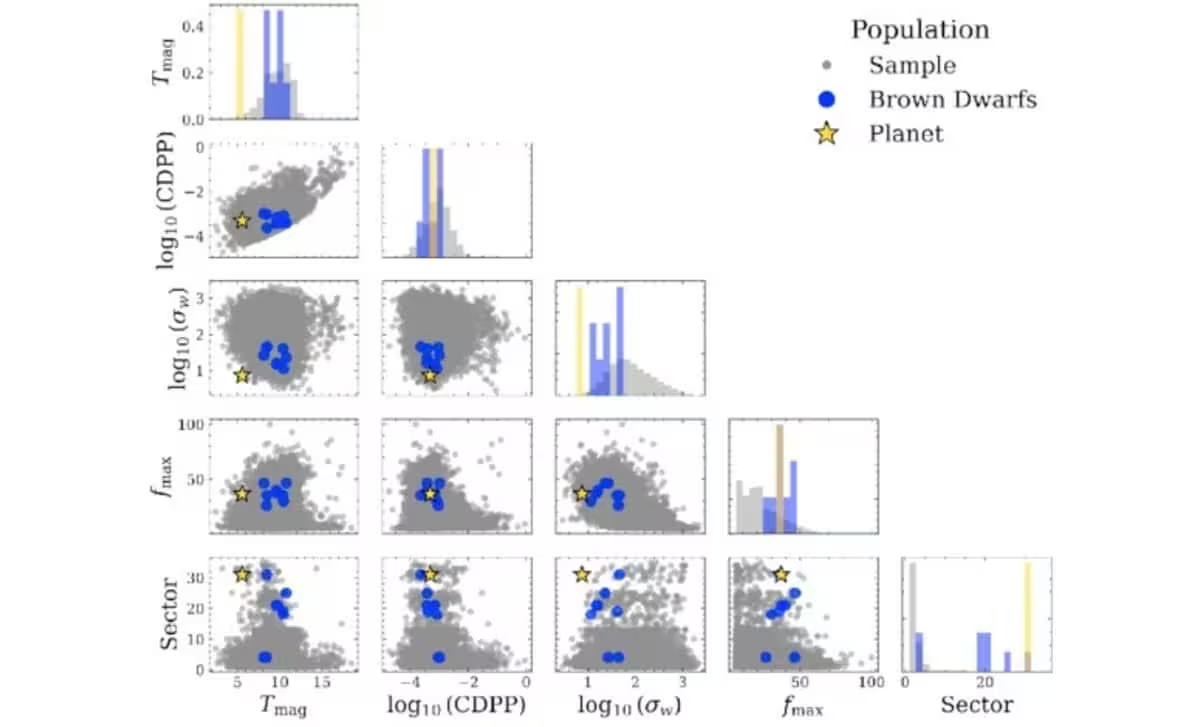
Beyond the candidate around HD 156295, the survey flagged eight additional stellar systems displaying similar gravitational signatures. These companions are likely brown dwarfs—substellar objects that exist in the mass gap between the largest planets and the smallest stars, too heavy for planet classification but lacking the mass to trigger hydrogen fusion. These objects were found to have masses ranging from 25 to 59 times that of Jupiter, with orbital periods stretching between 1,100 and 2,800 days.
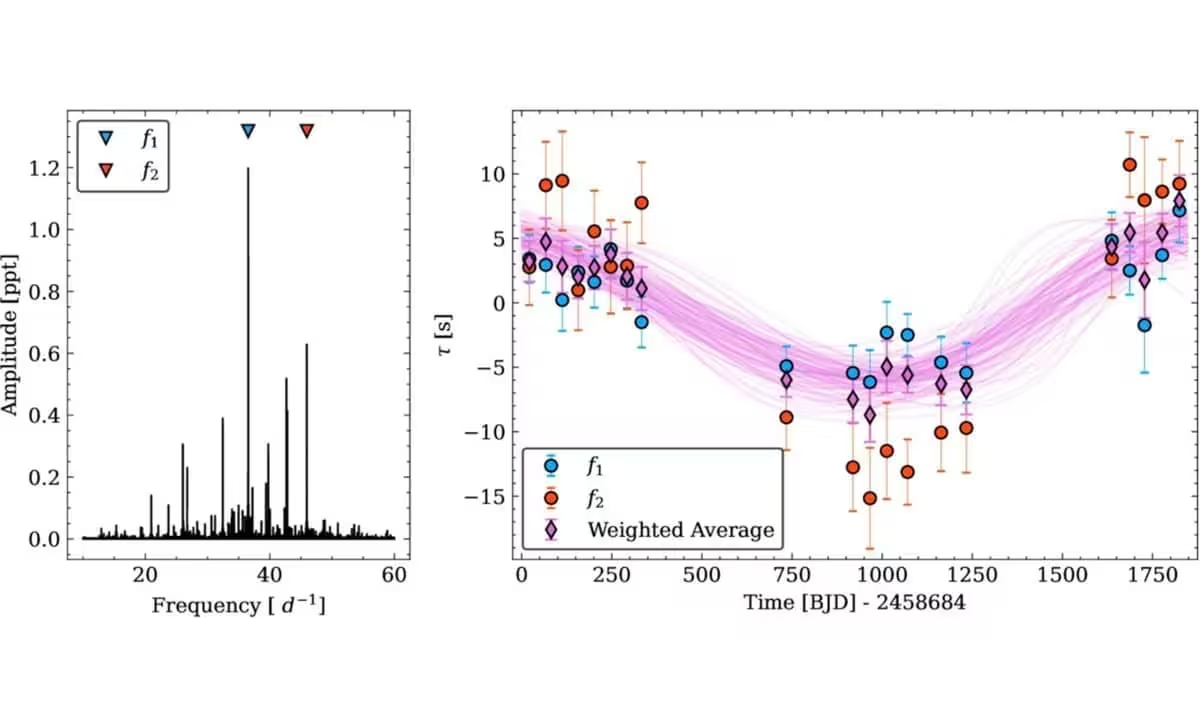
While definitive confirmation of these objects awaits further data, the study underscores the utility of pulsation timing in mapping out complex, distant planetary architectures. Astronomers anticipate that future missions, such as the European Space Agency’s PLATO, will provide the precision necessary to verify these findings and expand our understanding of how giant worlds evolve around massive, energetic stars.
This article has been fact checked for accuracy, with information verified against reputable sources. Learn more about us and our editorial process.
Last reviewed on .
Article history
- Latest version
Reference(s)
- Wilson, Logan G.., et al. “A Search for Substellar Companions around A-type Stars: Pulsation Timing Detection of Eight Brown Dwarf Candidates and a Possible Habitable-zone Planet.” The Astrophysical Journal, vol. 1009, no. 1, September 17, 2026, pp. 78 American Astronomical Society, doi: 10.3847/1538-4357/ae93a0. <https://iopscience.iop.org/article/10.3847/1538-4357/ae93a0>.
- “Plato.” <https://www.esa.int/Science_Exploration/Space_Science/Plato>.
Cite this page:
- Posted by Karan Das