Archaeologists Discover Largest Medieval Ship Ever Found With Its Kitchen Still Intact
Archaeologists have discovered a unique medieval shipwreck containing rare artifacts like combs, rosary beads, and a brick hearth, unlike any seen before.

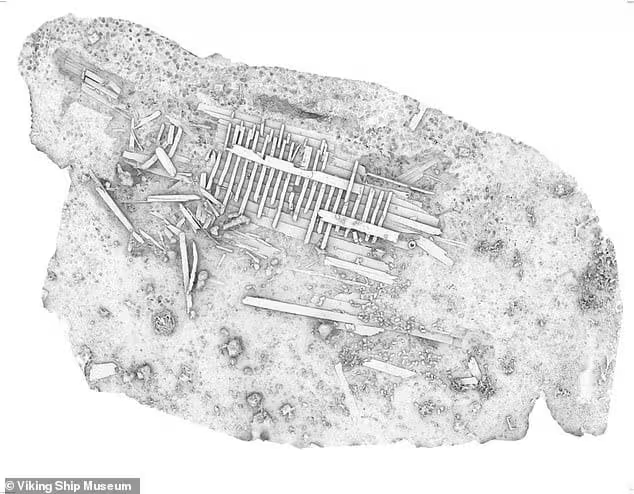
Maritime archaeologists working near Copenhagen have uncovered the remnants of a massive medieval vessel, marking a significant milestone in our understanding of North European trade. Discovered 13 meters below the surface of the Øresund strait, the wreck is the largest cog ever documented, providing an unprecedented look into the technology that powered commerce during the Middle Ages.
The discovery was made by the Viking Ship Museum during environmental surveys for the Lynetteholm urban development project. Measuring approximately 28 meters in length, 9 meters in width, and 6 meters in height, the vessel was capable of carrying roughly 300 metric tons of cargo, establishing it as a heavy-duty workhorse of its era.
Engineering the Medieval Cargo Revolution
The cog represented a structural shift in maritime logistics. By utilizing a flat-bottomed hull and a single square-rigged mast, these ships allowed small crews to transport large volumes of everyday commodities across hazardous northern waters. Lead archaeologist Otto Uldum noted that while cogs grew steadily in size between 1200 and 1400, this particular vessel—dated to approximately 1410—sits at the upper limits of known construction for the period.
Scientific analysis of the timber reveals a complex manufacturing history. Tree-ring dating indicates the hull planks were crafted from oak sourced in Pomerania (modern-day Poland), while the ship’s internal rib structure was built in the Netherlands. This evidence points to a sophisticated trade network where raw materials were transported to Dutch shipyards, which served as the primary hubs for constructing these massive vessels.

Rare Preservation of Shipboard Life
Because the wreck was partially buried in protective sand, archaeologists were able to recover elements rarely seen in historical shipwrecks. Beyond the hull, the team identified the remains of a stern castle—a defensive and residential structure—and a significant portion of the original rigging, including deadeyes. This provides scholars with a tangible reference for how these ships were actually equipped for high-seas travel.
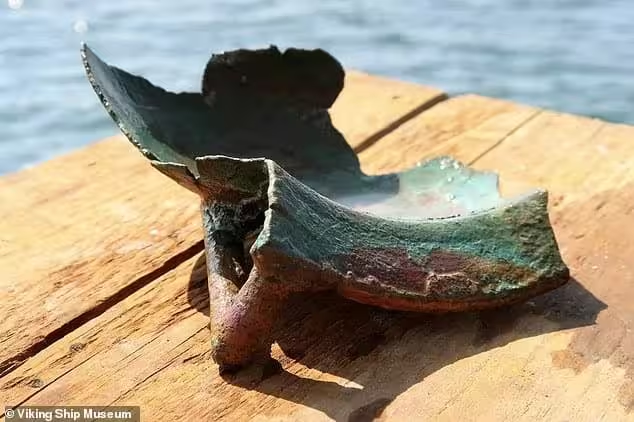
Inside the vessel, the discovery of a galley built from roughly 200 bricks and 15 tiles offers an intimate look at the crew’s daily routine. The presence of bronze cooking pots, ceramic bowls, and fish bones indicates that sailors were moving away from a diet of cold, preserved rations toward hot, freshly prepared meals. Personal artifacts, including combs and rosary beads, underscore the human element of these long-distance voyages, showing that crew members sought to maintain their domestic habits while at sea.
Unanswered Questions in the Strait
Despite the high level of preservation, the ship’s final moments remain a mystery. The cargo hold was empty, suggesting that whatever goods the ship was carrying—likely salt or textiles—were lost to the currents after the vessel went down. Furthermore, investigators have found no evidence of conflict or battle, leaving the cause of the shipwreck to speculation.
The timbers are now undergoing conservation at the National Museum of Denmark’s facility in Brede. For researchers, the vessel serves as a vital touchstone for the expansion of medieval economic networks. As Uldum noted, while the find confirms the established history of trade in the region, it provides the physical proof of the vessels that made that historical expansion possible.

This article has been fact checked for accuracy, with information verified against reputable sources. Learn more about us and our editorial process.
Last reviewed on .
Article history
- Latest version
Cite this page:
- Posted by Vikram Desai