New Quantum Chemistry Method Accurately Predicts Excited State Molecular Properties
A novel quadratic unitary cluster framework successfully bypasses traditional mathematical limits to calculate molecular dipoles and oscillator strengths.
A new quantum chemical technique successfully predicts complex molecular properties by combining a quadratic unitary cluster method with a second-order approximation. Researchers tested the approach on 11 small molecules and found it matches gold-standard benchmarks while avoiding mathematical pitfalls that plague older models.
Predicting how molecules behave when they absorb light or shift under electric fields is crucial for understanding photochemical processes, energy transfer, and spectroscopy. Traditional wave-function methods struggle with electronically excited states because they are highly sensitive to electron correlation and near-degeneracies. Standard approaches often require complex left and right eigenvector calculations that become computationally expensive and mathematically flawed as systems grow.
To solve these problems, a team of researchers led by Kamal Majee, Sudipta Chakraborty, Amrita Manna, Ján Šimunek, Jozef Noga, and Achintya Kumar Dutta developed a framework known as the second-order polarization propagator approximation to the quadratic unitary coupled-cluster singles and doubles method, abbreviated as qUCCSD(2). The details of this development are available on the arXiv preprint server. By employing an anti-Hermitian cluster operator, the method creates a Hermitian similarity-transformed Hamiltonian. This mathematical design means researchers can evaluate molecular properties without introducing left-hand eigenvectors, greatly simplifying both the theoretical formulas and the computational workload.
How the New Method Outperforms Traditional Approaches
The research team implemented the qUCCSD(2) method within their in-house software package called BAGH, utilizing the PySCF interface for calculations. They benchmarked ground-state and excited-state dipole moments alongside oscillator strengths for 11 small molecules, including BH, HCl, H2O, H2S, BF, CO, H2CO, H2CS, HNO, FCH, and H2CSi, using an aug-cc-pVTZ basis set. The results were compared against extrapolated full configuration interaction reference values, alongside conventional coupled cluster singles and doubles (CCSD) and third-order algebraic diagrammatic construction (ADC(3)) methods.
For ground-state dipole moments across the 11 test molecules, qUCCSD(2) yielded a mean absolute error of just 0.035 Debye and a root mean square error of 0.046 Debye. This performance is slightly better than conventional CCSD, which recorded a mean absolute error of 0.041 Debye, and vastly superior to ADC(3), which suffered from a mean absolute error of 0.111 Debye. The authors report that the qUCCSD(2) approach maintains high accuracy by replacing low-order perturbative approximations with iteratively converged cluster amplitudes.
Solving the Size-Consistency Problem in Molecular Clusters
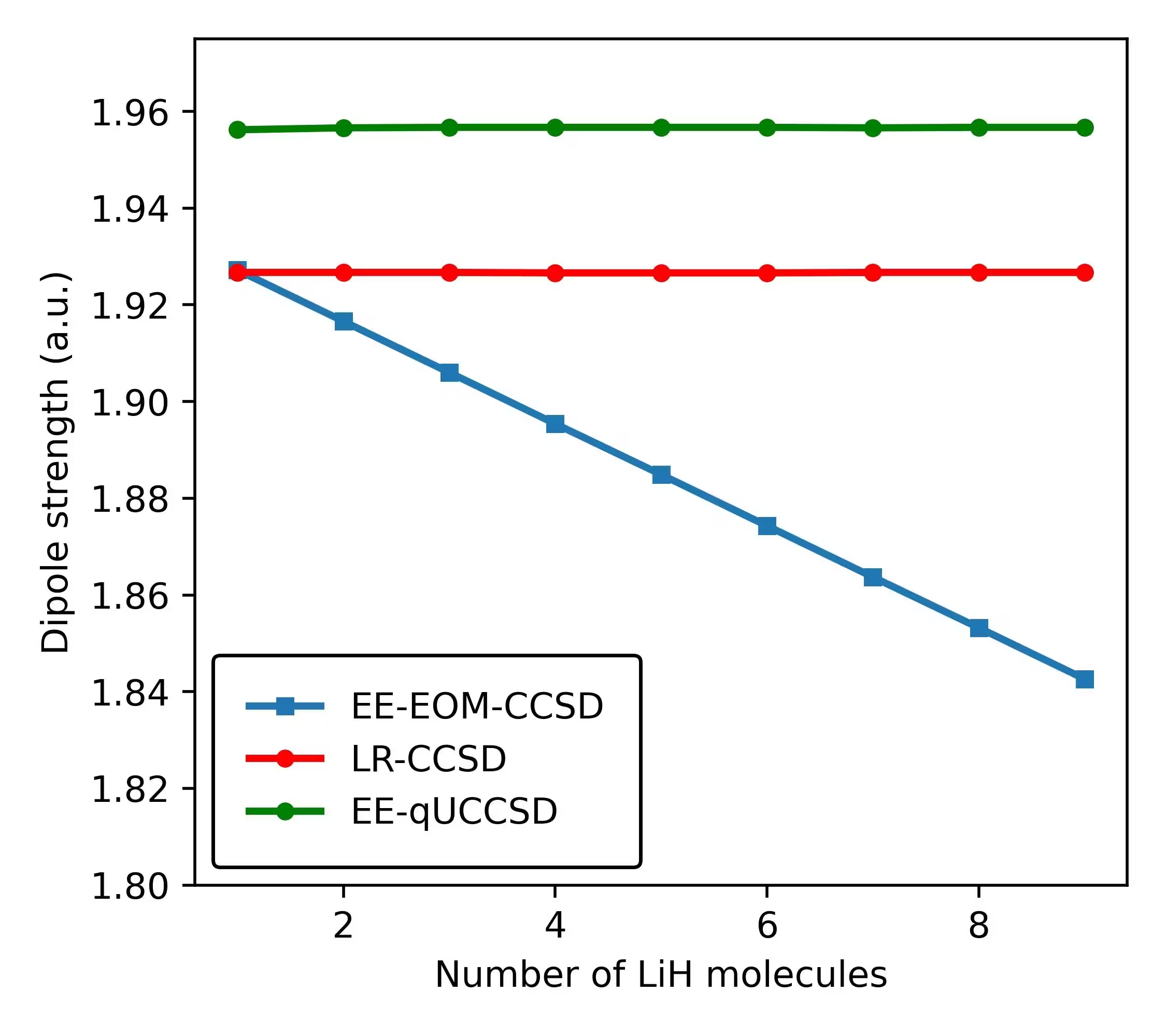
One of the major breakthroughs of the new framework involves size-intensivity, a property where transition moments remain consistent regardless of how many non-interacting molecules are added to a system. Standard equation-of-motion coupled-cluster methods fail this test, meaning their calculated dipole strength drops artificially as system size increases and can even become unphysically negative.
To test this behavior, the team simulated a growing chain of non-interacting lithium hydride (LiH) molecules separated by 5,000 atomic units. While older models showed a sharp, unphysical decline in dipole strength as more molecules were added, the Hermitian nature of the qUCCSD method kept the transition moment nearly unchanged. Because the new approach does not require separate left vectors, it naturally preserves size-intensivity without extra mathematical corrections.
Limitations and Future Improvements in Quantum Chemistry
Despite its successes, the qUCCSD(2) framework shows distinct accuracy variations depending on the character of the excited state. The authors found that the method performs better for valence states, yielding a mean absolute error of 0.052 Debye, compared to Rydberg states, where the error rises to 0.091 Debye. Rydberg states feature diffuse electron densities that make them particularly sensitive to electron correlation details and basis set flexibility.
Furthermore, systems with strong multireference character or pronounced double-excitation contributions still present challenges for singles-and-doubles methods. The researchers note that incorporating higher excitations, such as triple excitations, will be necessary to further refine descriptions for complex molecules. Work toward implementing these higher-order corrections is currently underway.
The study was posted to the arXiv preprint server on November 17, 2026.
This article has been fact checked for accuracy, with information verified against reputable sources. Learn more about us and our editorial process.
Last reviewed on .
Article history
- Latest version
Reference(s)
- Majee, Kamal. “Second-Order Polarization Propagator Approximation to the Quadratic Unitary Coupled Cluster Framework I: First-Order Properties.” arXiv.org <http://arxiv.org/abs/2611.23152v1>.
Cite this page:
- Posted by Anjali Singh