New Quantum Framework Maps Atomic Structure in Exotic Molecules Containing Antimatter
A generalized theoretical approach extends atomic bonding analysis beyond electrons to handle antimatter particles and quantum-superposed protons.
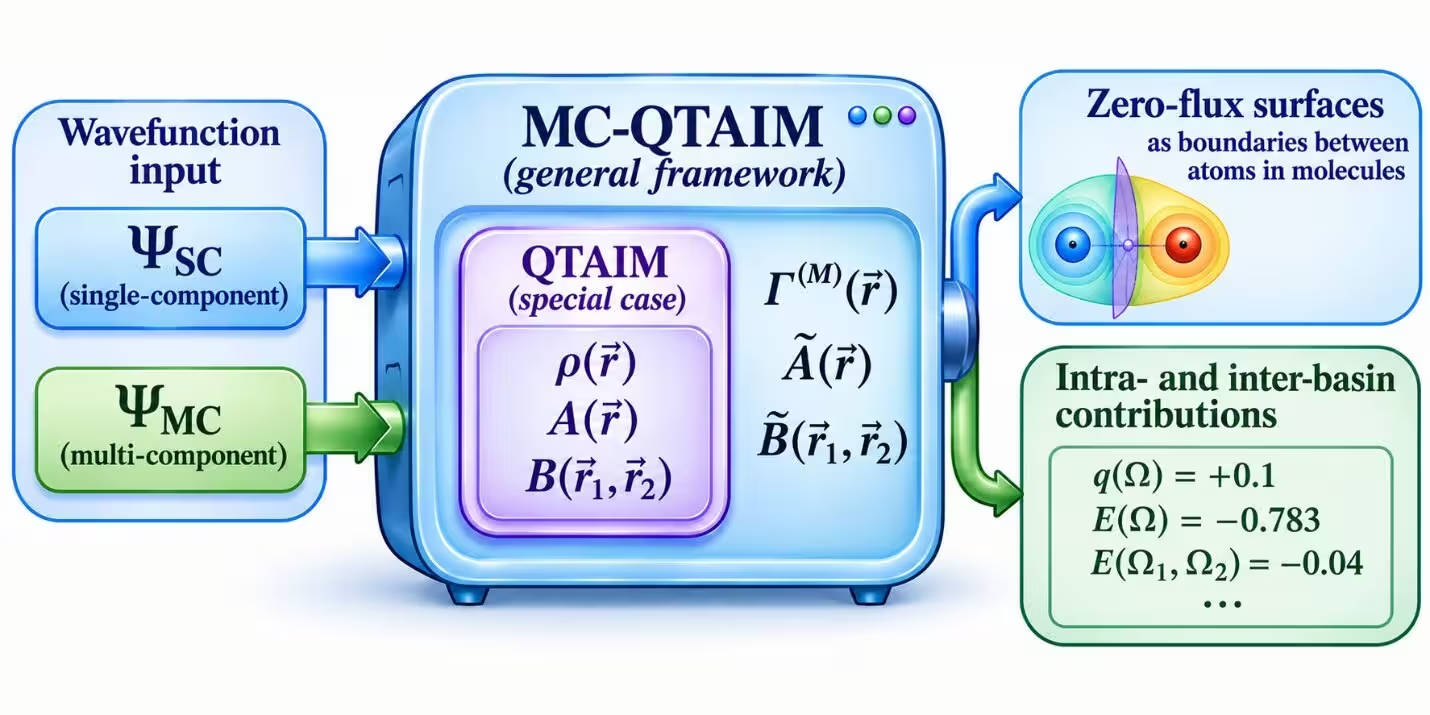
A breakthrough quantum chemical framework published in a preprint review article explains how scientists can look beyond electrons to map atoms in exotic molecules, including systems containing antimatter or quantum-superposed protons. Traditionally, the quantum theory of atoms in molecules, originally developed by Richard Bader, has been restricted to electronic wavefunctions where nuclei are treated as static point charges. However, a review published in the arXiv preprint server by Shant Shahbazian from the Alikhanian National Laboratory details the multi-component quantum theory of atoms in molecules (MC-QTAIM), which generalizes this classic framework to handle systems containing multiple distinguishable classes of quantum particles simultaneously.
How Multi-Component Quantum Theory Expands Chemical Analysis Beyond Electrons
The standard electronic approach assumes the Born-Oppenheimer approximation, which cleanly separates the fast motion of light electrons from the slow movement of heavy nuclei. While this simplification underpins decades of computational chemistry, it breaks down in exotic molecules where light particles share similar masses, such as positronic species where a positively charged antimatter electron binds to conventional matter. To address this limitation, MC-QTAIM utilizes multi-component wavefunctions that incorporate the quantum behavior of both light nuclei and additional subatomic particles.
Instead of relying solely on electron density to locate the boundaries between atomic basins, the MC-QTAIM framework introduces a new mathematical entity called the Gamma density. This mass-scaled density sums the probability distributions of the light particle and heavier components, ensuring that the model smoothly reduces back to conventional electronic analysis if all other masses approach infinity. By solving the local zero-flux equation of this Gamma density, researchers can map atomic basins and calculate properties such as atomic charges and inter-basin interactions in systems that were previously inaccessible.
Partitioning Total Energy in Systems With Positrons and Quantum Protons
To understand the energetic forces holding complex molecules together, the author also presents the multi-component interacting quantum atoms (MC-IQA) scheme. This energy partitioning method dissects molecular systems into intra-basin energies and inter-basin interactions, separating electrostatic forces from exchange-correlation contributions. In positronic molecules, this analysis reveals novel bonding mechanisms, such as how a single delocalized positron can create an electrostatic bridge that binds two negatively charged hydride ions that would otherwise repel each other.
The review also examines exotic quantum states, including the stationary superposed states of protons found in molecules with multi-well potential energy surfaces like malonaldehyde. In these dynamic systems, where protons delocalize across multiple equivalent positions via quantum tunneling, standard atomic basin definitions can completely break down. The author notes that applying MC-QTAIM to these wavefunctions shows how specific nuclear basins can vanish, highlighting the deep theoretical challenges that arise when trying to assign fixed molecular structures to non-adiabatic quantum states.
Despite these powerful extensions, practical application faces significant computational hurdles. The primary obstacle remains the over-localization of computed densities when using basic multi-component Hartree-Fock wavefunctions, which can artificially inflate kinetic and electrostatic energy terms. The author suggests that future progress will rely on combining MC-QTAIM with multicomponent density functional theory and properly constrained coordinate frames to prevent rotational and translational contamination. These advances could eventually allow chemists to reliably explore high-pressure condensed phases, metallic hydrogen, and biomedical applications involving positron annihilation.
The study was posted to the arXiv preprint server on November 17, 2026.
This article has been fact checked for accuracy, with information verified against reputable sources. Learn more about us and our editorial process.
Last reviewed on .
Article history
- Latest version
Reference(s)
- Shahbazian, Shant. “The MC-QTAIM: Why, How, and When?.” arXiv.org <http://arxiv.org/abs/2611.23159v1>.
Cite this page:
- Posted by Bilal Abbasi