Tiny Magnetic Needle Reveals Surprising Spin Reversals in Electric Fields
Physicists model the complex interplay of rotation, damping, and polarization torques in nanoscale ferromagnetic gyroscopes.

When a tiny 120-nanometer magnetic cobalt needle spins in combined electric and magnetic fields, its internal electron spins reverse direction multiple times before settling into a steady wobble. Researchers examining the coupled spin and rotation dynamics of ferromagnetic nanoparticles have formulated complete equations of motion that reveal how external electric fields exert powerful polarization torques capable of overriding traditional magnetic alignment.
The study, published as a preprint on arXiv by Y. B. Band and Igor Kuzmenko, details how a single-domain symmetric top behaves when subjected to both static magnetic and electric fields. While previous models treated magnetic needles using only a standard Zeeman interaction for their internal macro-spin, this comprehensive framework integrates rotational kinetic energy, magnetocrystalline and shape anisotropy, electrostatic dipole energy, linear magnetoelectric coupling, and relativistic motional spin-orbit coupling.
Overriding Magnetic Alignment with Electric Fields
The authors analyzed a prolate spheroid cobalt needle measuring 120 nanometers in length and 30 nanometers across. In a 0.5 Tesla magnetic field, the internal anisotropy field reaches approximately 1.3 Tesla, which significantly exceeds the applied magnetic field strength. During the initial Gilbert-damping transient lasting about 0.6 nanoseconds, the spin vector reverses direction several times. Whether the easy axis ends up parallel or antiparallel to the spin depends entirely on the parity of these reversals.
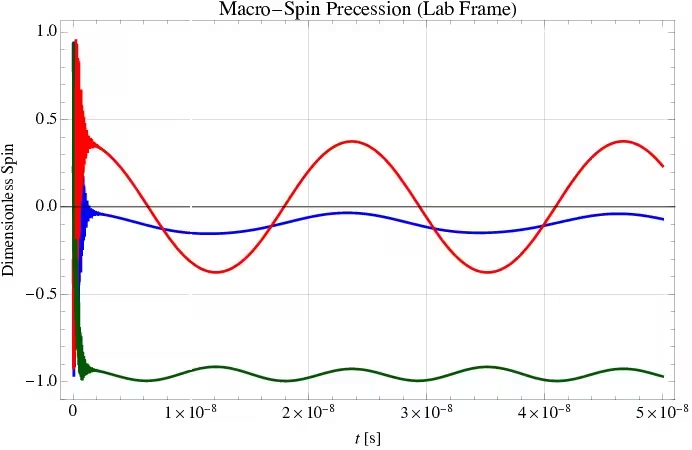
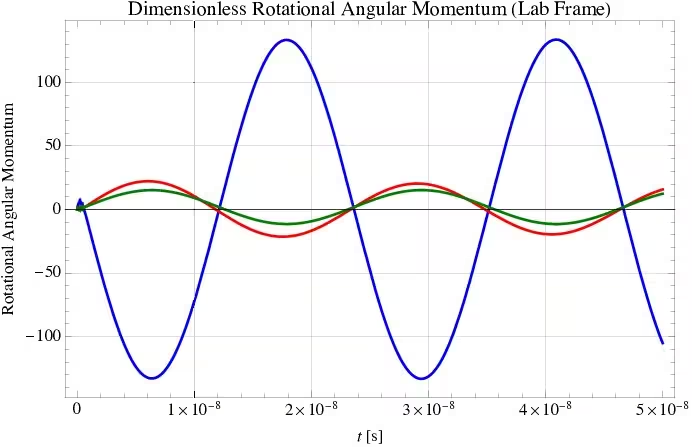
Once this initial transient settles, the needle enters a libration phase, precessing while undergoing nutation at twice the frequency with a period of roughly 20 nanoseconds. During this steady phase, the total energy remains conserved while the Zeeman and rotational kinetic energies oscillate out of phase.
When a static electric field is introduced, it induces surface charges on the conducting metallic needle. Because the interior free-charge screening causes the internal electric field to approach zero, the induced electric dipole saturates to a geometry-dependent bound. This creates a shape-dependent polarization torque that tends to align the long axis of the needle directly with the electric field vector.
Implications for Precision Magnetometry
The strength of this polarization torque competes directly with the magnetic torque. The researchers defined a crossover field threshold of approximately 8.5 by ten to the seventh volts per meter in a 0.5 Tesla field, where the maximum polarization torque equals half the maximum magnetic torque. Below this crossover threshold, the magnetic field dominates the orientation of the needle. Far above this threshold, the electrostatic polarization torque completely takes over.
The authors note that stray electric fields must be strictly controlled if such ferromagnetic needles are deployed as high-precision magnetometers or torque sensors. Because electric fields can drastically alter the rotational dynamics via the electrostatic polarization torque, any unshielded electrostatic interference would invalidate magnetic measurements.
To handle the complex rotational kinematics without running into mathematical singularities at the polar boundaries, the team utilized singularity-free normalized quaternions. They also accounted for dissipative channels including Landau-Lifshitz-Gilbert spin relaxation and an electric analog of damping driven by Joule dissipation of conduction electrons undergoing Debye relaxation.
The study was posted to the arXiv preprint server on November 17, 2026.
This article has been fact checked for accuracy, with information verified against reputable sources. Learn more about us and our editorial process.
Last reviewed on .
Article history
- Latest version
Reference(s)
- Band, Y.. “Dynamics of a Single-Domain Dissipative Magnetic Gyroscope in Electric and Magnetic Fields.” arXiv.org <http://arxiv.org/abs/2611.23167v1>.
Cite this page:
- Posted by Bilal Abbasi