AI-Generated DNA Nanobridges Repair Damaged Intestinal Cell Barriers
An advanced artificial intelligence system successfully proposed and guided the experimental validation of physical repair strategies for leaky gut tissues.
Human intestinal cells grown on laboratory inserts experience a 40 percent drop in electrical resistance when treated with membrane-depleting chemicals, mimicking the breakdown of gut tissue seen in aging and chronic inflammation. Artificial intelligence is stepping into uncharted biological territory by designing physical repair strategies rather than relying on traditional biochemical drugs. A research team recently published in arXiv describing Abelio, an advanced artificial intelligence architecture that goes beyond summarizing existing studies to formulate completely novel experimental directions.
How Artificial Intelligence Expands Beyond Conventional Thinking
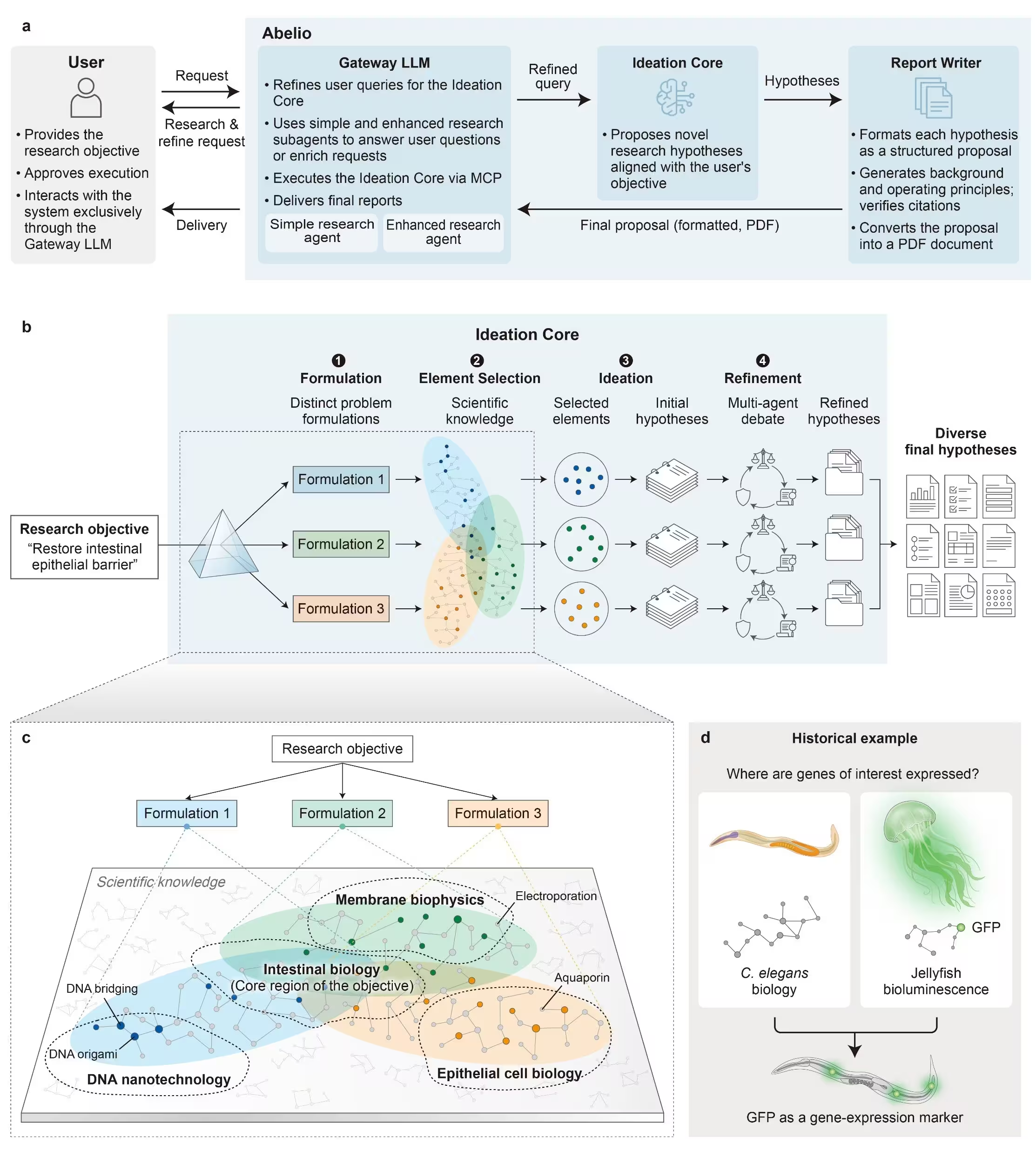
Most artificial intelligence systems used in laboratories are built to search existing literature, summarize papers, or refine hypotheses within established disciplinary boundaries. Abelio was designed to break past these intellectual silos by using specialized subagents that systematically reframe research objectives from multiple biological scales and viewpoints. The system uses a dedicated hypothesis-generation core containing three distinct stages, namely formulation, element selection, and ideation and refinement, which alternate between exploring diverse possibilities and narrowing down to concrete proposals. When tested across 50 expert-curated research objectives, the system generated 293 unique hypotheses, producing higher inter-hypothesis diversity and scientific soundness than four frontier large language models.
The development team used the system to tackle age-related intestinal epithelial leakage, a condition affecting millions of people worldwide where tight junctions between cells become compromised. Conventional research has heavily focused on regulating the expression and assembly of tight junction proteins inside the cell. Instead of following this beaten path, Abelio proposed physical interventions that rely on macromolecular crowding and DNA-mediated membrane bridging to physically bridge gaps at cell surfaces. Neither of these concepts had been considered by the human investigators prior to the automated ideation run.
Testing Synthetic DNA Nanobridges in Damaged Cell Monolayers
To see whether the computer-generated proposals could survive real-world laboratory testing, the researchers prospectively evaluated the concepts in an in vitro barrier model using Caco-2 human intestinal cells. The team weakened the cell monolayers by applying 20 millimolar methyl-beta-cyclodextrin for one hour, which depleted cellular cholesterol and successfully dropped transepithelial electrical resistance by approximately 40 percent without killing the cells. The artificial intelligence system proposed anchoring complementary short DNA strands modified with cholesterol to opposing cell membranes to form transient, self-assembling intercellular nanobridges that physically restrict leakage.
The laboratory experiments showed that introducing an 8-nucleotide complementary DNA pair successfully restored electrical resistance and reduced macromolecular flux compared to scrambled control sequences. Furthermore, the researchers tested the reversibility of the system by adding a specific 14-nucleotide invader strand that disrupted the DNA duplex via toehold-mediated strand displacement, which promptly reversed the barrier-protective effect and returned permeability to damaged baseline levels. A separate polymer-based proposal involving membrane-tethered poly(ethylene glycol) brushes also demonstrated that dual-surface treatment successfully preserved barrier function, confirming that membrane anchoring is critical for physical restoration.
What These Findings Mean for Future Scientific Discoveries
These outcomes demonstrate that structured artificial intelligence ideation can successfully guide human researchers toward testable, unconventional physical strategies that bypass traditional drug discovery pipelines. While the computer-generated designs provided actionable starting points, the successful execution still required extensive human oversight, empirical optimization, and wet-lab validation. The authors note that evaluating the true novelty and quality of automated scientific ideas remains a complex challenge, as current language model judges face known limitations. Future work will need to determine how well these promising physical interventions perform in living organisms and whether the ideation framework can be generalized successfully across other major biomedical challenges.
The study was posted to the arXiv preprint server on November 17, 2026.
This article has been fact checked for accuracy, with information verified against reputable sources. Learn more about us and our editorial process.
Last reviewed on .
Article history
- Latest version
Reference(s)
- Nah, Geonho. “Structured AI ideation yields physical strategies for epithelial barrier repair.” arXiv.org <http://arxiv.org/abs/2611.22988v1>.
Cite this page:
- Posted by Priya Sharma