New Simulation Method Solves Longstanding Dark Matter Puzzle
Astronomy

New Simulation Method Solves Longstanding Dark Matter Puzzle

A novel finite-element technique integrates cosmic phase space directly, avoiding the artificial noise of traditional particle models.
By John Williams
Published:
Email this Article
New Simulation Method Solves Longstanding Dark Matter Puzzle
Photo by Brecht Corbeel on Unsplash

Astrophysicists have developed a new computational technique that successfully bridges the gap between collisionless and collisional physics in space simulations. The approach, published on the arXiv preprint server, directly integrates the complex Vlasov equation without relying on traditional discrete super-particles that introduce artificial noise and heating in cosmic models.

Solving the Complexity Barrier in 6D Phase Space

Simulating systems where particles rarely collide, such as dark matter halos, stellar dynamics, and cosmic rays, has long required severe compromises. Traditional Monte-Carlo and N-body methods approximate immense clouds of actual particles using a much smaller number of discrete super-particles, which creates artificial discreteness noise and spurious heating. Alternatively, mapping the entire six-dimensional phase space onto a uniform grid becomes computationally impossible for large-scale problems.

The author Philip F. Hopkins of the California Institute of Technology designed a quasi-Lagrangian method that evolves the distribution function directly in six-plus-one dimensions. Instead of treating particles as single points, the scheme partitions configuration space into moving mesh elements. Each element carries a set of momentum-Lagrangian basis functions representing local anisotropic velocity distributions.
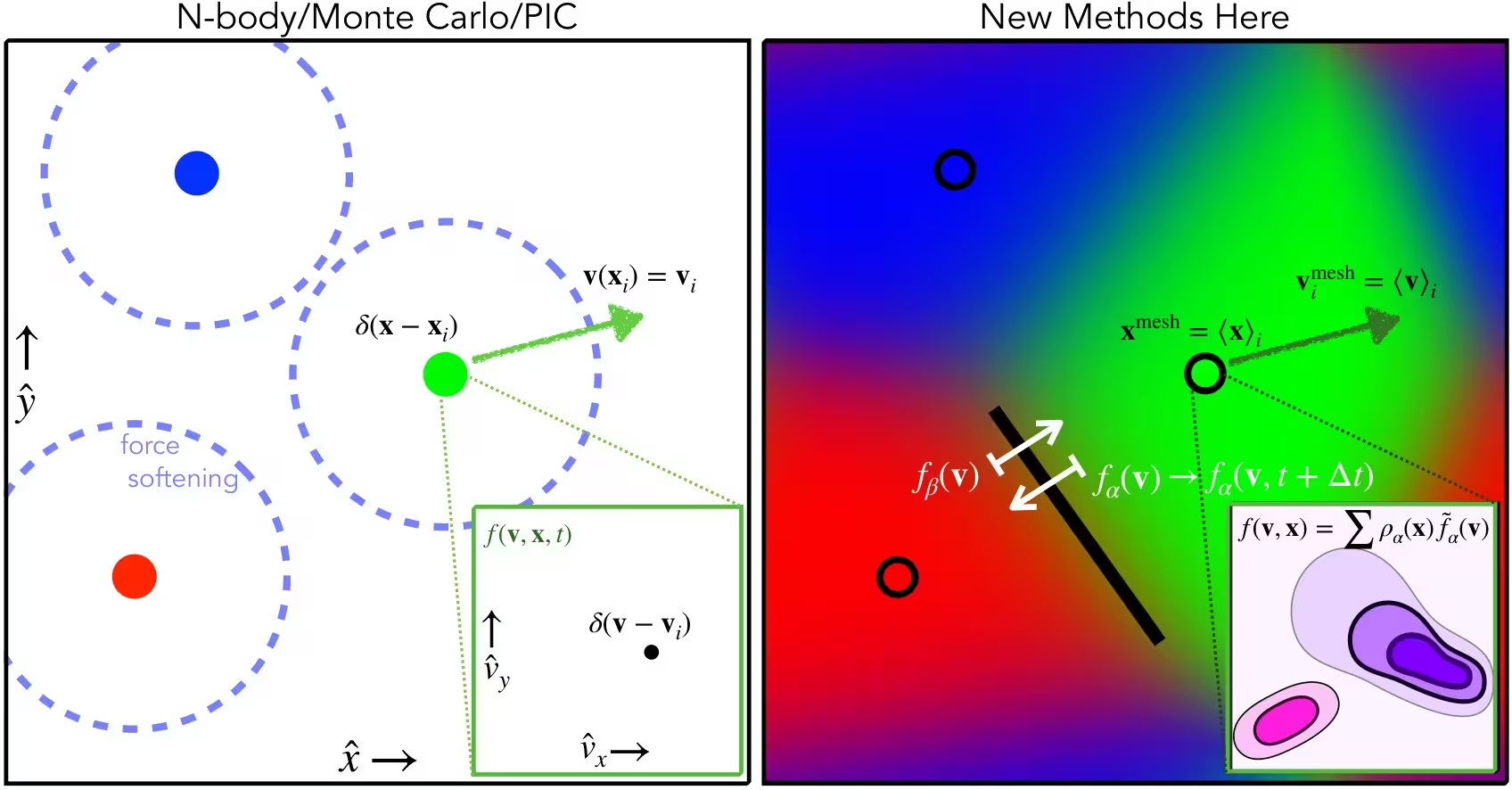
Figure 1: High-level schematic illustrating the method here (right), as compared to standard MC/PIC/NB methods (left). Left: In MC/PIC/NB: particles ii sample trajectories of individual micro-particles, i.e. a distribution function (DF) f⁡(𝐱,𝐯,t)∝δ⁡(𝐱−𝐱i,𝐯−𝐯i,t)f({\bf x},\,{\bf v},\,t)\propto\delta({\bf x}-{\bf x}_{i},\,{\bf v}-{\bf v}_{i},\,t), but then get assigned a “weight” corresponding to many micro-particles (Δ​mi≫mmicro\Delta m_{i}\gg m_{\rm micro}). As such, concepts like “force softening” must be defined ad-hoc since the volume is not formally partitioned in any meaningful manner, and collisions or inter-particle forces must be sampled in a Monte-Carlo or coarse-grained manner. Right: The volume domain obeys a partition of unity into cells/domains Ωi\Omega_{i}, around mesh-generating points 𝐱imesh{\bf x}^{\rm mesh}_{i}. For the MFM-like method we implement, these involve a smooth, overlapping decomposition with effective faces (black line) between neighbors, with Lagrangian motion 𝐱ime
High-level schematic illustrating the method here (right), as compared to standard MC/PIC/NB methods (left). Left: In MC/PIC/NB: particles ii sample trajectories of individual micro-particles, i.e. a distribution function (DF) f⁡(𝐱,𝐯,t)∝δ⁡(𝐱−𝐱i,𝐯−𝐯i,t)f({\bf x},\,{\bf v},\,t)\propto\delta({\bf x}-{\bf x}_{i},\,{\bf v}-{\bf v}_{i},\,t), but then get assigned a “weight” corresponding to many micro-particles (Δ​mi≫mmicro\Delta m_{i}\gg m_{\rm micro}). As such, concepts like “force softening” must be defined ad-hoc since the volume is not formally partitioned in any meaningful manner, and collisions or inter-particle forces must be sampled in a Monte-Carlo or coarse-grained manner. Right: The volume domain obeys a partition of unity into cells/domains Ωi\Omega_{i}, around mesh-generating points 𝐱imesh{\bf x}^{\rm mesh}_{i}. For the MFM-like method we implement, these involve a smooth, overlapping decomposition with effective faces (black line) between neighbors, with Lagrangian motion 𝐱ime Credit: Philip F. Hopkins / arXiv

How the Method Handles Complex Flows and Collisions

To integrate the equations across spatial and velocity domains, the framework employs higher-order reconstruction paired with Godunov-type solver steps. By solving one-sided Riemann problems at the boundaries between cells, the algorithm accurately tracks multi-streaming behaviors, shell-crossing events, and phase-wrapping without letting computational costs spiral out of control.

A crucial advantage of this framework is its ability to handle collisional and collisionless regimes within the same architecture. In strongly collisional environments, an internal relaxation operator drives cells toward a local Maxwellian distribution. This allows the simulation to recover standard fluid dynamics smoothly when mean free paths become extremely short, a feat that standard particle-based techniques cannot achieve.
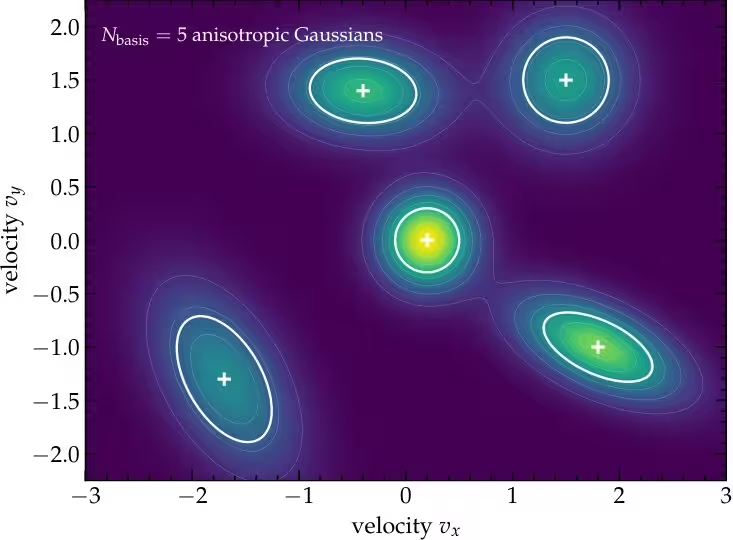
Figure 2: Schematic of the per-cell basis-function representation of the velocity DF fa​(𝐯)f_{a}({\bf v}). Left: a stylized 1D distribution (heavy black) with multiple unresolved peaks, reconstructed (red dashed) as a sum of Nbasis=6N_{\rm basis}=6 Gaussian components (thin dashed coloured lines), each with its own weight ϖα\varpi_{\alpha}, mean ⟨vα⟩\langle v_{\alpha}\rangle, and dispersion σα\sigma_{\alpha}, all Lagrangian-evolved with the local flow. Right: a stylized 2D distribution fa​(vx,vy)f_{a}(v_{x},v_{y}) (filled contours of the mixture) built from Nbasis=5N_{\rm basis}=5 anisotropic Gaussian basis components (here 55 independent streams), with 1​σ1\sigma ellipses (white) marking the orientation and aspect of each individual g~α\tilde{g}_{\alpha}, and centres (white ++) at ⟨𝐯α⟩\langle{\bf v}_{\alpha}\rangle. The same parameters carry over directly to D=3D=3, where each basis carries (m,𝐩,𝐓)(m,\,{\bf p},\,{\bf T}) with 𝐓{\bf T} a symmetric 3×33\times 3 tensor encoding an anisotropic loca
Schematic of the per-cell basis-function representation of the velocity DF fa​(𝐯)f_{a}({\bf v}). Left: a stylized 1D distribution (heavy black) with multiple unresolved peaks, reconstructed (red dashed) as a sum of Nbasis=6N_{\rm basis}=6 Gaussian components (thin dashed coloured lines), each with its own weight ϖα\varpi_{\alpha}, mean ⟨vα⟩\langle v_{\alpha}\rangle, and dispersion σα\sigma_{\alpha}, all Lagrangian-evolved with the local flow. Right: a stylized 2D distribution fa​(vx,vy)f_{a}(v_{x},v_{y}) (filled contours of the mixture) built from Nbasis=5N_{\rm basis}=5 anisotropic Gaussian basis components (here 55 independent streams), with 1​σ1\sigma ellipses (white) marking the orientation and aspect of each individual g~α\tilde{g}_{\alpha}, and centres (white ++) at ⟨𝐯α⟩\langle{\bf v}_{\alpha}\rangle. The same parameters carry over directly to D=3D=3, where each basis carries (m,𝐩,𝐓)(m,\,{\bf p},\,{\bf T}) with 𝐓{\bf T} a symmetric 3×33\times 3 tensor encoding an anisotropic loca Credit: Philip F. Hopkins / arXiv

Testing Against Standard Astrophysical Benchmarks

The author validated the numerical method through a series of rigorous benchmark tests, including two-stream instabilities, expanding density waves, harmonic oscillator breathing modes, and self-gravitating Hernquist spheres. In tests tracking long-term orbital mixing, the framework maintained total energy and momentum conservation to high precision while avoiding the artificial core contraction often seen in older particle simulations.

The code implementation has been made publicly available within the GIZMO simulation framework. Researchers suggest this flexible foundation will improve studies across multiple domains, including dark matter interactions, plasma physics, particulate dust dynamics, and radiation hydrodynamics.

The study was posted to the arXiv preprint server on November 17, 2026.

Fact Checked

This article has been fact checked for accuracy, with information verified against reputable sources. Learn more about us and our editorial process.

Last reviewed on .

Article history

  • Latest version

Reference(s)

  1. Hopkins, Philip. “An Efficient Method for Directly Integrating the Vlasov Equation in Collisionless and Weakly-Collisional Simulations.” arXiv.org <http://arxiv.org/abs/2611.23084v1>.

Cite this page:

Williams, John. “New Simulation Method Solves Longstanding Dark Matter Puzzle.” BioScience. BioScience ISSN 2521-5760, 18 November 2026. <https://www.bioscience.com.pk/en/subject/astronomy/an-efficient-method-for-directly-integrating-the-vlasov-equation-in-collisionless-and-weakly-collisional-simulations>. Williams, J. (2026, November 18). “New Simulation Method Solves Longstanding Dark Matter Puzzle.” BioScience. ISSN 2521-5760. Retrieved November 18, 2026 from https://www.bioscience.com.pk/en/subject/astronomy/an-efficient-method-for-directly-integrating-the-vlasov-equation-in-collisionless-and-weakly-collisional-simulations Williams, John. “New Simulation Method Solves Longstanding Dark Matter Puzzle.” BioScience. ISSN 2521-5760. https://www.bioscience.com.pk/en/subject/astronomy/an-efficient-method-for-directly-integrating-the-vlasov-equation-in-collisionless-and-weakly-collisional-simulations (accessed November 18, 2026).
End of the article