Automated Software Merges Global Pulsar Data in Under Two Hours
A new tool harmonizes conflicting observatory datasets and timing software, accelerating the search for cosmic gravitational waves.

A new automated software package called MetaPulsar cuts the time required to merge global pulsar timing array datasets from years down to less than two hours. By streamlining how independent observatories combine their data, the tool removes a major bottleneck in the ongoing search for low frequency gravitational waves generated by supermassive black hole binaries across the universe.
Pulsar timing arrays monitor the ultra-regular pulses of rapidly rotating neutron stars known as millisecond pulsars, acting like a galactic-scale detector network. When gravitational waves pass through space between Earth and these stellar beacons, they subtly alter the arrival times of the pulses by fractions of a microsecond. Combining data from multiple international collaborations, such as the European Pulsar Timing Array, the North American Nanohertz Observatory for Gravitational Waves (NANOGrav), and the Parkes Pulsar Timing Array in Australia, greatly enhances sensitivity and sky coverage. Historically, creating these combined datasets required years of meticulous manual data re-processing, often leaving the resulting products outdated by the time they were published.
To solve this inefficiency, researchers Wang-Wei Yu and Rutger van Haasteren from the Max Planck Institute for Gravitational Physics developed MetaPulsar, a software package described in a study published on the arXiv preprint server. Instead of forcing a complete manual re-assessment of every timing model, the tool ingests the individual parameter files and pulse arrival time files directly as published by each collaboration. It then translates these disparate inputs into a single, mutually consistent deterministic model that is compatible with both major pulsar timing software packages, PINT and Tempo2.
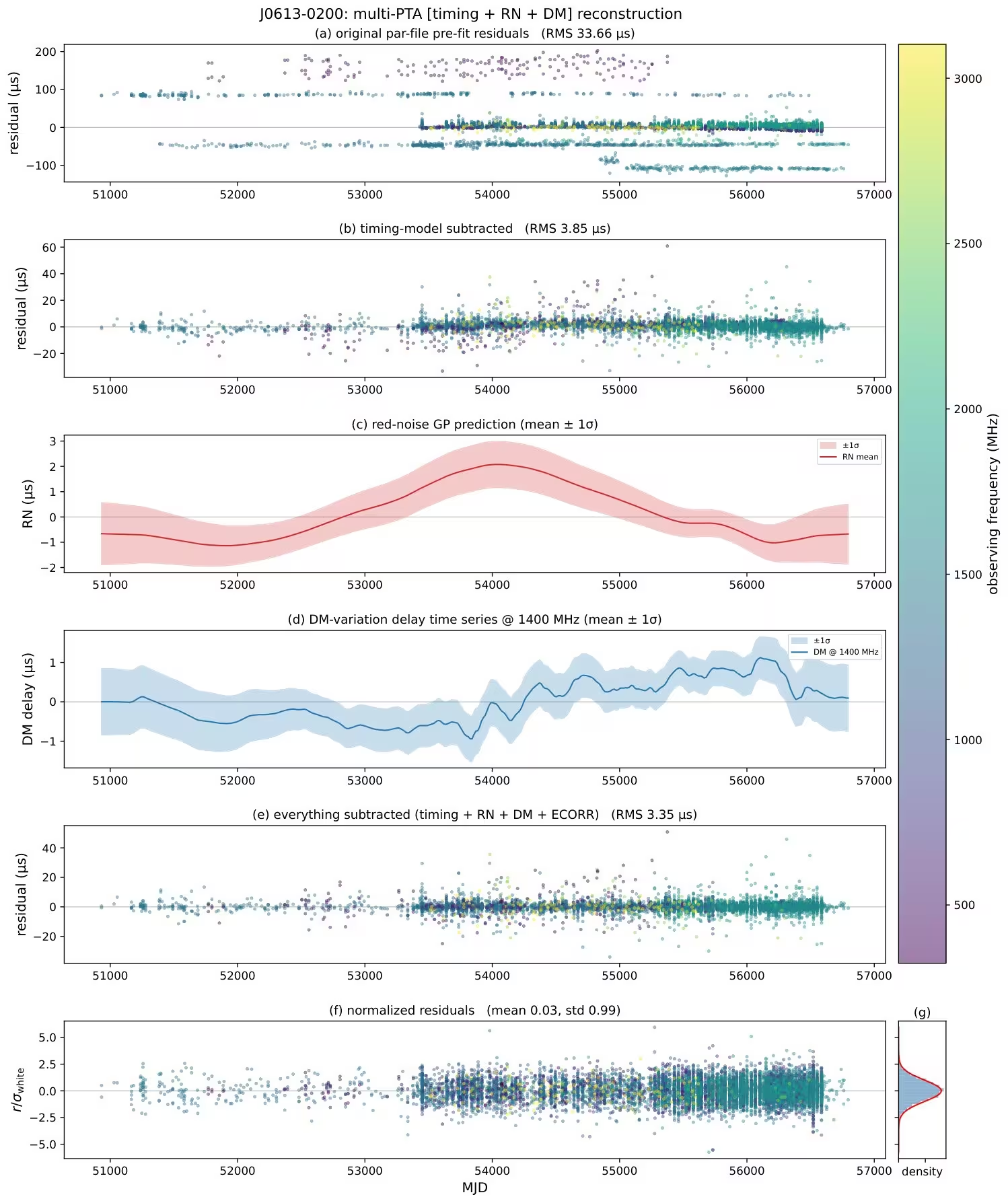
The authors validated their automated approach in four distinct ways using real observational data from the constituent sets of the International Pulsar Timing Array Data Release 2. First, they demonstrated that the linearized timing solution of a combined dataset does not depend on the specific initial parameter values inside the input files, with only minor exceptions for Shapiro-delay parameters that account for general relativistic time dilation caused by a binary companion’s mass. Second, examining specific stars like the pulsar PSR J0613-0200 revealed that the combined timing models properly account for intrinsic red noise and interstellar medium dispersion variations. Third, the team quantified the cross-collaboration consistency of timing parameters for every pulsar observed by more than one facility.
Finally, the researchers performed a complete gravitational-wave background search on the direct combination of the NANOGrav 9-year, European Data Release 1, and Parkes Data Release 2 datasets, encompassing 62 pulsars and nearly 200,000 individual pulse arrival times spanning 18.3 years. As detailed in the study, assembling the combined dataset took under two hours, and the entire workflow from raw files to a fully evaluated gravitational-wave background posterior required less than six hours on standard hardware.
How MetaPulsar Harmonizes Conflicting Timing Software
A primary challenge in combining international pulsar data stems from historical differences between software packages like PINT and Tempo2. Although both programs rely on the same underlying physics, they interpret unstated default conventions, reference clocks, and binary orbital models differently. MetaPulsar bypasses these discrepancies by applying a standardized sequence of adjustments. It preserves the phase-connected rotation counts established by individual collaborations, converts conflicting binary orbital parameter representations, and writes out a unified convention profile that both software packages can read without introducing significant discrepancies.
When testing the rewritten timing models across 95 individual pulsar datasets containing over 200,000 pulse arrival times, the researchers found that PINT and Tempo2 agreed on the resulting residual series with a median root-mean-square difference of just 1.2 nanoseconds. This level of discrepancy remains far below the observational uncertainties inherent in radio telescope measurements. Such high fidelity confirms that automated mechanical combination can replace years of manual curation without sacrificing scientific accuracy.
What This Means for Future Gravitational Wave Discoveries
The successful deployment of MetaPulsar points toward a significant restructuring of how international pulsar timing collaborations manage their workloads. Rather than treating data combination as a monolithic multi-year project that attempts to redo every step by hand, the authors advocate for a decentralized workflow. Individual observatories retain responsibility for generating accurate pulse arrival times, while automated tools handle the mechanical merging process on the fly.
This division of labor allows international consortia to focus their expertise on rigorous data quality checks, advanced noise modeling, and sophisticated gravitational-wave searches. Because the combination script runs rapidly, researchers can generate updated analyses almost immediately whenever a partner collaboration releases new observations, effectively eliminating the risk of being scooped by newer independent datasets.
The study was posted to the arXiv preprint server on November 17, 2026.
This article has been fact checked for accuracy, with information verified against reputable sources. Learn more about us and our editorial process.
Last reviewed on .
Article history
- Latest version
Reference(s)
- Yu, Wang-Wei. “Combining Pulsar Timing data with $\texttt{MetaPulsar}$. The linearized timing model.” arXiv.org <http://arxiv.org/abs/2611.23114v1>.
Cite this page:
- Posted by Karan Das