Ancient Star Clusters Retain Chemical Fossils of Early Galactic Mixing
High-resolution simulations suggest that heavy element variations in metal-poor globular clusters are inherited directly from turbulent natal gas clouds.
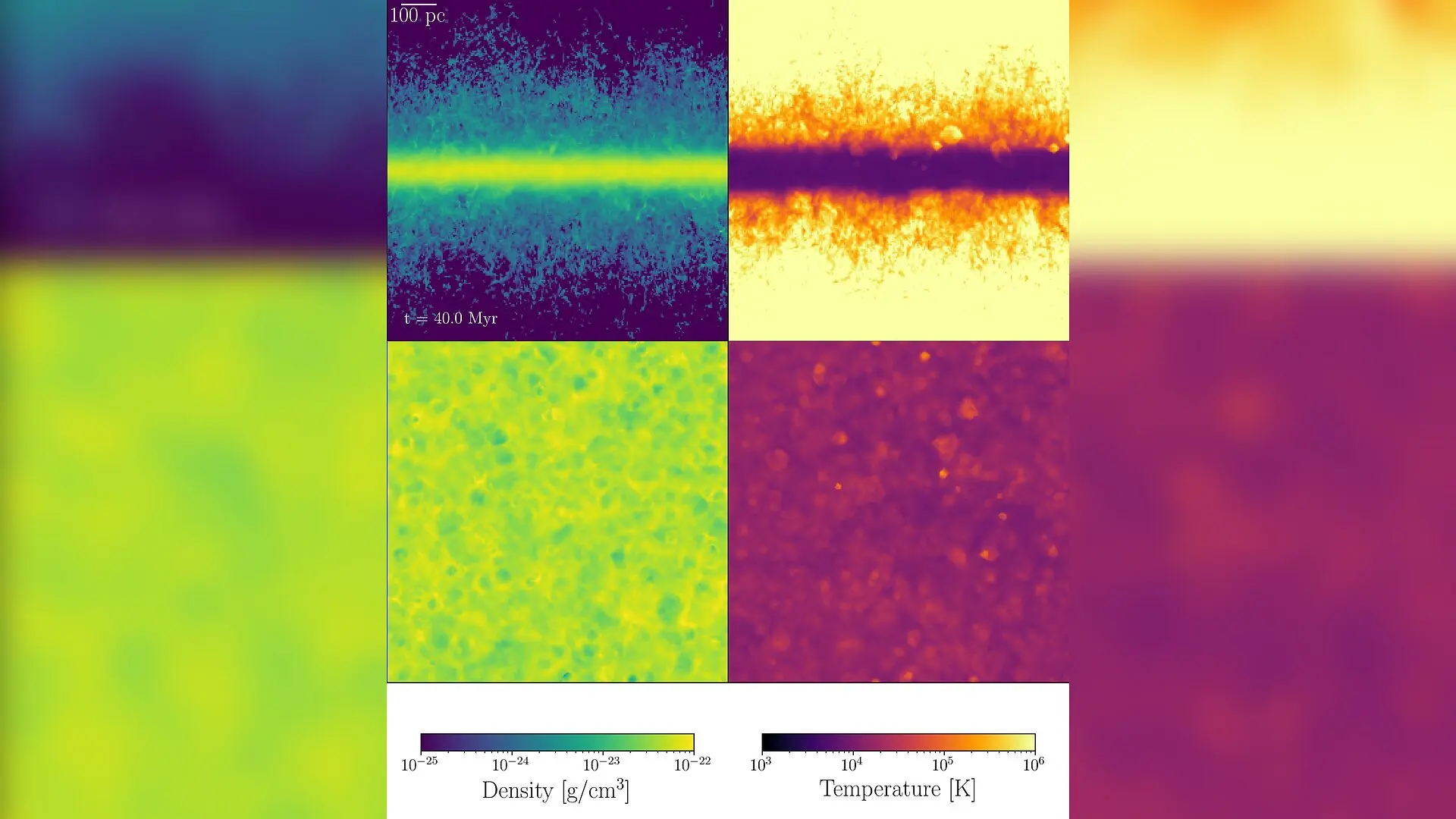
Ancient stellar assemblies known as globular clusters preserve chemical irregularities that may trace turbulent gas mixing across the early Milky Way, according to a recent study. Researchers investigating the origins of heavy element variations among metal-poor stars suggest that turbulent motions in gas disks can naturally retain spatial abundance differences for billions of years.
Globular clusters are dense groupings containing hundreds of thousands of stars tightly packed into regions typically spanning tens of light-years across. While most of these stellar systems maintain a uniform iron content, several metal-poor clusters exhibit large variations in elements produced by rapid neutron capture, a mechanism known as the r-process that builds heavy atoms like europium and barium during rare, energetic stellar events.
Observations show that the magnitude of these r-process variations is largest in the most metal-poor clusters and decreases steadily as metallicity increases. To understand how these chemical signatures arise, a research team led by Lailani Kenoly examined parsec-scale simulations of a supernova-driven turbulent galactic disk available on the arXiv preprint server. The authors modeled the transport of rare elements in a 1-kiloparsec simulation box with a spatial resolution of 3.9 parsecs over a period of 120 million years.
How Turbulence Stirs Heavy Elements in Galaxy Disks
Core-collapse supernovae regularly inject iron into the interstellar medium, creating a smooth and well-mixed distribution of iron across the galactic disk over time. In contrast, r-process elements are synthesized in much rarer events, such as neutron star mergers or uncommon types of supernovae, leaving behind distinct localized pockets of high enrichment surrounded by pristine gas.
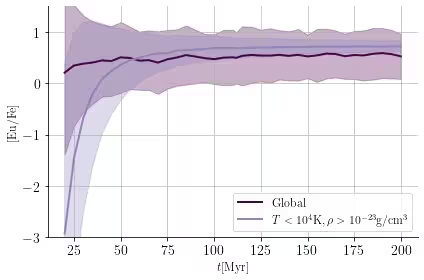
The simulations demonstrate that supernova-driven turbulence actively redistributes these heavy elements, but local inhomogeneities persist across various physical scales. When the researchers sampled the simulated gas at scales comparable to prospective star-forming regions, they discovered that distinct spatial areas retained markedly different characteristic abundances of r-process material relative to iron.
Connecting Pre-Stellar Gas Clumps to Ancient Star Clusters
The statistical analysis reveals that regional abundance dispersion decreases as chemical enrichment proceeds and mixing continues over time. This trend mirrors the observed decline in r-process variation among metal-rich globular clusters compared to their more ancient, metal-poor counterparts.
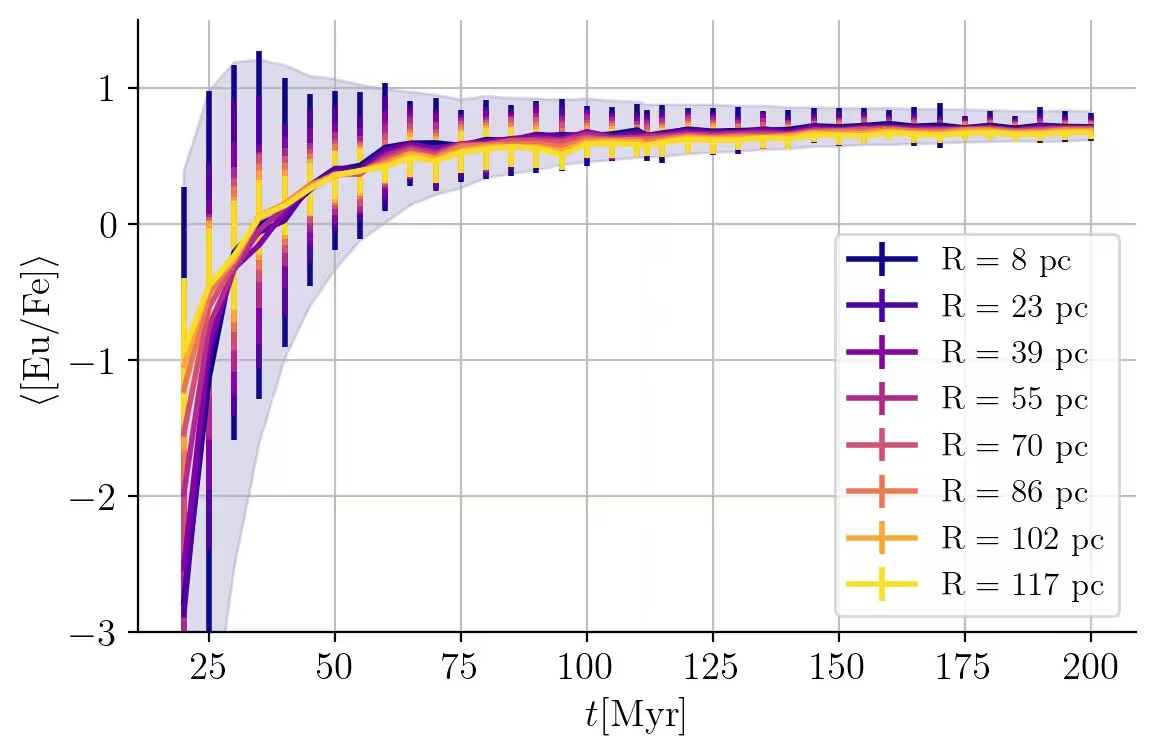
The authors note that the absolute abundance variance found in the simulated gas remains larger than the scatter measured directly from starlight within real globular clusters. This difference is expected, because subsequent physical processes during cloud assembly, gravitational collapse, and local stellar feedback likely smooth out some of the pre-existing chemical variance before protostellar gas finally locks into solid stars.
What These Chemical Fossils Mean for Galactic History
These findings support the interpretation that stellar systems can inherit chemical inhomogeneities directly from their natal environments, rather than requiring complex chemical self-enrichment scenarios happening entirely within the cluster itself. The research indicates that globular clusters serve as pristine cosmic fossils, retaining a permanent chemical memory of how rare nucleosynthetic events and turbulent fluid mixing interacted before the birth of their oldest stars.
The study was posted to the arXiv preprint server on November 10, 2026.
This article has been fact checked for accuracy, with information verified against reputable sources. Learn more about us and our editorial process.
Last reviewed on .
Article history
- Latest version
Reference(s)
- Kenoly, Lailani. “r-Process Abundance Variations in Globular Clusters as Fossils of Turbulent Mixing.” arXiv.org <http://arxiv.org/abs/2611.14472v1>.
Cite this page:
- Posted by Karan Das