Ancient Afterglow Rules Out Stupendously Large Black Holes as Dark Matter Source
New research using cosmic light and galaxy clustering suggests that giant primordial black holes cannot account for the vast majority of dark matter.
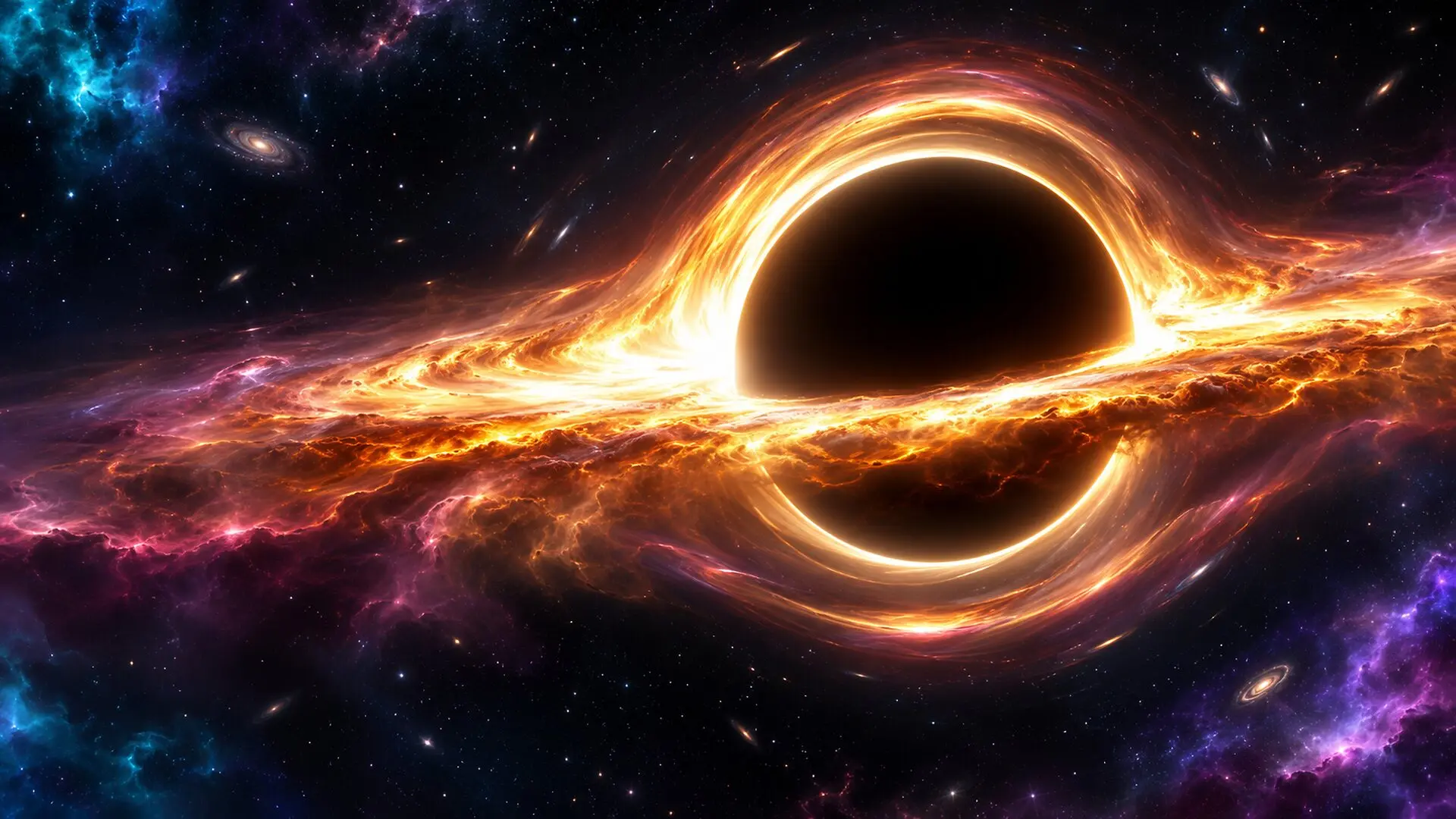
Hypothetical black holes so immense they dwarf the supermassive giants lurking in galactic centers have been largely ruled out as a significant component of dark matter. New research published in Physical Review Letters indicates that these colossal objects, if they existed in sufficient numbers to explain the universe’s missing mass, would have left behind telltale signatures in the early cosmos that simply do not exist in current data.
A team from Johannes Gutenberg University Mainz and their colleagues investigated these “Stupendously Large Black Holes” (SLABs)—objects with masses ranging from 100 million to 10 quintillion times that of the Sun. By modeling how such massive, discrete entities would have influenced the early universe, researchers found that they would have disrupted the delicate balance between matter and radiation.
Echoes of the Early Universe
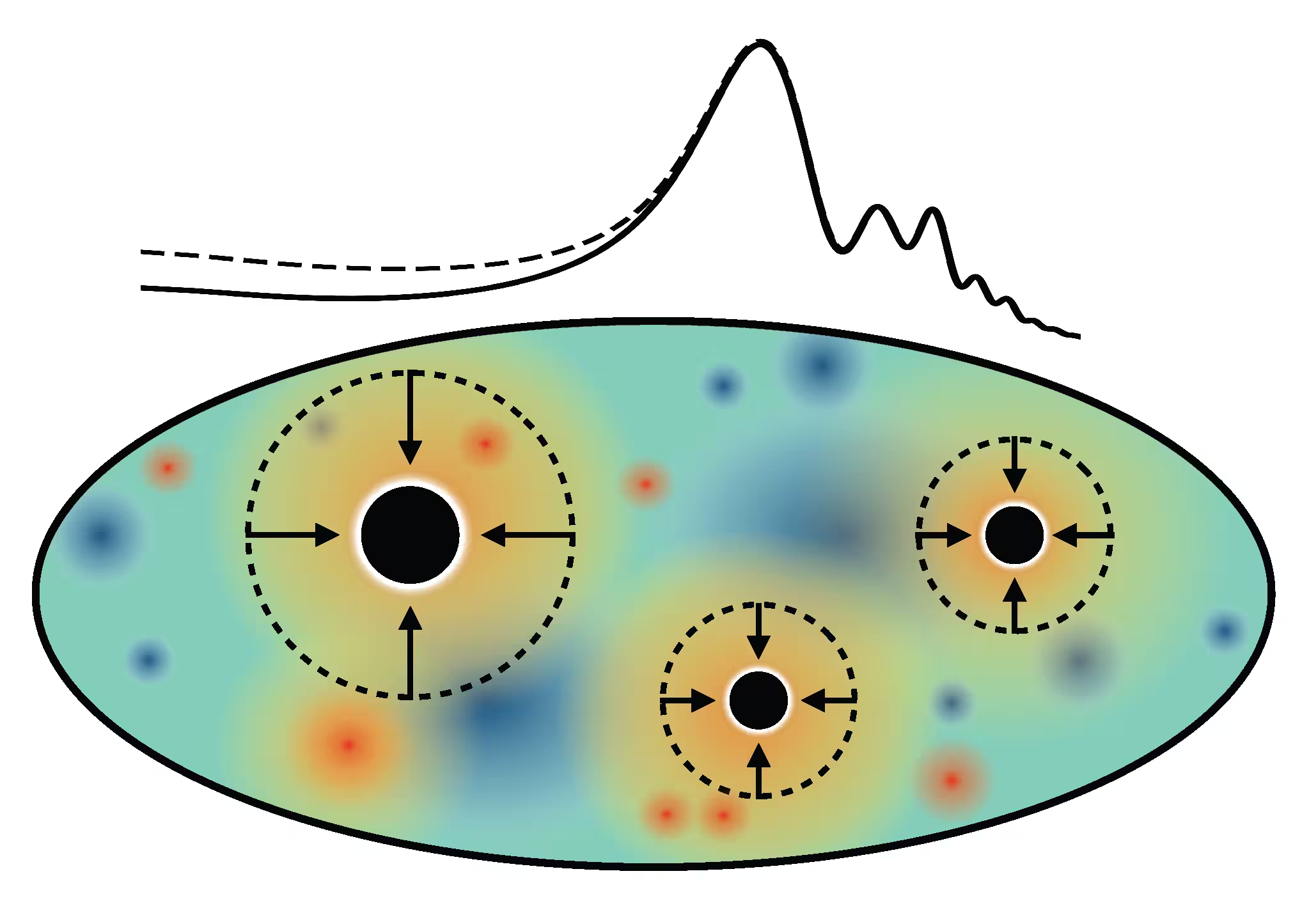
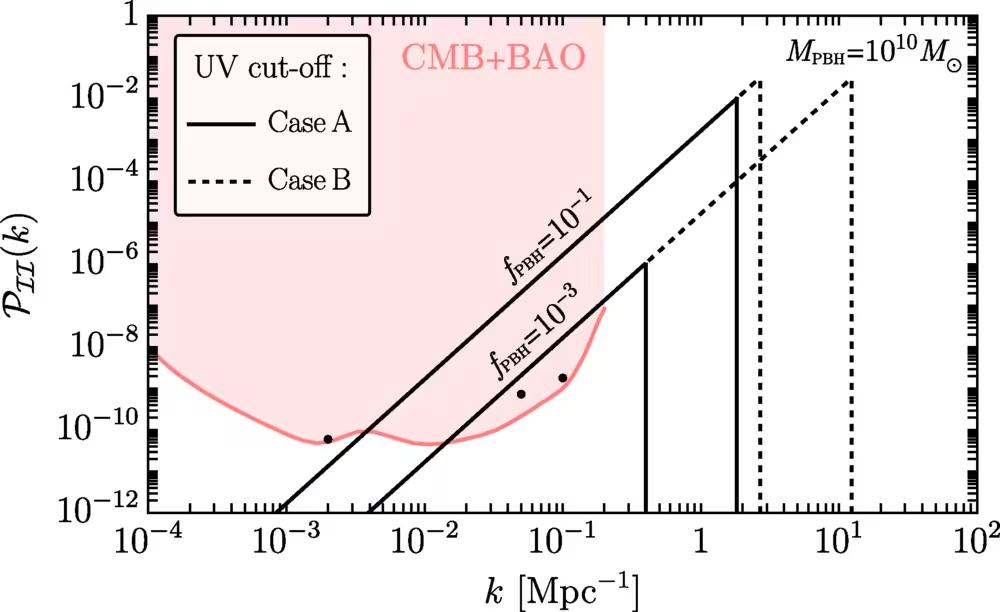
To test their hypothesis, the team analyzed data from the cosmic microwave background (CMB)—the residual heat from the Big Bang—and baryon acoustic oscillations (BAO), which are distinct patterns in the distribution of matter created by primordial sound waves. Because black holes are distinct, separate entities rather than a smooth, uniform fluid, a massive population of them would have created “isocurvature perturbations”—statistical fluctuations in the local ratio of matter to radiation.
As the universe expanded, these imbalances would have imprinted themselves onto the CMB in ways that contradict the high-precision measurements captured by the European Space Agency’s Planck mission. Even though the Planck spacecraft ceased operations in 2013, its archived data continues to serve as a high-fidelity diagnostic tool for testing fundamental cosmological theories.
Narrowing the Search
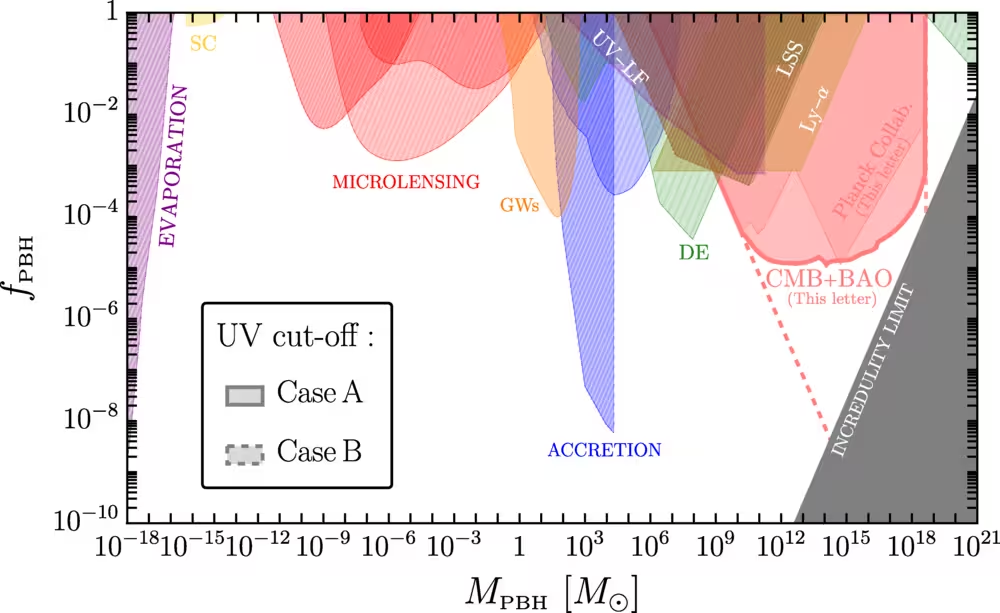
The study, led by researchers including Christopher Gerlach, Yann Gouttenoire, Antonio J. Iovino, and Nicholas Leister, effectively closes a chapter on one specific class of dark matter candidates. By applying strict statistical constraints, the authors demonstrated that even under conservative modeling assumptions, SLABs cannot account for a meaningful portion of the dark matter density observed today.
However, the researchers caution that this finding is specific to the extremely high-mass range. It does not exclude the possibility that smaller, more numerous primordial black holes could exist, nor does it address other exotic dark matter theories. The current model relies on the assumption of a “monochromatic” mass distribution—where all black holes in the population share roughly the same mass—and assumes they were distributed randomly, following a Poisson distribution. Future studies will need to explore whether more complex distributions or different physical behaviors might leave the door slightly ajar.
Implications for Modern Astrophysics
The exclusion of SLABs as a primary dark matter source forces astrophysicists to reconsider models that link primordial black holes to other observed cosmic phenomena. This includes the unexpectedly massive galaxies recently identified by the James Webb Space Telescope, as well as the nanohertz gravitational-wave background detected by pulsar timing arrays like NANOGrav. While those observations remain robust, the “giant primordial black hole” explanation for them has lost significant theoretical support.
As the scientific community continues to filter through potential explanations for the invisible matter binding our universe, this study provides a crucial boundary. By identifying what dark matter is not, researchers are steadily refining the criteria for what it might actually be. As Leister noted, the early universe remains a landscape of unresolved puzzles, and narrowing the search space is an essential step toward uncovering the truth.
This article has been fact checked for accuracy, with information verified against reputable sources. Learn more about us and our editorial process.
Last reviewed on .
Article history
- Latest version
Reference(s)
- Gerlach, Christopher., et al. “Closing the Mass Window for Stupendously Large Black Holes.” Physical Review Letters, vol. 137, no. 18, October 26, 2026 American Physical Society (APS), doi: 10.1103/qlf9-thf4. <https://doi.org/10.1103/qlf9-thf4>.
- “Johannes Gutenberg-Universität Mainz.” <https://www.uni-mainz.de/>.
Cite this page:
- Posted by Karan Das