Massive Space Survey Reveals 156,000 Pulsing Stars and a New Way to Date Clusters
A new all-sky census of pulsating variable stars shows that rapid rotation fuels their rhythmic heartbeats and links vibration frequencies to stellar aging.
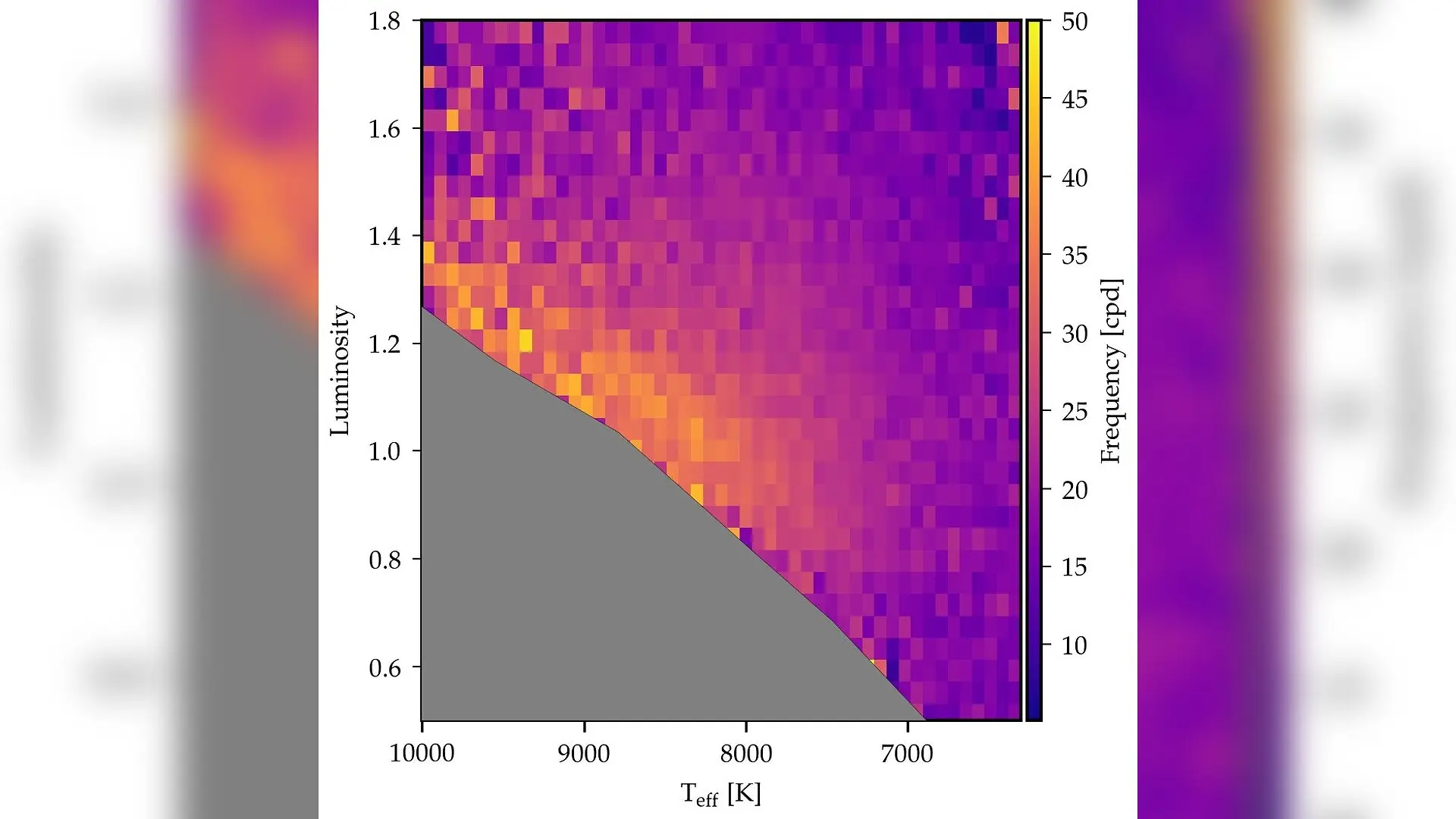
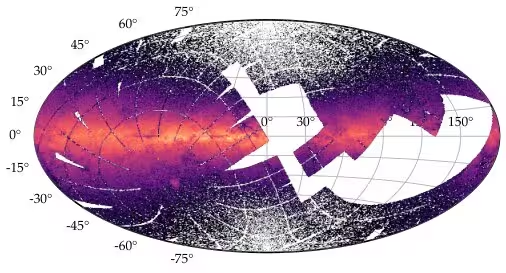
Astronomers poring through space telescope data have identified more than 156,000 pulsing stars known as Delta Scuti variables across nearly the entire night sky, revealing new secrets about how these stellar metronomes evolve and rotate.
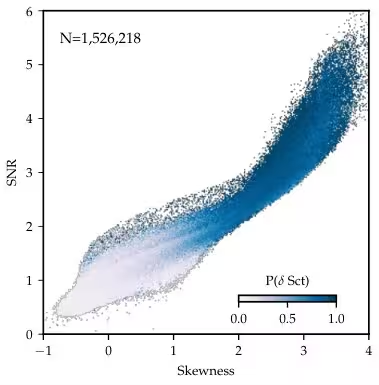
The massive census, available on the arXiv preprint server, analyzes over 1.5 million intermediate-mass stars with masses between 1.5 and 2.3 times that of our Sun. These objects reside in a specific region of the Hertzsprung-Russell diagram, which is a standard graph astronomers use to classify stars by their temperature and brightness, known as the classical instability strip.
How Fast Spin Influences Star Pulsations
The research team found that Delta Scuti pulsators spin significantly faster than non-variable stars of the same type, with a median rotational velocity of 114 kilometers per second compared to just 68 kilometers per second for quiet stars. Rapid rotation appears to help sustain the internal heat-engine mechanism that drives these pulsations, preventing certain elements from sinking out of the stellar outer layers.
However, the survey also uncovered a stubborn population of slowly rotating pulsators that spin below 50 kilometers per second. While some of these slow rotators might simply be rapid spinners viewed directly from the pole, their existence points to possible alternative excitation mechanisms within the stellar plasma, such as turbulent pressure.
Connecting Pulsation Frequencies to Star Cluster Ages
By cross-matching their massive stellar catalog with data from open star clusters, the authors report a clear link between a cluster’s age and the average pulsation frequency of its Delta Scuti members. Younger clusters under 100 million years old host stars vibrating at much higher frequencies, between 30 and 50 cycles per day, than clusters older than one billion years, where dominant frequencies drop to 10 to 20 cycles per day.
This frequency shift occurs because stars expand and become less dense as they age, causing their acoustic vibration cycles to slow down like a stretching rubber band. This correlation offers astronomers a fresh ensemble-asteroseismic age indicator to estimate the ages of young stellar groups without relying solely on traditional color-magnitude techniques.
What Controls the Pulsator Fraction Across the Sky
Previous space missions like Kepler suggested that only about 70 percent of stars inside the instability strip actually pulsate, creating a puzzle about what makes the region impure. The new study demonstrates that instrument sensitivity plays a major role in this mystery, as fainter stars are harder to detect.
When looking only at the brightest targets in the TESS survey, the detected pulsator fraction climbs from a modest 30 percent across the full sample up to roughly 80 percent. Even at the highest brightness levels, though, roughly 20 percent of the stars remain quiet, confirming that genuine non-variable stars genuinely share space inside the instability strip.
The study was posted to the arXiv preprint server on October 29, 2026.
This article has been fact checked for accuracy, with information verified against reputable sources. Learn more about us and our editorial process.
Last reviewed on .
Article history
- Latest version
Reference(s)
- Hey, Daniel. “The $δ$ Scuti instability strip and period-luminosity relation as seen by TESS and Gaia DR3.” arXiv.org <http://arxiv.org/abs/2610.40656v1>.
Cite this page:
- Posted by John Williams