Earth’s Gravity May Have Supercharged The Moon’s Mysterious Volcanic Past
New research suggests Earth’s gravitational pull may have generated internal heat, explaining the Moon’s surprisingly long history of volcanic activity.
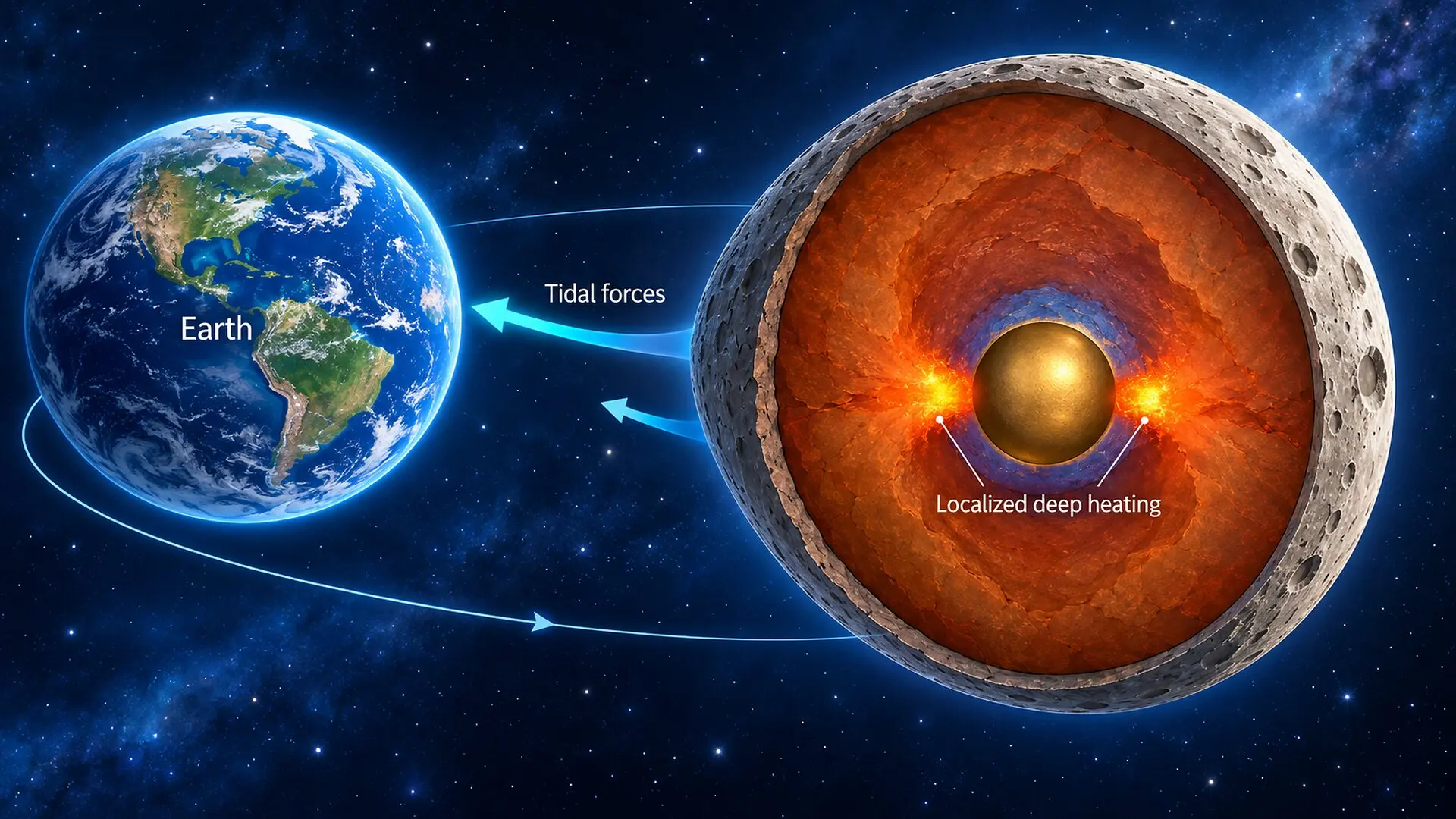
Deep within the Moon, a localized region may have once acted as a geothermal engine, potentially fueling the lunar surface’s long-standing history of volcanic activity. New numerical simulations suggest that gravitational interactions between Earth and the Moon could have concentrated tidal heat at the boundary between the lunar core and mantle, rather than distributing it evenly across the interior.
The findings, published in the journal Planet, provide a compelling theoretical framework for how the Moon remained geologically active for billions of years. Led by Miao Chen and Da Wang of the Chengdu University of Technology, alongside researchers from the Chinese Academy of Sciences, the study models how tidal deformation can be converted into heat based on the specific physical properties of the lunar interior.
Solving the Mystery of Late-Stage Lunar Volcanism
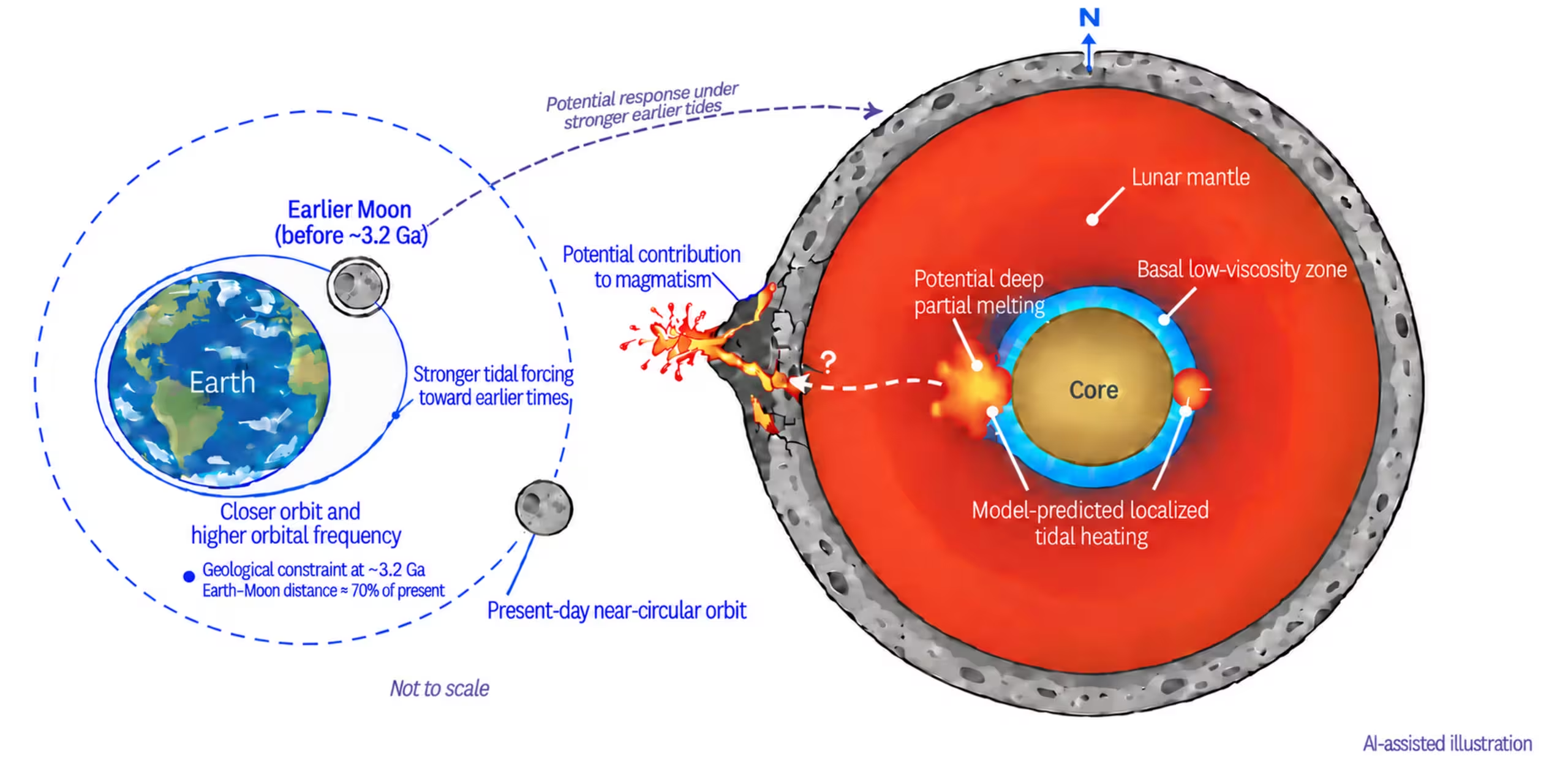
Geological samples returned by missions such as Chang’e-5 have confirmed that the Moon experienced volcanic eruptions as recently as 2 billion years ago. For a relatively small celestial body, maintaining the high internal temperatures required to generate magma so late in its evolution has long puzzled planetary scientists. While radioactive decay and primordial heat are traditional explanations, they generally decline over time, leaving a gap in our understanding of the Moon’s prolonged activity.
The researchers propose that tidal dissipation—the conversion of orbital energy into heat through internal friction—may be the missing variable. Because the Moon is not a perfectly elastic sphere, the constant gravitational tugging from Earth causes it to deform. In the team’s model, a layer of lower viscosity near the core-mantle boundary (CMB) significantly amplifies this effect.
The Tidal Heating Anomaly Zone
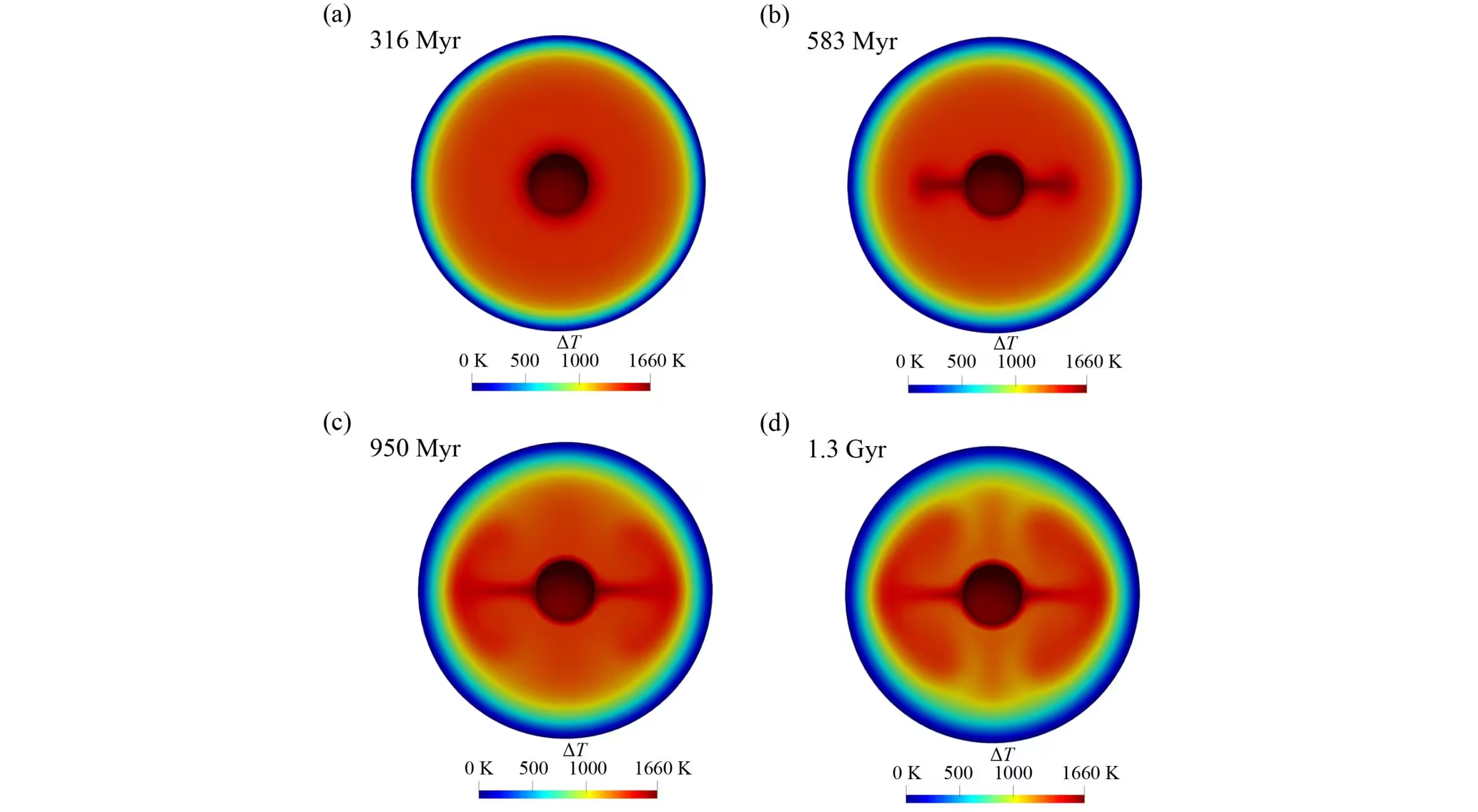
By integrating three-dimensional mantle-convection simulations, the team identified a phenomenon they termed the Tidal Heating Anomaly Zone (THAZ). In their models, tidal energy is not dispersed uniformly; instead, it becomes concentrated in two symmetric regions near the equator of the core-mantle boundary.
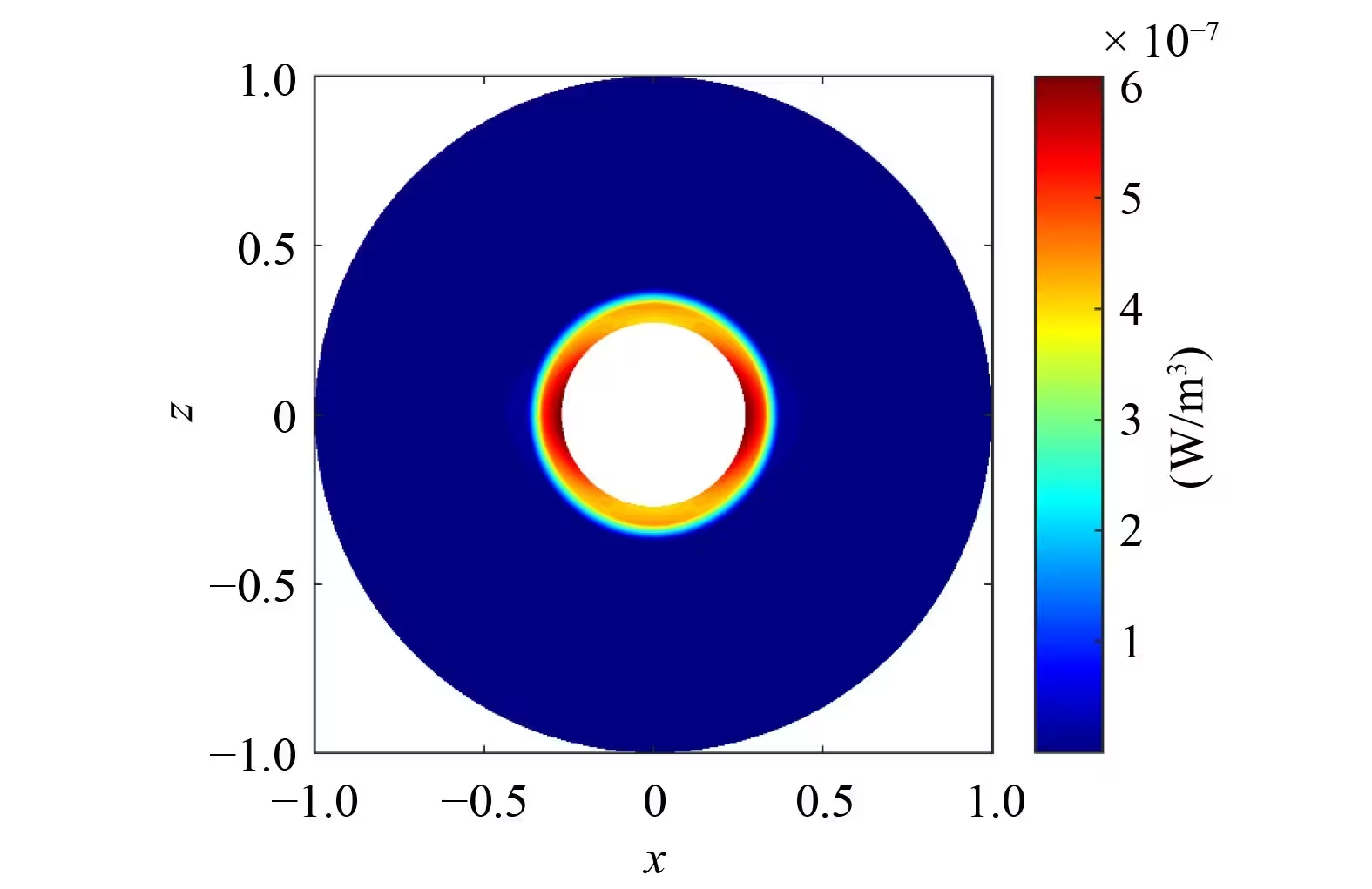
The efficiency of this heating is highly sensitive to the Moon’s orbital eccentricity—the measure of how much its orbit deviates from a perfect circle. In a high-eccentricity scenario (e=0.5), the THAZ generated approximately 150 gigawatts of power, roughly 4.3 times higher than the heat produced by radioactive decay in that same region. In contrast, a more circular orbit (e=0.05) resulted in a hundredfold reduction in tidal power, highlighting that the Moon’s orbital history is critical to its thermal budget.
Implications for Mantle Dynamics
The concentration of heat at the base of the mantle would naturally trigger convective upwellings. The researchers posit that these plumes could transport thermal energy from the deep interior toward the surface. This mechanism might help mobilize dense, titanium-rich materials formed during the cooling of the ancient lunar magma ocean, potentially influencing where and when melting occurs in the upper mantle.
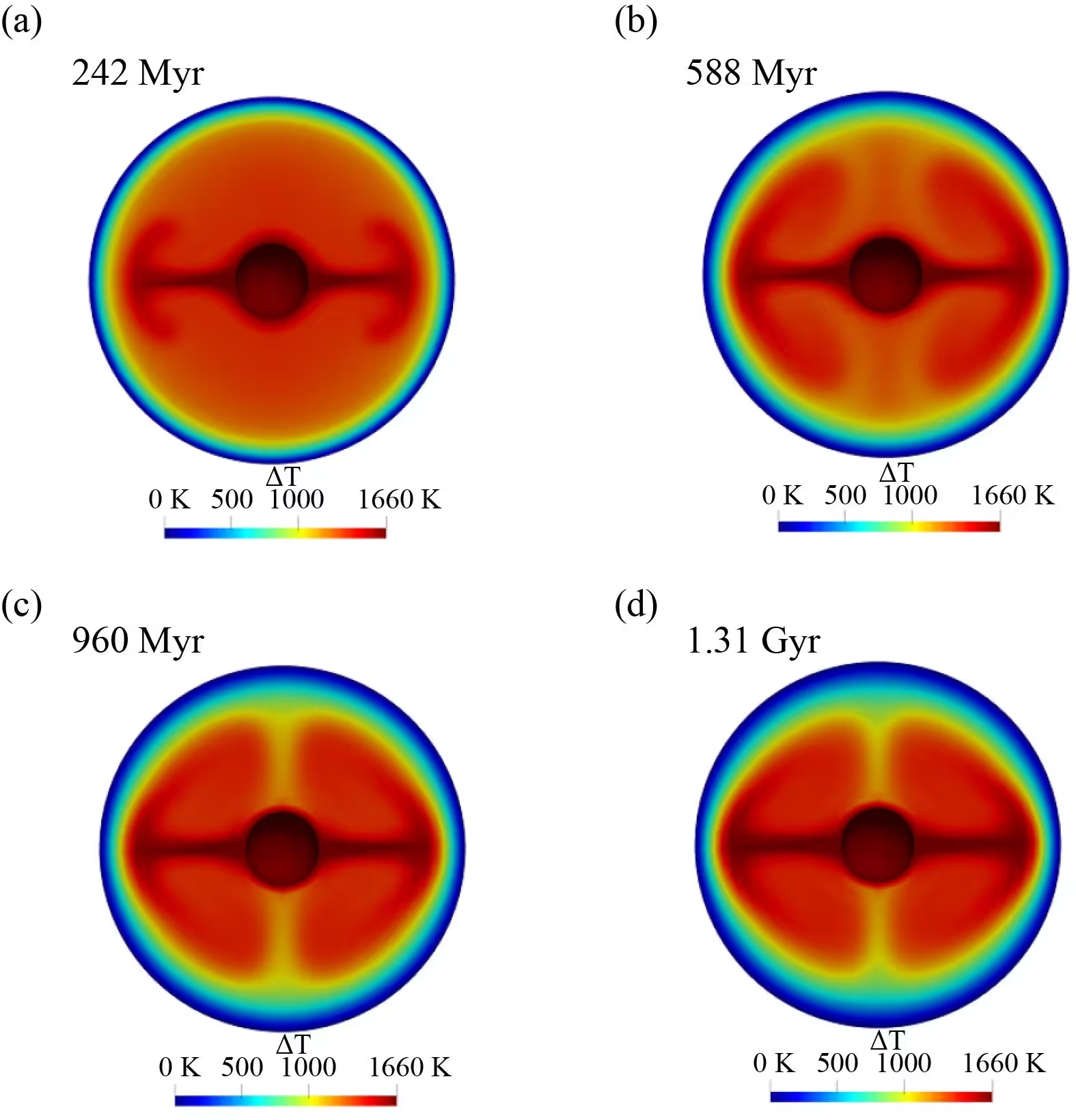
While the simulation provides a robust theoretical link, the authors caution that it remains a simplified model. Current calculations do not fully account for complex factors such as latent heat from rock melting, heat transport through magma migration, or the specific influence of the Moon’s near-side and far-side crustal differences. Future investigations that combine these geophysical models with observational data will be essential to confirm if this deep-seated tidal heating was indeed the driver behind the Moon’s persistent volcanic activity.
Additional context on this research can be found in the following peer-reviewed studies:
- Thermal asymmetry in the Moon’s mantle inferred from monthly tidal response(Nature, 2025)
- A Low-Viscosity Lower Lunar Mantle Implied by Measured Monthly and Yearly Tides(AGU Advances, 2024)
- The lunar solid inner core and the mantle overturn(Nature, 2023)
This article has been fact checked for accuracy, with information verified against reputable sources. Learn more about us and our editorial process.
Last reviewed on .
Article history
- Latest version
Reference(s)
- CHEN, Miao., et al. “Tidal Heating Anomaly Zone at the core-mantle boundary of the Moon.” Planet, vol. 2, no. 2, January 1, 2026, pp. 26014 China Engineering Science Press Co. Ltd., doi: 10.15302/planet.2026.26014. <https://journal.hep.com.cn/planet/EN/10.15302/planet.2026.26014>.
- projects, Contributors. “university in Chengdu, Sichuan, China.”, September 3, 2005 Wikimedia Foundation, Inc. <https://en.wikipedia.org/wiki/Chengdu_University_of_Technology>.
- “Chinese Academy of Sciences.” <https://www.google.com/goto?url=CAESUgHrOzAVVYZGtUtDgOsKWcuQco7XWK9-uO7hX_YdKgkc-hh5zszW6jlajwTbuu_MWFO4Ln5o5OALZYe-bpoM6e2xPndk1M1yCtm9apn8aHlDSjU>.
- Park, R.. “Thermal asymmetry in the Moon’s mantle inferred from monthly tidal response - Nature.”, vol. 641, no. 8065, pp. 1188-1192. Nature, doi: 10.1038/s41586-025-08949-5. <https://www.nature.com/articles/s41586-025-08949-5>.
- Goossens, Sander., et al. “A Low‐Viscosity Lower Lunar Mantle Implied by Measured Monthly and Yearly Tides.” AGU Advances, vol. 5, no. 5, September 14, 2024 American Geophysical Union (AGU), doi: 10.1029/2024AV001285. <https://agupubs.onlinelibrary.wiley.com/doi/full/10.1029/2024AV001285>.
- Briaud, Arthur. “The lunar solid inner core and the mantle overturn - Nature.”, vol. 617, no. 7962, pp. 743-746. Nature, doi: 10.1038/s41586-023-05935-7. <https://www.nature.com/articles/s41586-023-05935-7>.
Cite this page:
- Posted by Aisha Ahmed