Hubble Reveals a Giant Spiral Galaxy Racing Toward a Dramatic Fate
Hubble reveals how galaxy M88’s journey toward Virgo Cluster’s core reshapes its cosmic destiny.
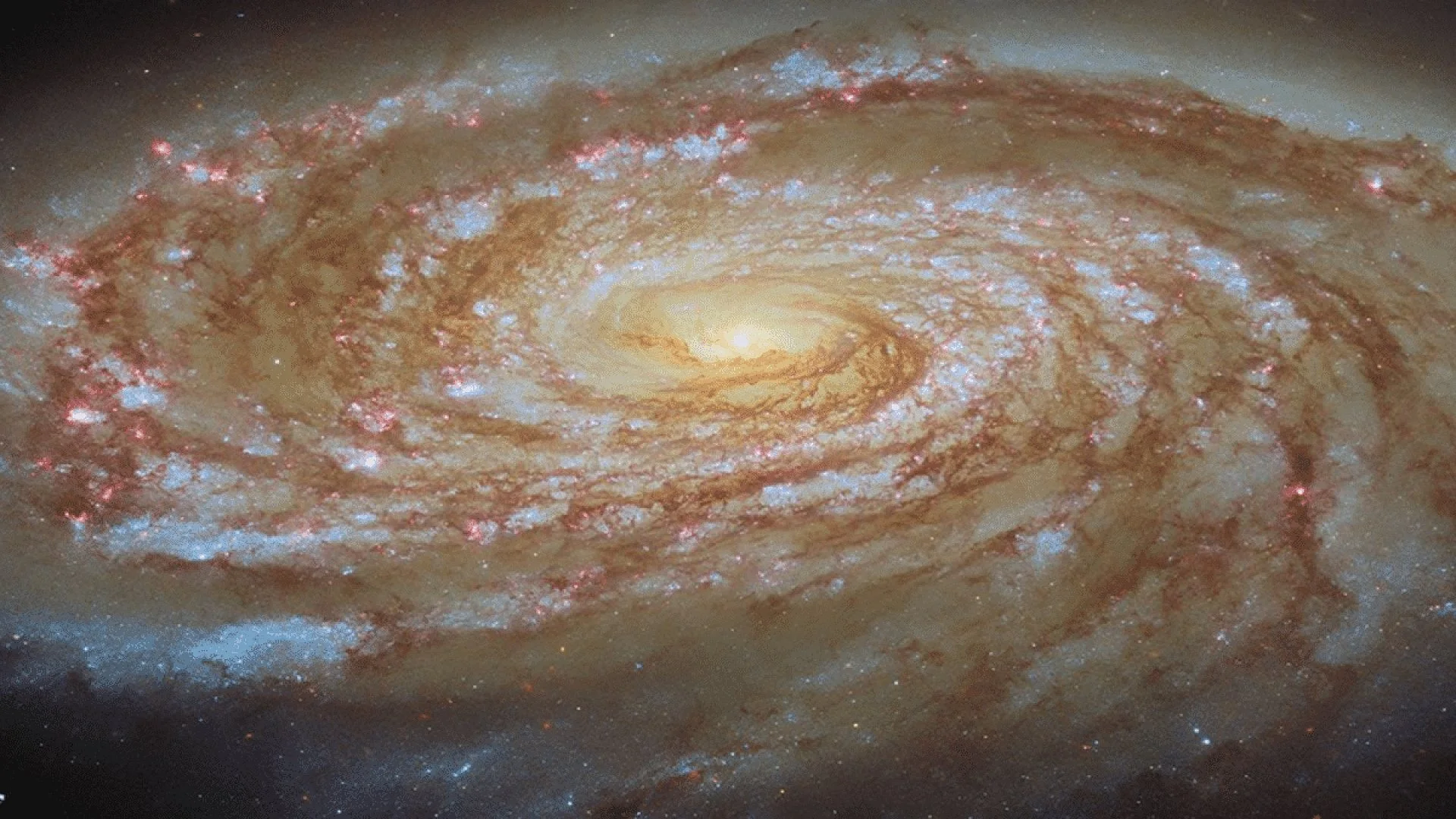
A fresh Hubble capture, produced jointly by NASA and the European Space Agency, brings Messier 88 (M88) into sharp focus, exposing a massive spiral galaxy about 63 million light‑years away in the constellation Coma Berenices that is currently undergoing changes destined to reshape its future over hundreds of millions of years.
Supermassive Black Hole Drives Energetic Core Activity
At the heart of M88 sits a black hole whose mass is estimated at roughly one hundred million solar masses. Unlike a quiet nucleus, this monster is actively accreting gas and dust, classifying the galaxy as an active galaxy. The infalling material releases enormous energy, launching outflows that can shape the surrounding interstellar environment.
The new Hubble picture reveals a luminous, warm‑colored core surrounded by a dense swarm of older, reddish stars. Extending outward, tightly wound spiral arms host clusters of young stars and dark dust lanes, generating the vivid blue and pink hues that trace ongoing star formation. Viewed at an angle rather than face‑on, the galaxy appears elongated, allowing astronomers to map the disk’s structure and the distribution of star‑forming regions with exceptional clarity.
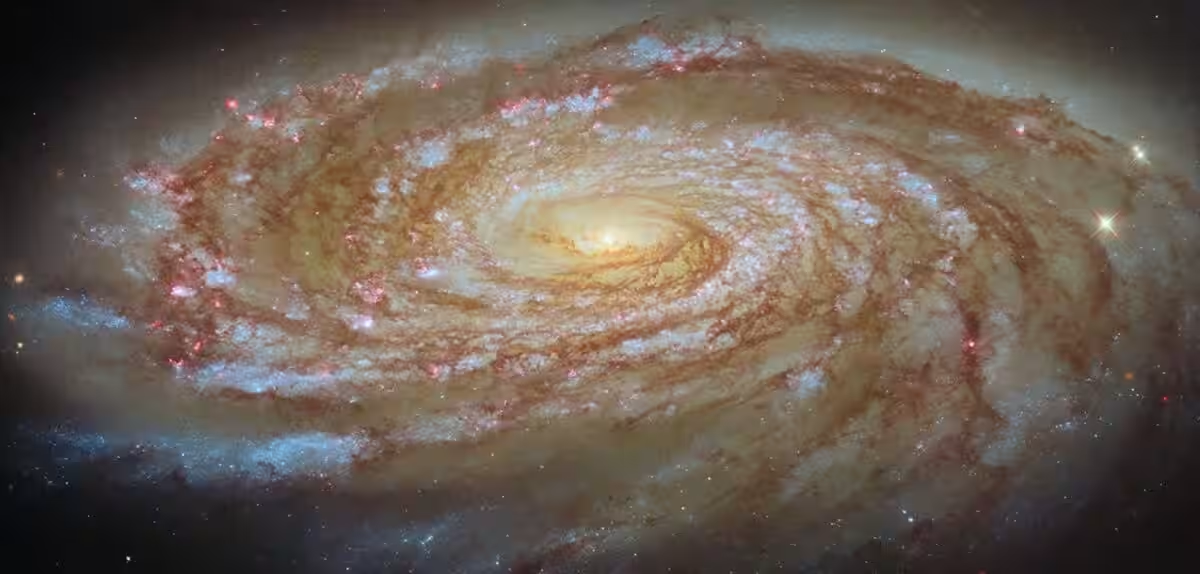
Credit: ESA/Hubble & NASA, D. Thilker
M88’s Trajectory Toward the Virgo Cluster Core
The galaxy is a member of the Virgo Cluster, a massive assembly of more than a thousand galaxies bound together by gravity. Within this crowded arena, members orbit the cluster’s centre and interact with the pervasive hot intracluster medium. Calculations indicate that M88 is slowly drifting inward, on a path that will bring it close to the dominant elliptical galaxy Messier 87 (M87) in roughly two to three hundred million years.
As M88 penetrates deeper into the cluster’s dense interior, it will encounter increasingly hostile conditions. The intracluster gas behaves like an invisible wind, exerting pressure on any galaxy that moves through it; the faster the passage, the stronger the force on the galaxy’s own gas supply.
Signs of Ram‑Pressure Stripping Appear in the Disk
Observations already reveal that M88 is experiencing ram‑pressure stripping, a process where the hot cluster gas pushes interstellar material out of a galaxy, analogous to wind resistance on a moving vehicle but on a cosmic scale. The galaxy’s gaseous disk looks truncated, not extending as far as typical for a spiral of its size, and the leading edge appears compressed, causing gas and dust to pile up like snow in front of a plow.
This loss of cold gas— the essential fuel for star formation—has measurable consequences. Measurements show that M88’s outer regions contain significantly less cold gas than expected, indicating that the environmental forces are already curtailing its ability to birth new stars. Over time, this depletion will likely shift the galaxy’s evolutionary trajectory, reducing its star‑forming activity and altering its appearance.
This article has been fact checked for accuracy, with information verified against reputable sources. Learn more about us and our editorial process.
Last reviewed on .
Article history
- Latest version
Reference(s)
- Gianopoulos, Andrea. “Hubble Captures M88 on Journey to Center of Virgo Cluster - NASA Science.”, May 29, 2026 NASA <https://science.nasa.gov/missions/hubble/hubble-captures-m88-on-journey-to-center-of-virgo-cluster/>.
Cite this page:
- Posted by Aisha Ahmed