Saturn’s Rings May Be Younger Than the Dinosaurs, and Scientists Are Still Trying to Explain How They Formed
New evidence challenges traditional views on Saturn’s age and the origins of its iconic rings
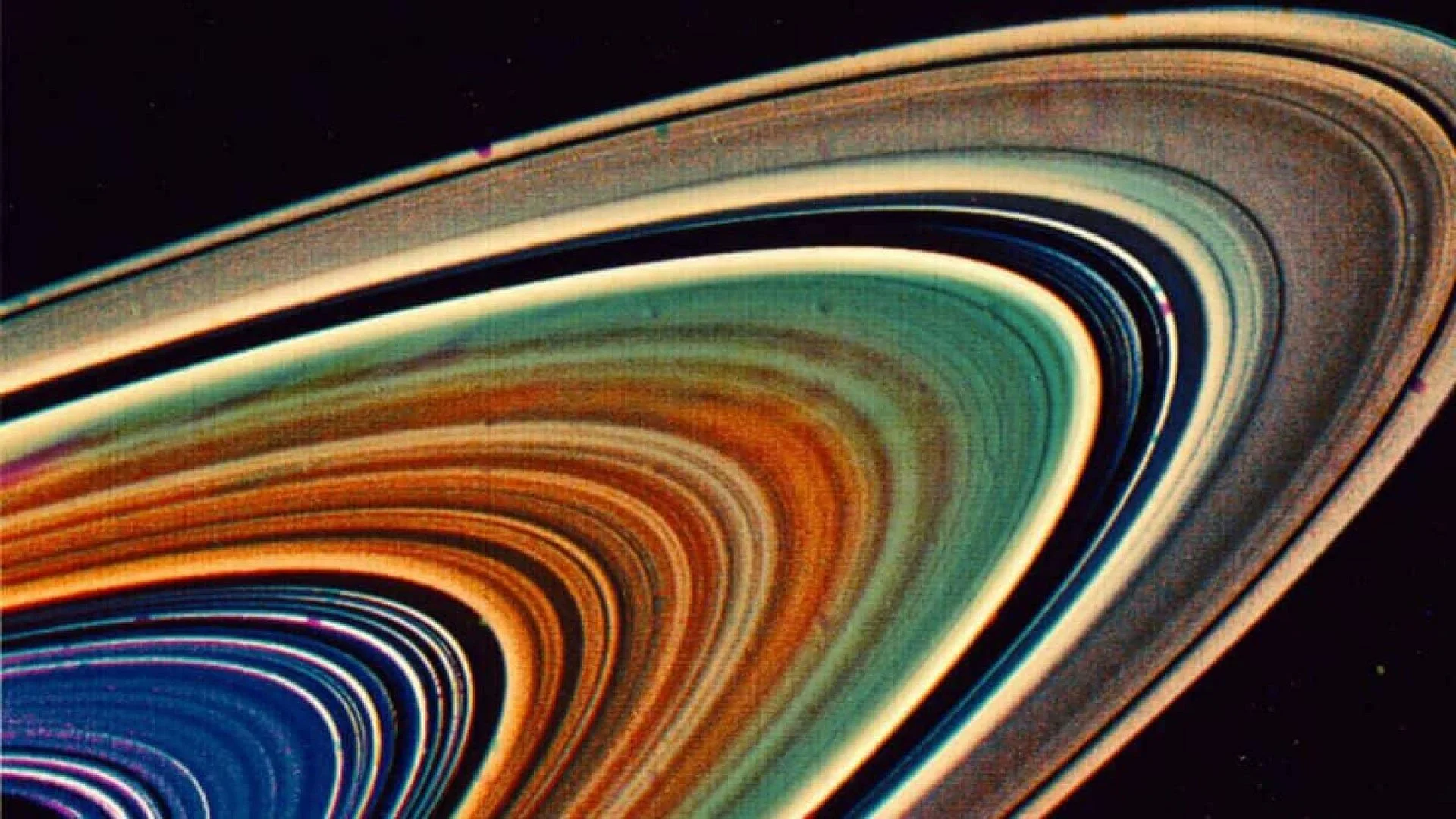
The dazzling bands that encircle Saturn have long captured imaginations, but fresh analysis of NASA’s Cassini data suggests they could be far younger than the planet itself. A 2023 study linked the rings’ unusually clean appearance to a relatively brief exposure to interplanetary dust, challenging the assumption that they have existed for billions of years.
Saturn formed roughly 4.5 billion years ago, making it almost as ancient as the Solar System. If the rings are indeed a recent addition, the giant would have spent most of its history without the iconic halo seen today.
Dust‑Driven Dating Shows Rings May Be Only a Few Hundred Million Years Old
Researchers point to the rings’ high reflectivity and low contamination as clues to their age. In a paper published in Science Advances in 2023, Sascha Kempf and collaborators used Cassini’s Cosmic Dust Analyzer to quantify the flux of dust entering Saturn’s environment.
The main rings consist primarily of water ice—about 95‑98 percent—giving them their brilliant sheen. A thin veil of darker material, comprising roughly 0.1‑2 percent of the volume, is thought to originate from dust drifting inward from other parts of the Solar System.
By comparing the measured dust influx with the present level of contamination, the team estimated that the rings have been exposed to space dust for between 100 and 400 million years. This exposure age, while not identical to the rings’ formation time, indicates a system far younger than the planet it surrounds.
A Missing Moon Might Hold the Key to the Rings’ Origin
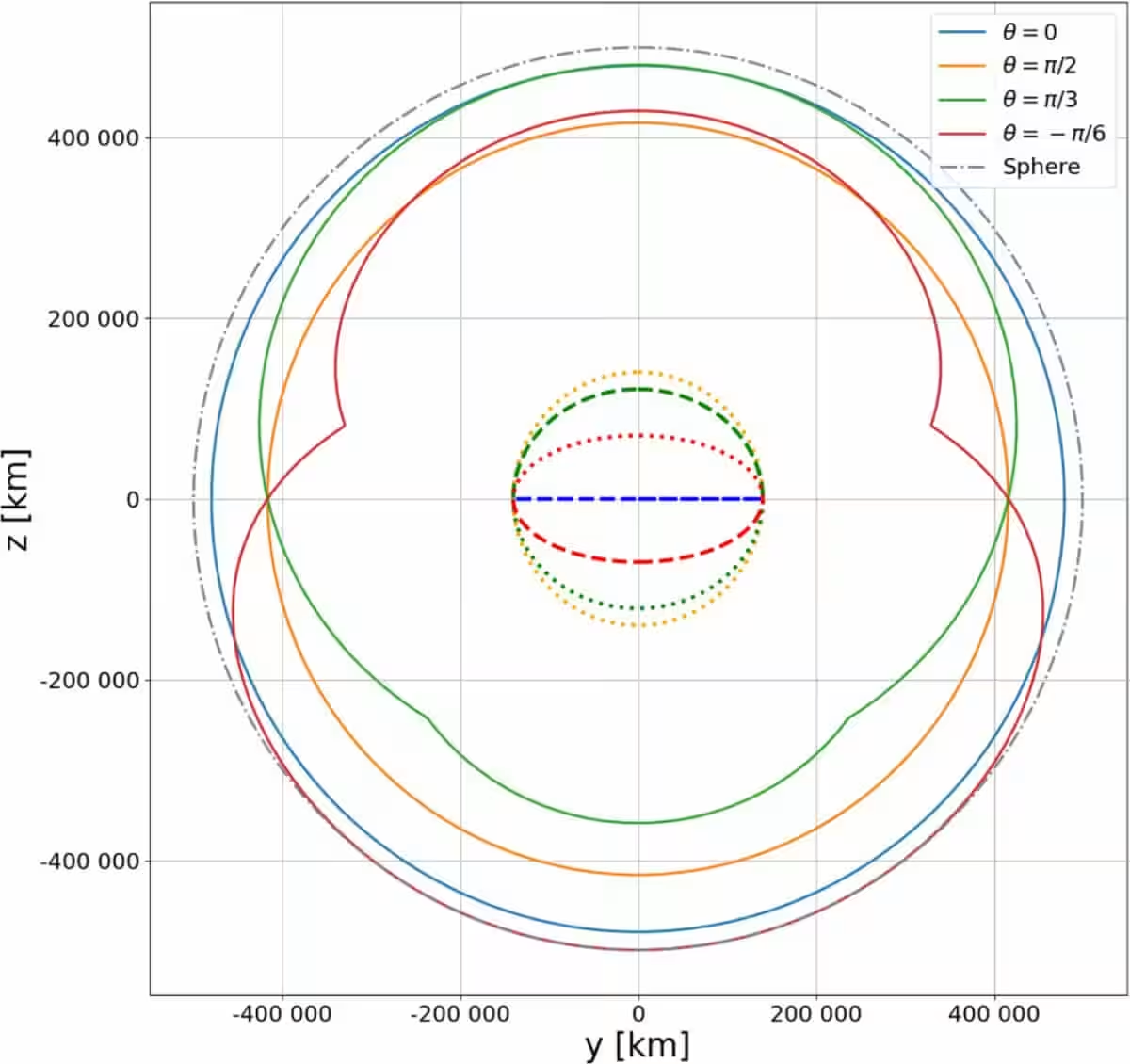
Cassini also supplied critical mass estimates for the rings. A 2019 analysis led by Luciano Less used the spacecraft’s final trajectories to show that the rings contain roughly half the mass of Saturn’s moon Mimas. A relatively lightweight ring system aligns more comfortably with a younger age, because less material would be needed to reach the observed level of contamination.
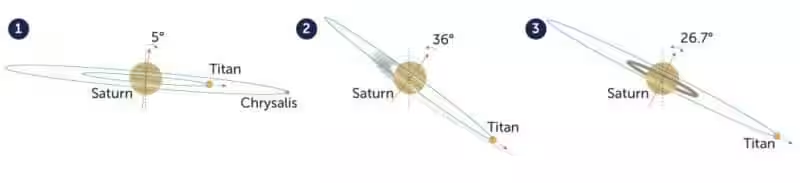
The “Chrysalis” scenario, outlined in a 2022 Science article, proposes that an additional icy satellite—comparable in size to Iapetus—became destabilized 100‑200 million years ago and ventured too close to Saturn. The planet’s gravity would have shredded the moon, sending most debris spiraling into the planet while leaving a fraction in orbit to coalesce into the present rings. This model also seeks to account for Saturn’s pronounced 26.7‑degree axial tilt, linking two long‑standing puzzles to a single cataclysmic event.
Debate Persists Over How Young the Rings Really Are
Critics argue that the exposure age derived from dust accumulation may not directly translate to a formation age. In a 2026 paper in Icarus, Gregorio Ricerchi and Aurélien Crida contend that the calculation hinges on assumptions about dust transport within the rings. Processes such as impacts, radial spreading, or infall into Saturn could constantly remove material, meaning the current contamination level might not serve as a simple chronometer.
Ricerchi and Crida suggest that a ring system appearing to have been exposed for only a few hundred million years could, in fact, be ancient—potentially tracing back to the early epochs of the Solar System.
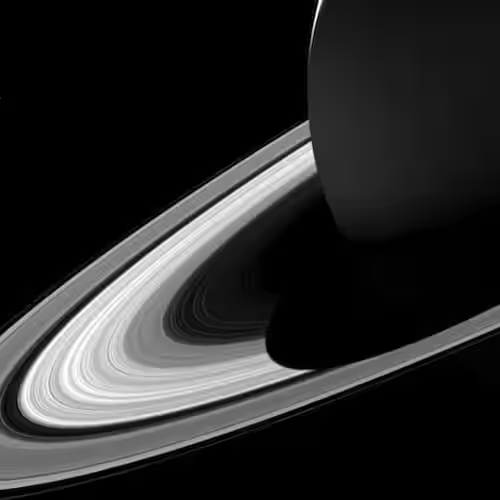
Regardless of the dispute, there is consensus that Saturn’s rings are gradually eroding. Cassini observations showed a steady drift of ring particles into the planet’s atmosphere, implying that the remaining material could disappear over the next few hundred million years.
This article has been fact checked for accuracy, with information verified against reputable sources. Learn more about us and our editorial process.
Last reviewed on .
Article history
- Latest version
Reference(s)
- Kempf, Sascha., et al. “Micrometeoroid infall onto Saturn’s rings constrains their age to no more than a few hundred million years.” Science Advances, vol. 9, no. 19, May 12, 2023 American Association for the Advancement of Science (AAAS), doi: 10.1126/sciadv.adf8537. <https://www.science.org/doi/10.1126/sciadv.adf8537>.
- “Sascha Kempf.” Physics <https://www.colorado.edu/physics/sascha-kempf>.
- <https://www.researchgate.net/profile/Luciano-Iess>.
- <https://www.sciencedirect.com/science/article/pii/S0019103526000953>.
- Ricerchi, Gregorio. “Gregorio RICERCHI - Université Côte d'Azur.” Université Côte d'Azur <https://univ-cotedazur.fr/annuaire/gregorio-ricerchi>.
- Crida, Aurelien. “Aurelien CRIDA - Université Côte d'Azur.” Université Côte d'Azur <https://univ-cotedazur.fr/aurelien-crida>.
Cite this page:
- Posted by Aisha Ahmed