Astrophotographer Unveils Incredible Image of Galactic “Eyes” in Deep Space
A stunning new photograph of Markarian’s Chain showcases galaxies in collision, luminous streams of stars, and the iconic “Eyes” duo with striking clarity.
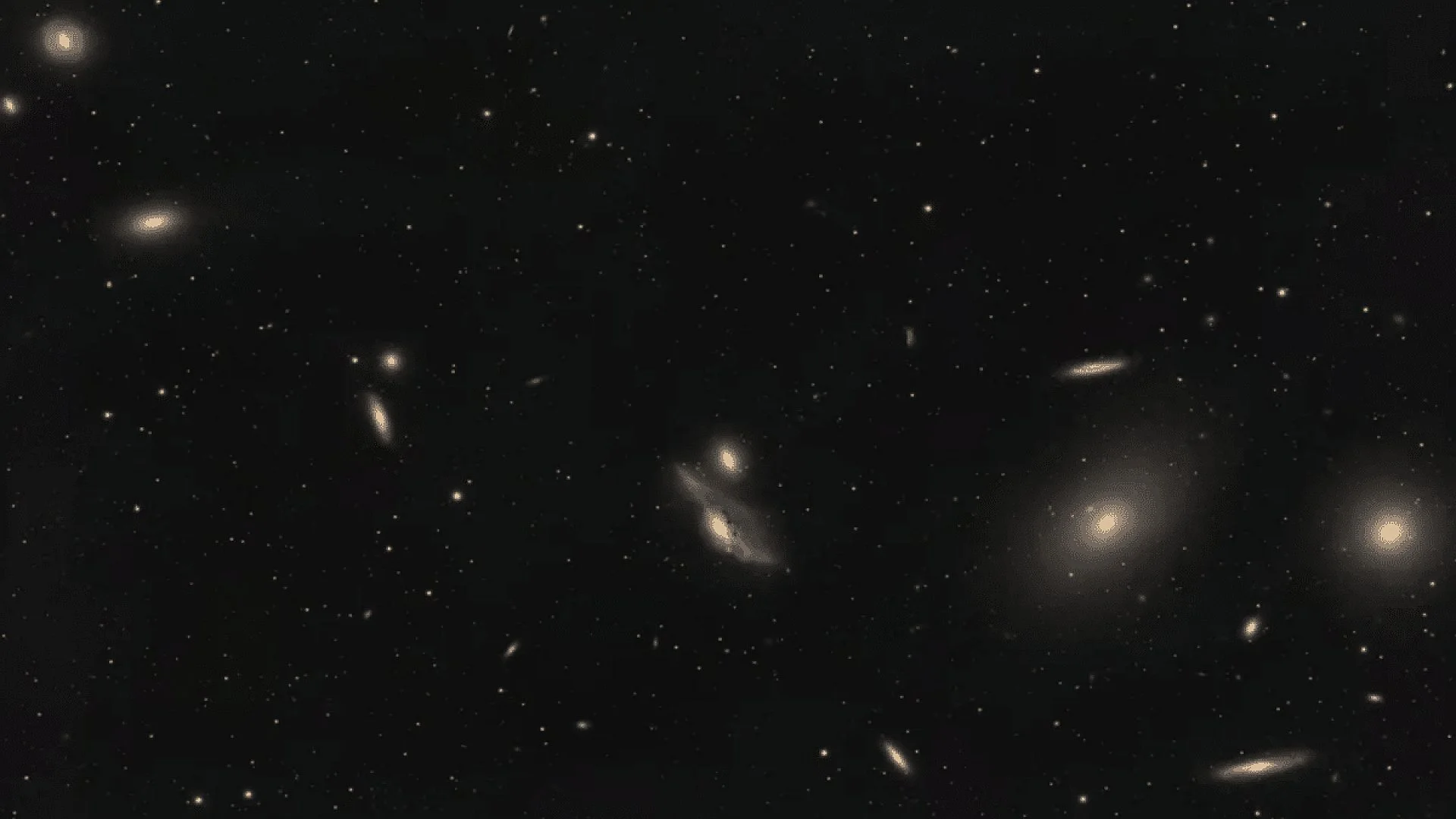
A breathtaking new deep-space image, captured by astrophotographer Ronald Brecher, is generating immense excitement within the astronomy community. This stunning visual representation of Markarian’s Chain, a majestic collection of galaxies within the Virgo Cluster, offers a captivating glimpse into one of the densest galactic regions observable from Earth. According to the esteemed astronomy website Messier Objects, the Virgo Cluster may comprise approximately 2,000 galaxies in motion through space, making this image a testament to Brecher’s exceptional astrophotography skills.
Unveiling the Cosmic Tapestry of Markarian’s Chain
Markarian’s Chain is renowned among astronomers for its remarkable concentration of galaxies within a relatively small area of the night sky. Situated between the constellations Leo and Virgo, this galactic chain forms a part of the massive Virgo Galaxy Cluster, a gravitationally bound structure comprising elliptical, spiral, and irregular galaxies. Brecher’s image masterfully captures this complex cosmic environment, revealing subtle color variations and faint dust structures often obscured in amateur observations.
The chain was named in honor of astronomer Benjamin E. Markarian, who discovered that these galaxies share a synchronized motion through space. The astronomy website Messier Objects notes that this apparent alignment is not a coincidence but rather a result of the cluster’s dynamic evolution shaped by gravity over billions of years. In Brecher’s image, several prominent galaxies stand out, including M84 and M86, two giant elliptical galaxies first cataloged by Charles Messier in 1781. Their vibrant cores dominate the right side of the composition, while numerous smaller galaxies scatter across the frame like distant embers.
The image’s striking contrast between serene elliptical systems and visibly distorted galaxies undergoing interaction is particularly captivating. Streams of stars and warped structures hint at the violent gravitational encounters that are reshaping the cluster. Instead of appearing as isolated islands in space, these galaxies seem connected through invisible tidal forces that continue to transform them over cosmic timescales.
Unraveling the Mystery of “The Eyes” Galaxies
At the heart of the image lies one of the most fascinating features of Markarian’s Chain: the interacting pair NGC 4438 and NGC 4435, collectively known as “The Eyes.” These galaxies appear to be locked in a dramatic gravitational encounter that has twisted and disrupted their original structures. Long trails of dust and stars stretch outward, evidence of tidal forces pulling material away during close interaction.
“Note the striking color and detail in NGC 4438 and NGC 4435, which make a close pair of galaxies known as ‘The Eyes’, just below center in this image”, noted Brecher in a post on his website.
The larger galaxy, NGC 4438, exhibits some of the most severe distortions in the chain. Its once-orderly spiral structure appears heavily warped, with dark dust lanes cutting through a chaotic disk. Astronomers believe close encounters between galaxies can trigger bursts of star formation, redistribute interstellar gas, and sometimes even feed central supermassive black holes. In this case, the interaction has transformed both galaxies into a visual record of gravitational disruption in action.
The nickname “The Eyes” originates from the pair’s appearance through telescopes, where the bright galactic cores resemble glowing eyes staring through the darkness of space. Brecher’s high-resolution processing enhances that effect dramatically, turning the pair into the emotional centerpiece of the image. The combination of color, texture, and visible tidal damage provides viewers with a rare opportunity to appreciate the dynamic nature of galaxies.
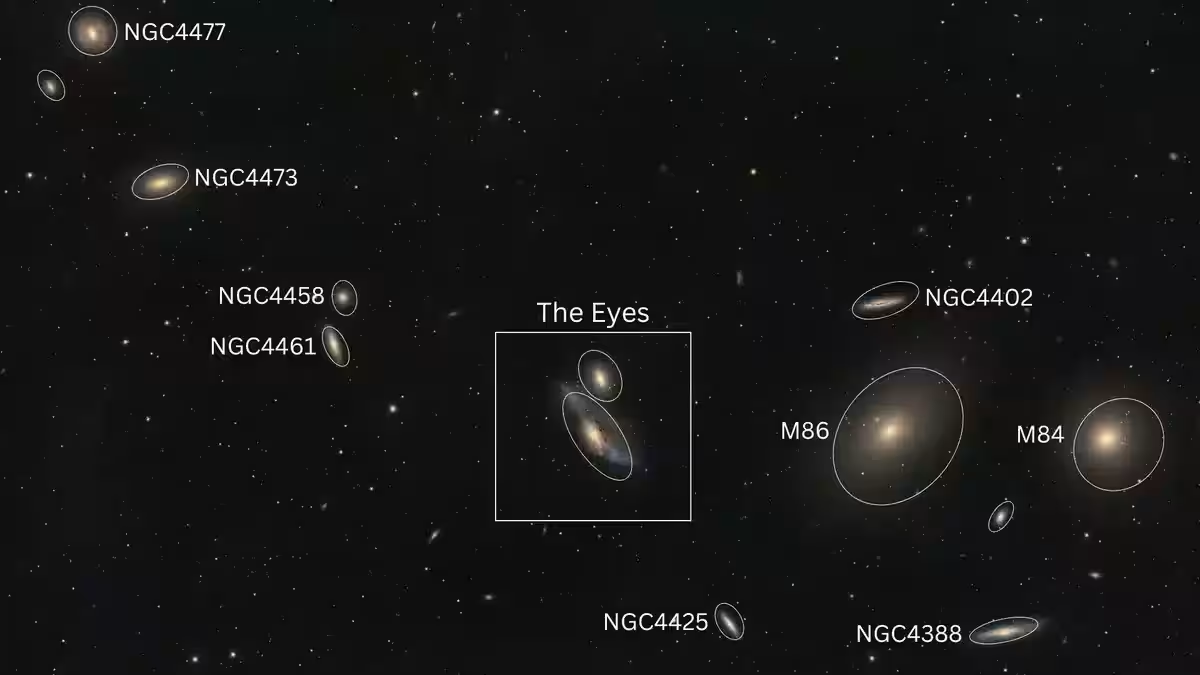
Image credit: Ronald Brecher
A Backyard Observatory’s Triumph: Capturing the Beauty of Markarian’s Chain
One of the most impressive aspects of the project is that the image was captured from Brecher’s home in Guelph, Canada, using a Skywatcher Esprit 120 telescope paired with a dedicated astronomy camera and multiple filters. Over a ten-day period between April 17 and April 27, he collected data, which was later combined to create an image with more than nine and a half hours of exposure time. This remarkable achievement demonstrates the capabilities of advanced amateur equipment in producing work approaching professional quality.
Long-exposure astrophotography demands both technical precision and patience. Every hour of collected light adds detail that would otherwise remain invisible to the human eye. Tracking systems must compensate for Earth’s rotation with near-perfect accuracy while atmospheric conditions remain stable enough to preserve sharpness. The resulting image showcases the potential of amateur astrophotography in capturing the breathtaking beauty of the night sky.
Brecher’s processing also preserves natural galactic colors, rather than oversaturating the scene. Golden elliptical galaxies contrast against cooler bluish spiral systems, reflecting differences in stellar populations and star formation activity. Older galaxies rich in aging stars tend to glow yellow or orange, while younger star-forming regions radiate bluer light. These distinctions transform the image from a visually impressive photograph into a scientifically informative portrait of galactic evolution.
Locating Markarian’s Chain in the Night Sky
For observers seeking to locate Markarian’s Chain themselves, spring offers the best opportunity. The galactic grouping becomes visible after sunset high in the southwestern sky. The easiest starting point is the constellation Leo, one of the most recognizable spring constellations in the Northern Hemisphere. From there, observers can identify the bright star Denebola at the lion’s tail and then trace toward Vindemiatrix in Virgo.
Markarian’s Chain sits roughly halfway between those reference points. Under dark skies, a modest 6-inch telescope is sufficient to begin revealing several of the brighter galaxies. Binoculars may detect the glow of larger members like M84 and M86, though detailed structures require greater magnification and favorable conditions. Observers are often surprised by how many galaxies become visible within a single telescope field once the chain is properly located.
The experience carries a unique sense of scale. Every faint patch of light represents an entire galaxy containing billions of stars, many separated from Earth by tens of millions of light-years. Brecher’s image captures that overwhelming depth beautifully, transforming a small region of the spring sky into a crowded cosmic landscape filled with collisions, motion, and ancient stellar systems still evolving today.
This article has been fact checked for accuracy, with information verified against reputable sources. Learn more about us and our editorial process.
Last reviewed on .
Article history
- Latest version
Reference(s)
- Brecher, Ron. “Markarian’s Chain.”, April 29, 2026 Ron Brecher <https://astrodoc.ca/markarians-chain/>.
Cite this page:
- Posted by Aisha Ahmed