Scientists Release a Massive New Map of the Universe’s First Light
A new data release from the Atacama Cosmology Telescope provides an unprecedented high-resolution map of ancient cosmic light, offering a deeper look into the early universe and the invisible structures that shaped it.
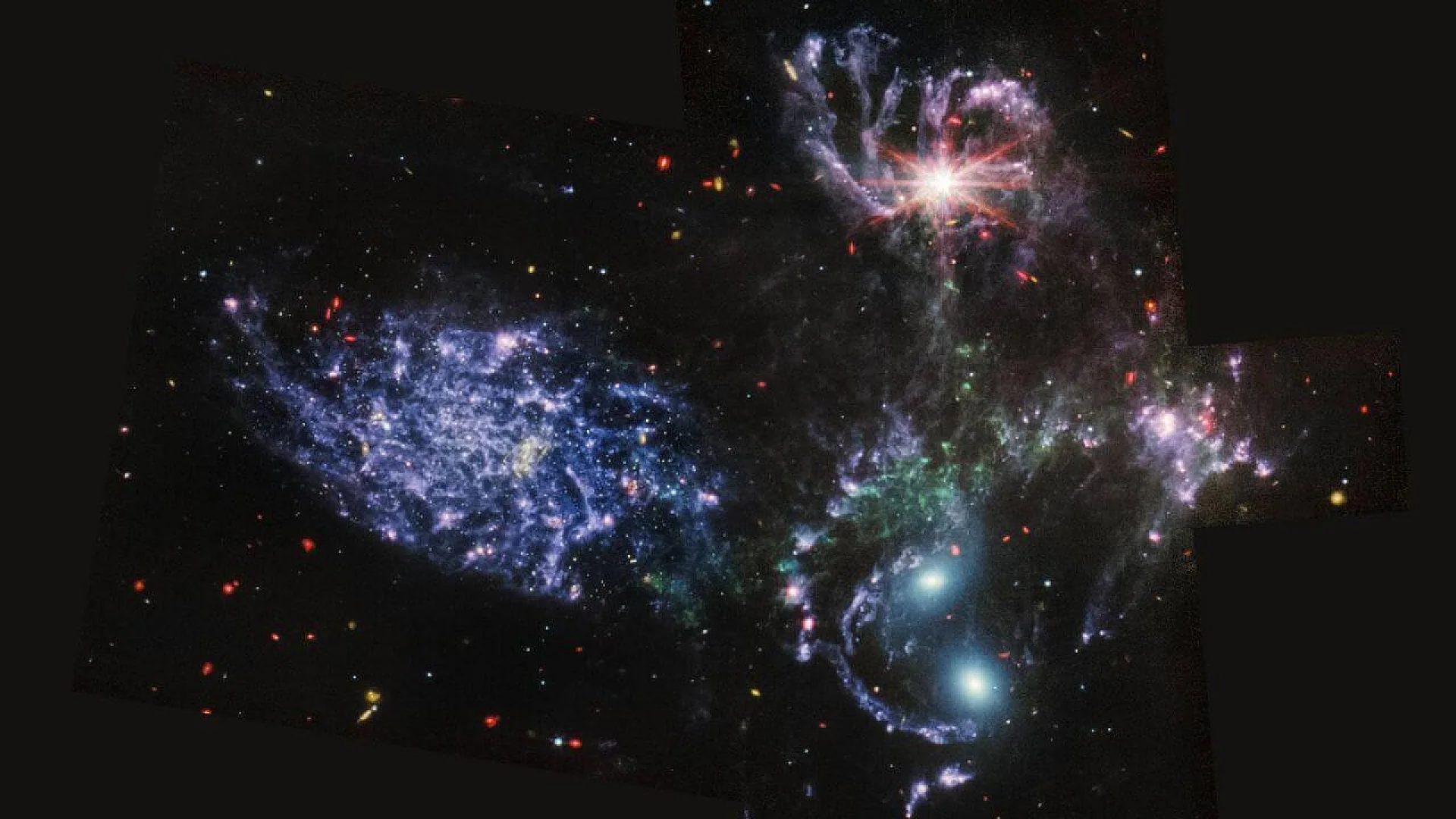
The story of our universe begins with light. Not the light of stars, because stars came later, but with the afterglow of the Big Bang that still fills the sky today. This dim radiation is called the Cosmic Microwave Background and it carries the imprint of processes that occurred when the universe was only a few hundred thousand years old. Scientists consider it a cosmic fossil that preserves clues about the birth of galaxies, the distribution of matter and the earliest conditions that set the stage for everything we see around us.
Now researchers have produced the most detailed ground-based map of this ancient light. The Atacama Cosmology Telescope team released a major data set that dramatically improves our view of the microwave sky. The new map covers about 19,000 square degrees at arcminute resolution, a level of detail that allows researchers to trace both fine-scale patterns in the radiation and the subtle distortions caused by dark matter spread across cosmic distances.
For the general reader, it helps to think of this map as a clearer photograph of the universe’s childhood. The sharper the picture, the more accurately scientists can reconstruct its history and predict its future.
Why scientists needed a better map of the ancient sky
Although satellites like Planck offered exquisite all-sky measurements at large scales, ground-based observatories can see much finer details. The challenge has always been to achieve high resolution, low noise and broad sky coverage at the same time. Telescopes on Earth must contend with atmospheric fluctuations, detector noise and foreground emissions from dust and galaxies. These obstacles can blur the smallest cosmic patterns or distort the faint polarization signals that reveal the direction of ancient light waves.
Researchers wanted a map that was wide enough to support statistical precision, deep enough to detect faint subtle distortions and clean enough to separate true cosmic signals from local interference. The new release from the Atacama Cosmology Telescope aims to address these scientific needs with improved data volume, enhanced sensitivity and a broader set of observation frequencies.
How the new map was created
The project relied on several years of observations from the Chilean Andes, where dry air and high altitude create ideal conditions for microwave astronomy. Detectors tuned to three main frequency bands, centered around 98, 150 and 220 gigahertz, scanned the sky from 2017 to 2022. These frequencies were chosen because they capture the Cosmic Microwave Background while also allowing foreground separation between dust, ionized gas and intergalactic electrons.
Creating the map required much more than pointing a telescope at the sky. The team processed hundreds of terabytes of raw data, removed corrupted segments, modeled atmospheric noise and accounted for correlations among thousands of detectors. Each step required careful statistical treatment because even a small bias can distort scientific conclusions. The data were assembled into large temperature and polarization maps that preserve tiny fluctuations only a few millionths of a degree in strength.
The finished map balances depth and breadth, delivering clear small-scale structure across a massive fraction of the sky.
What the new map reveals about the universe
The significance of this release lies in its combination of coverage, clarity and sensitivity. Ground-based maps usually excel either in depth or in resolution, but seldom both across such a large area. This time, the map reaches a median depth near ten microkelvin-arcminute, which means the faintest patterns in the cosmic background can now be studied over thousands of square degrees instead of small isolated patches.
A few highlights include:
A cleaner view of the early universe
The fine structure of the Cosmic Microwave Background becomes more distinct at arcminute scales. These patterns reflect sound waves in the early universe, which depend on fundamental physics parameters. Sharper patterns allow more precise measurements of the universe’s composition, expansion rate and the behavior of dark matter and radiation.
Improved lensing measurements
As ancient light travels through the universe, it bends around massive structures. This gravitational lensing distorts the Cosmic Microwave Background, creating a subtle signature. Deeper maps detect this signal more reliably, revealing the distribution of mass, including dark matter, across cosmic history.
Better understanding of galaxy clusters
Clusters of galaxies contain extremely hot gas that interacts with the Cosmic Microwave Background. The map captures these interactions, allowing scientists to locate clusters, estimate their masses and study how galaxies evolve within them.
Opportunities for cross-survey collaborations
By overlapping with major optical and spectroscopic surveys, the map enables joint analyses that pair microwave insights with galaxy catalogs, redshift surveys and gravitational lensing data from visible light.
These capabilities make the new map a powerful tool for both current and future studies.
Why these findings matter for science and society
The Cosmic Microwave Background is more than a snapshot of the early universe. It is a framework that supports nearly every modern cosmological theory. A clearer map improves our ability to test models of dark energy, investigate the mass of neutrinos, refine our measurement of the universe’s age and explore potential deviations from the standard cosmological picture.
For the broader public, this research matters because it helps answer fundamental questions about existence. It supports the quest to understand how the universe began, how it evolved and how unseen forces shaped its structure. It serves as a scientific foundation for future discoveries, including next-generation telescopes and space missions.
Better cosmic maps also contribute to advances in statistical imaging, data analysis and detector engineering. The technologies behind CMB experiments often push boundaries that later influence other scientific and industrial fields.
Limitations and what comes next
Although this release marks a major achievement, certain challenges remain. Large-scale temperature measurements still carry some calibration uncertainties, and daytime observations can introduce beam distortion due to heating of telescope components. Some lower frequency channels used for foreground removal are not yet included in the public release and will arrive in future updates.
Even with these limitations, the dataset stands as an essential resource for ongoing scientific inquiry. Upcoming observatories, such as the Simons Observatory and next-generation CMB experiments, will build on this foundation, reaching even greater sensitivity and frequency coverage.
The new map is not only a scientific achievement, it is a public resource
One of the most exciting features of this release is its accessibility. The data are publicly available, allowing scientists, educators and enthusiasts worldwide to explore the microwave sky. Alongside the main maps, the team provides null tests, simulations, point-source products and visual tools that help users examine the structure of the cosmos.
For science lovers, this is an invitation to explore one of the most beautiful and informative images ever created. For researchers, it is a starting point for years of discovery.
A new window into the ancient universe
The latest map from the Atacama Cosmology Telescope represents a significant step forward in our understanding of the cosmos. By combining wide coverage, high resolution and deep sensitivity, it gives us a more detailed portrait of the universe’s earliest light. Each swirl, distortion and temperature fluctuation tells a story about the forces that shaped galaxies, stars and eventually life itself.
As new analyses begin and new surveys join the effort, this map will continue to guide discoveries and inspire curiosity about the origins of our universe. It is not simply a scientific product but a reminder that even the faintest relics of the past can illuminate the mysteries of existence.
The research was published in Journal of Cosmology and Astroparticle Physics on November 19, 2025.
This content has been reviewed by subject-matter experts to ensure scientific accuracy. Learn more about us and our editorial process.
Last reviewed on .
Article history
- Latest version
- Last updated by Dayyal Dungrela, MLT, BSc, BS
- Peer reviewed by Dr. Arjun Patel, PhD
Reference(s)
- Naess, Sigurd., et al. “The Atacama Cosmology Telescope: DR6 maps.” Journal of Cosmology and Astroparticle Physics, 19 November 2025, doi: 10.1088/1475-7516/2025/11/061. <https://iopscience.iop.org/article/10.1088/1475-7516/2025/11/061>.
Cite this page:
- Posted by Aisha Ahmed